A landmark joint study by Boston University's Global Development Policy Centre and the South Centre reveals that 15 middle-income countries, including several in Africa and Latin America, are systematically excluded from voluntary pharmaceutical licensing arrangements.
These nations, already burdened by limited health infrastructure, face unaffordable medicine prices and delayed access due to intellectual property regimes they did not design and cannot easily navigate.
The report delivers an urgent message: while high-income countries deployed compulsory licenses freely during COVID-19, most middle-income nations lack the legal tools, political will, and technical capacity to do the same, and the gap is widening.
When Affordability Becomes a Matter of Life or Death
The story of access to medicine in low- and middle-income countries is not new; however, a November 2025 joint study by Boston University's Global Development Policy Centre (BU GDPC) and the South Centre has delivered new, forensic evidence of how deeply the problem persists.
Published following years of fieldwork, legal text analysis, and country comparisons, the report examines compulsory licensing (CL) laws in 15 middle-income countries, mapping the gap between what global trade rules permit and what national laws actually enable.
The timing matters. In 2025, the world signed the WHO Pandemic Treaty after three years of fractious negotiations, in which the language around technology transfer was ultimately watered down to "mutually agreed" terms.
In plain language, pharmaceutical companies are still not required to share. Countries remain dependent on the goodwill of the same industry that restricted COVID-19 vaccine access first to rich nations.
The Story Behind the Numbers
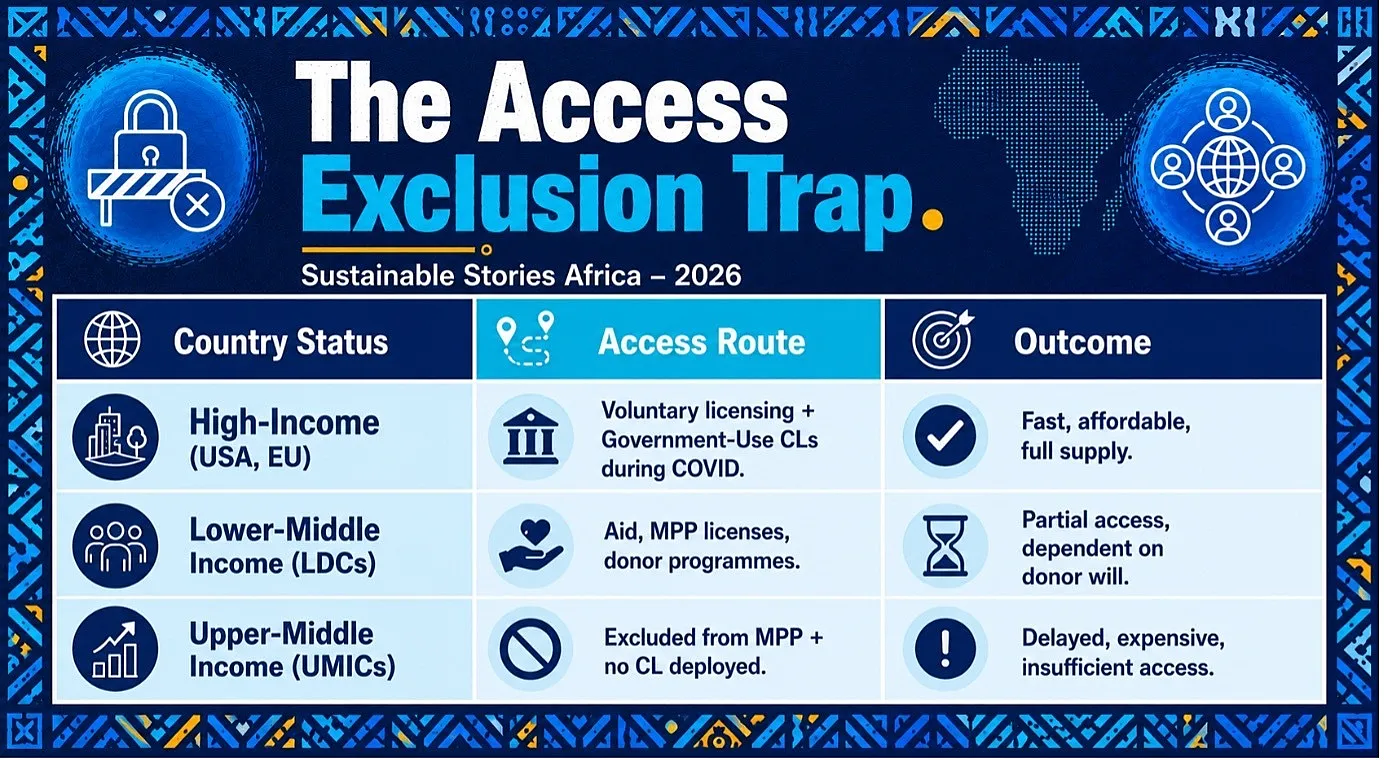
To understand why this matters, consider COVID-19. Pfizer/BioNTech and Moderna refused to license mRNA technology to qualified Global South producers, including a WHO-coordinated manufacturing programme in South Africa, while the US issued sweeping government-use licenses to its own contractors, sidestepping patents entirely.
Canada, Germany, France, Hungary, and Italy passed emergency legislation overriding patent rights, all TRIPS-compliant, yet deeply unequal.
TRIPS, administered through the WTO, permits compulsory licenses (CLs), authorisations allowing patent use without the holder's consent, in exchange for remuneration.
These are written rights, not loopholes. However, post-COVID, the countries needing them most either didn't, couldn't, or were punished for trying.
Between 2001 and 2016, 100 CL applications were filed globally, with 81% implemented and 78% involving HIV medicines.
Since 2010, as voluntary licensing expanded through the Medicines Patent Pool, CL activity dropped sharply, entirely excluding five of 15 study countries from access.
A Better Future Is Legally Possible
The BU GDPC/South Centre study confirms that all 15 countries in its sample have existing CL legislation. The legal right exists.
The problem is whether those laws are robust, usable, and enforceable. The report finds that no country has maximised its TRIPS CL policy space, meaning that every country studied is operating with one hand tied behind its back, even when the law permits them to act.
- Colombia issued a historic government-use licence on dolutegravir in 2024, projecting cost reductions of up to 90% for a key HIV treatment.
- Thailand's seven government-use licences between 2006 and 2008 saved the government approximately $370 million and allowed over 84,000 additional patients to access treatment.
These are not anomalies; they are proof of concept.
It's Time to Use Every Tool Available
Governments must stop treating compulsory licensing as a last resort to be avoided for fear of geopolitical reprisal, and start treating it as the public health instrument it was designed to be.
The BU GDPC/South Centre report recommends that middle-income countries reform their national patent laws immediately to maximise the use of the TRIPS flexibility toolkit.
Beyond reform, countries need technical support from WHO and UNDP, coordinated purchasing and CL issuance across borders, and the courage to face down industry pressure.
For Africa, specifically, this is not an abstract legal debate.
Many African nations remain caught between insufficient access to essential medicines and pharmaceutical companies that show little commercial interest in serving their markets at affordable prices.
The report's evidence base may focus on 15 countries outside Africa, but its conclusions apply with even greater urgency to the continent.
Building Medicine Sovereignty, Step by Step
The path forward requires political courage, legal reform, and regional solidarity. Middle-income countries must recognise that reforming their CL laws, even if they never issue a single licence, expands their negotiating leverage.
The threat of a CL, used strategically, has historically brought pharmaceutical companies to the table with lower prices.
Governments, civil society, and international institutions must work together to close the gap between what TRIPS allows and what national laws deliver.
In a world where the next pandemic is not a question of if but when, this gap is not a policy footnote; it is a matter of life and death.
Path Forward – Legal Tools Must Match Health Ambitions
Middle-income countries possess the legal right to issue compulsory licences under international law.
The BU GDPC/South Centre study provides a detailed blueprint for maximising that right through national law reform, regional cooperation, and supportive enabling policies.
The next step is political will, and the clock is ticking.