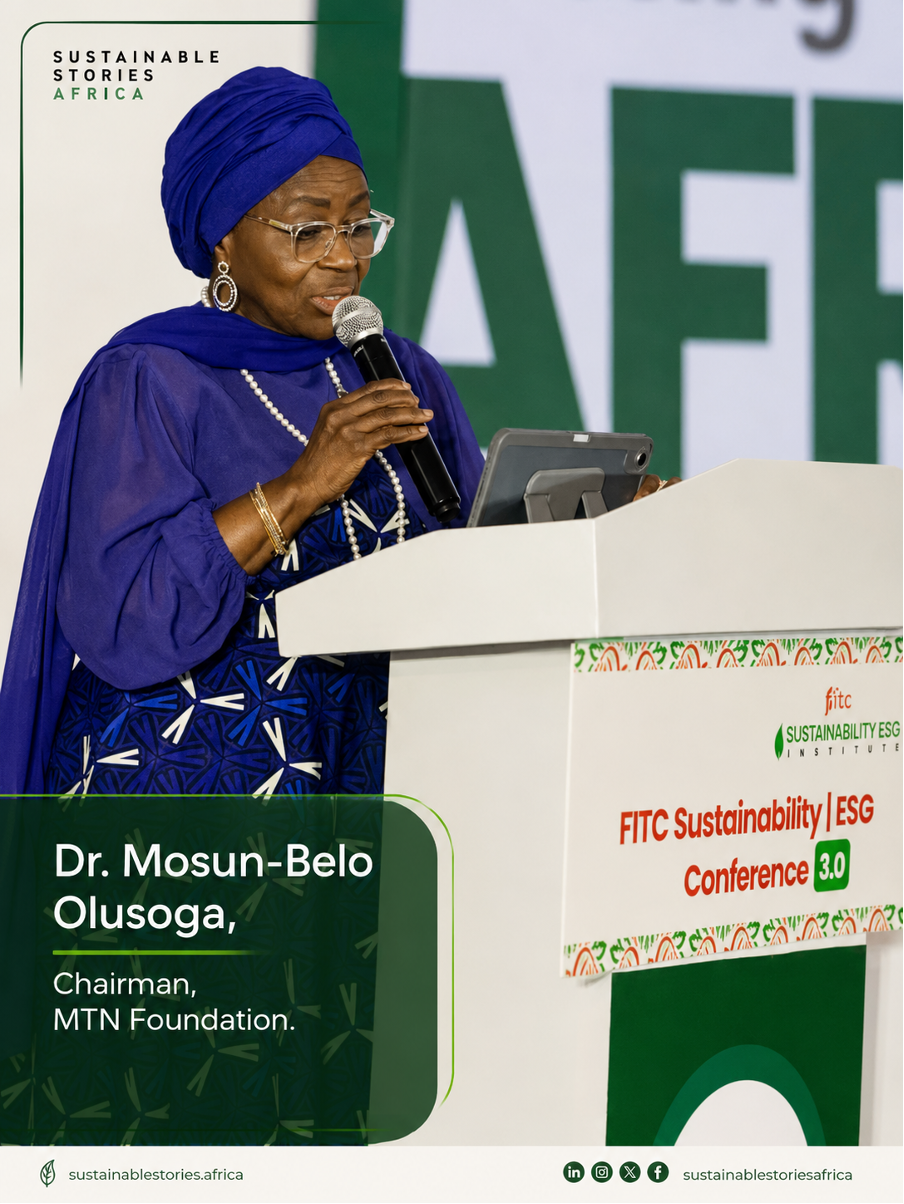
Mosun-Belo Olusoga, Chairman of MTN Foundation, has called for Africa to move ESG from corporate reporting to strategy, governance and capital allocation.
Her keynote framed sustainability as a competitiveness question, not a compliance exercise.
For African markets facing climate risk, youth unemployment and infrastructure gaps, the message was direct: potential will not create prosperity; leadership will.
 |  |
Five Imperatives For Africa’s Sustainability Future
Africa’s sustainability debate must shift from aspiration to execution if the continent is to convert its natural capital, youthful population and renewable energy resources into long-term prosperity, Mosun-Belo Olusoga, Chairman of MTN Foundation, said in a keynote address at the FITC Sustainability and ESG Conference, themed “Building A Sustainable Africa: Integrating Environmental Stewardship, Social Impact, and Governance for a Prosperous Future.”
Speaking to policymakers, financial sector leaders, business executives and development stakeholders, Olusoga argued that ESG has moved beyond philanthropy and public relations. It is now a core test of competitiveness, institutional resilience and development strategy.
“The questions investors ask today are fundamentally different from those they asked a decade ago,” she said.
- “They no longer ask only: Is this business profitable?
- They also ask: is it resilient? Is it well governed?
- Can it manage environmental and social risks?”
Her address landed at a moment when African economies are under pressure to attract patient capital, build climate resilience, strengthen institutions and create jobs for the world’s youngest population.
For Olusoga, the answer is not to blindly copy global ESG templates, but to make sustainability a practical African growth strategy.
From Potential To Prosperity Through Leadership
A central theme of the keynote was that Africa’s challenge is not a shortage of assets, but a shortage of execution discipline.
The continent contributes about 4% to global carbon emissions, she noted, yet faces a disproportionate share of climate-related risks.
At the same time, Africa holds abundant renewable energy resources, critical minerals, biodiversity and human capital.
That contradiction, she said, creates both responsibility and opportunity.
“For decades, the world has described Africa as a continent of immense potential,” Olusoga said. “Potential, however, does not create prosperity. Leadership does.”
She linked the argument to the African Union’s Agenda 2063 and the United Nations Sustainable Development Goals, saying both frameworks require growth that creates jobs, protects natural capital, expands infrastructure and strengthens communities.
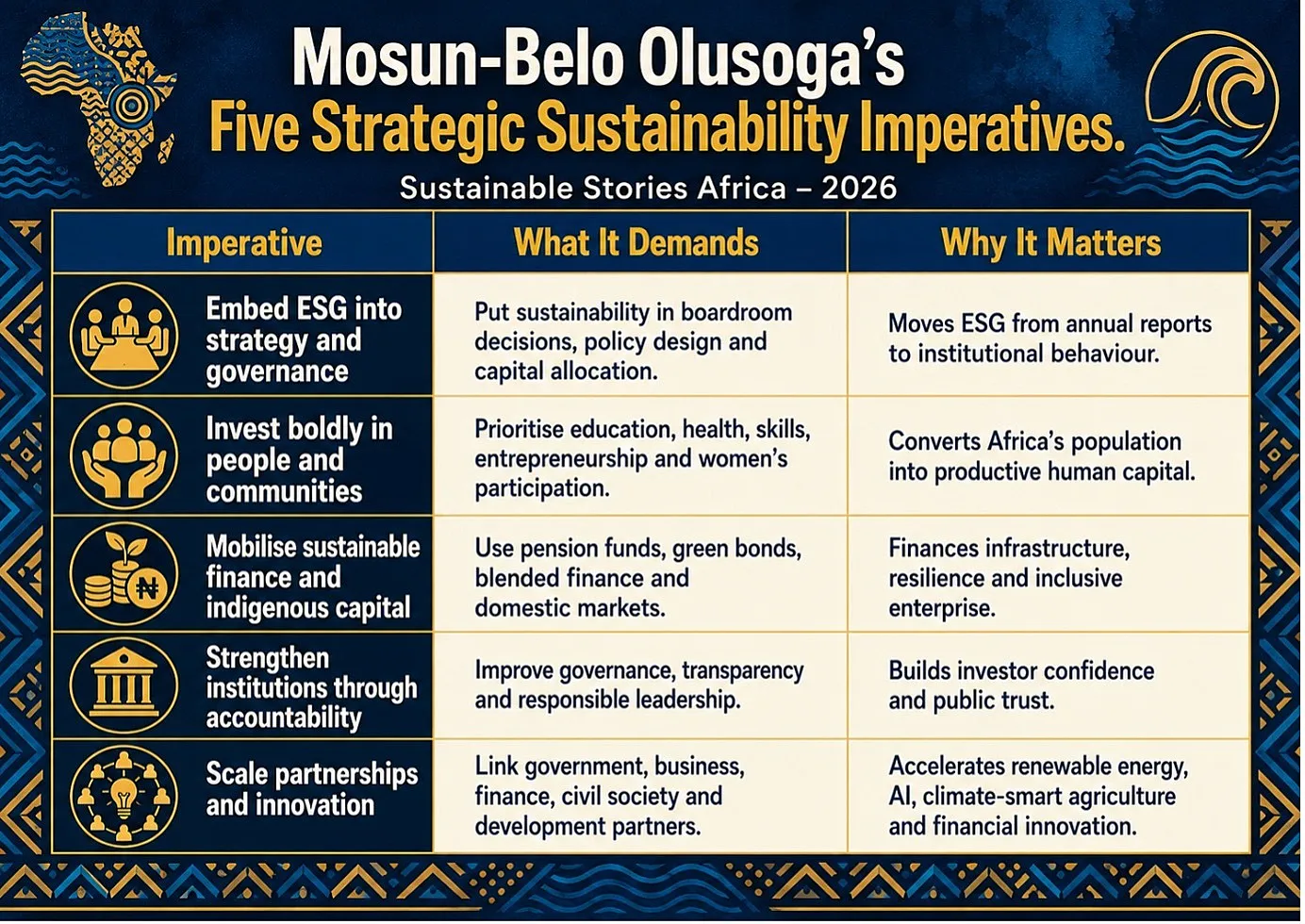
The keynote’s most practical contribution came through five imperatives for Africa’s sustainability agenda over the coming decade.
What Africa Gains From Strategic ESG
Olusoga’s argument was ultimately economic. Social investment, she said, is not merely good social policy; it is smart economic policy.
Investments in education, healthcare, digital skills, youth development and gender equality strengthen Africa’s long-term competitiveness.
Governance is not just about compliance. It reduces risk, attracts investment and creates the trust needed for long-term growth.
She also placed particular emphasis on indigenous capital. Africa, she argued, must unlock pension funds, blended capital, green bonds and domestic capital markets to finance infrastructure, renewable energy, climate resilience and inclusive enterprise.
“Sustainable finance is not about funding projects,” she said. “It is about financing transformation.”
The warning was equally clear. If African institutions treat ESG as a reporting burden, the continent risks missing a strategic opening.
- Capital will continue to flow toward markets that demonstrate transparency, resilience and long-term thinking.
- Consumers will reward responsible brands. Young professionals will choose organisations whose values reflect their own.
From Conference Words To Measurable Commitments
Olusoga called for a shift from short-term performance to long-term value creation; from philanthropy to strategic social investment; from compliance to responsible leadership; and from fragmented efforts to collaborative action.
- Governments, she said, must create enabling policies that reward responsible investment and sustainable enterprise.
- Boards must integrate sustainability into strategy, risk management and value creation.
- Investors must recognise that responsible businesses are resilient businesses.
- Financial institutions must build innovative financing mechanisms for Africa’s green and inclusive economy.
- Educational institutions also have a role: preparing young Africans for the jobs of tomorrow.
Her closing challenge was pointed: every organisation represented at the conference should ask what measurable commitment it will make today to strengthen Africa tomorrow.
The implication is significant for African markets. ESG is no longer an external demand imposed by foreign investors or regulators.
Properly applied, it becomes a domestic strategy for competitiveness, trust, resilience and inclusive prosperity.
Path Forward – Embedding Sustainability In Africa’s Institutions Now
Africa’s next sustainability frontier is execution: embedding ESG into institutions, budgets, boardrooms, capital markets and community investment.
Olusoga’s keynote promises that Africa can build economies that are not only larger, stronger, wealthier, and fairer, but also productive and sustainable.
The responsibility now sits with leaders who must turn conference language into measurable commitments.