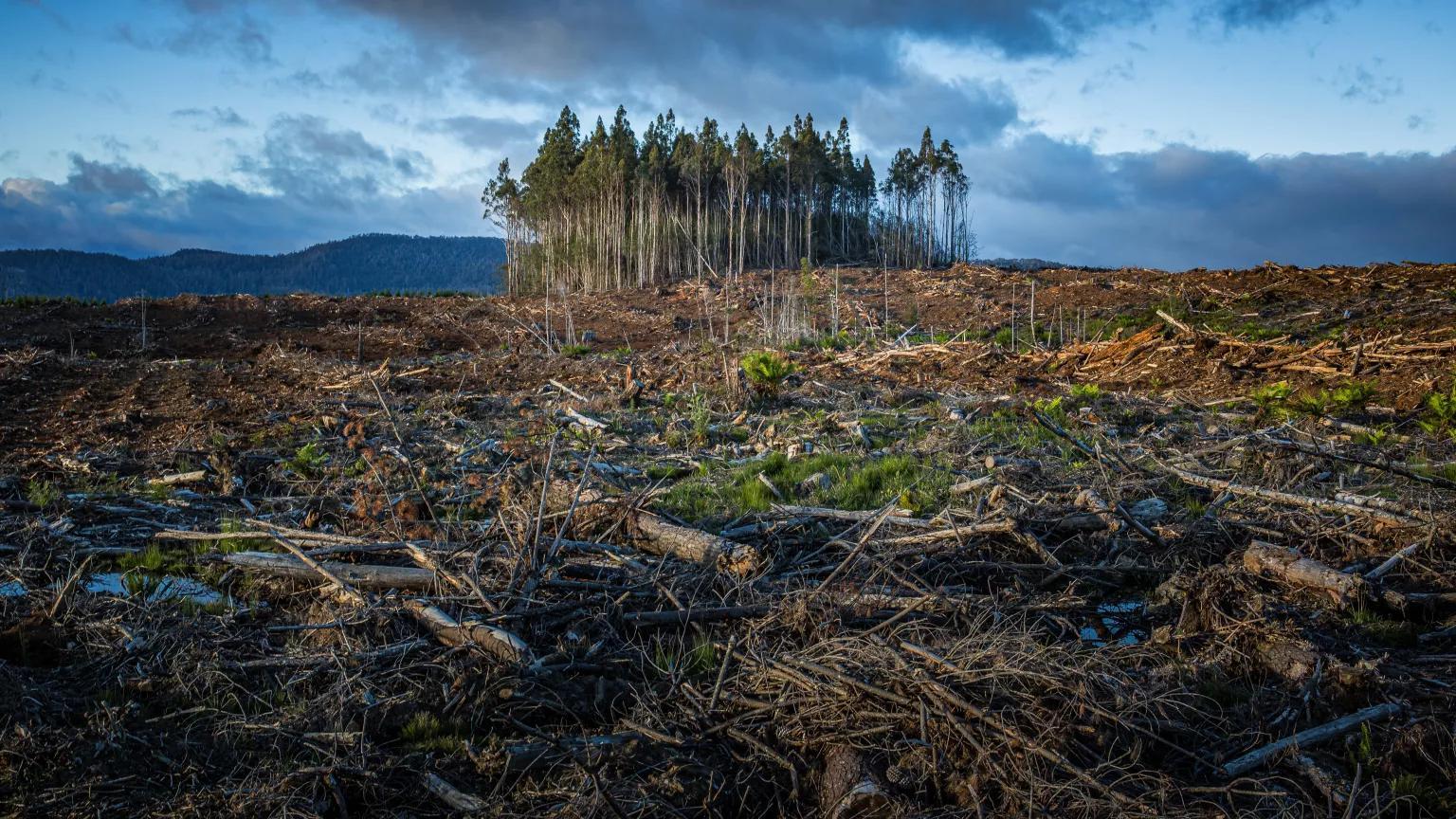
A landmark evidence review published in June 2025 by the University of Oxford's Environmental Change Institute, the Taskforce on Nature-related Financial Disclosures (TNFD) and Global Canopy has confirmed what many ESG practitioners have long suspected: the collapse of natural ecosystems is not merely an environmental tragedy; it is a material financial threat to corporations and financial institutions worldwide.
Drawing on over 600 database entries spanning 360 sources, the review maps how nature-related risks translate into disrupted operations, stranded assets, destroyed capital and declining firm value.
For Africa's resource-dependent economies, the implications are urgent, immediate and deeply systemic.
Nature Risk Is a Financial Crisis
A major new study has thrown down the gauntlet to global business: the degradation of nature is already costing companies billions of dollars, and those who are not assessing and disclosing these risks are operating in the dark, putting investors, lenders and communities at serious risk.
The Evidence Review on the Financial Effects of Nature-Related Risks, produced by Oxford's Environmental Change Institute in partnership with TNFD and Global Canopy, is the most comprehensive assessment to date of how biodiversity loss, water scarcity, invasive species, land-use change and ecosystem collapse cascade through supply chains and balance sheets.
The review draws on a database of over 600 evidence entries built from academic studies, company reports, case studies and news analysis.
For African economies, where natural capital underpins agriculture, energy, mining and water supply, the findings carry particular weight.
Six out of nine planetary boundaries have already been breached. A quarter of all species face extinction. And the financial system has not yet begun to account for the cost.
A Risk the World Can No Longer Ignore
The World Economic Forum's Global Risks Report 2025 now ranks 'Biodiversity Loss and Ecosystem Collapse' as the second-highest long-term global risk, just behind extreme weather events.
A decade ago, no environmental risk featured in the top five. This shift reflects a fundamental truth: nature underpins economic activity at every level, from the soil that feeds a nation to the rivers that cool a data centre.
The Oxford-TNFD review quantifies what is at stake. Nature-negative financial flows, including investments and activities that degrade natural capital, are estimated at $7 trillion annually, representing approximately 7% of global GDP.
Against this backdrop, the funding gap to meet biodiversity goals stands at $900 billion, while the gap to meet the full Sustainable Development Goals reaches $ 4.2trillion.
Strong Evidence, Deep Gaps
The review synthesises evidence across 17 physical, 5 transition and 6 systemic nature-related risks.
The findings are clear in some areas and alarming in their gaps in others.
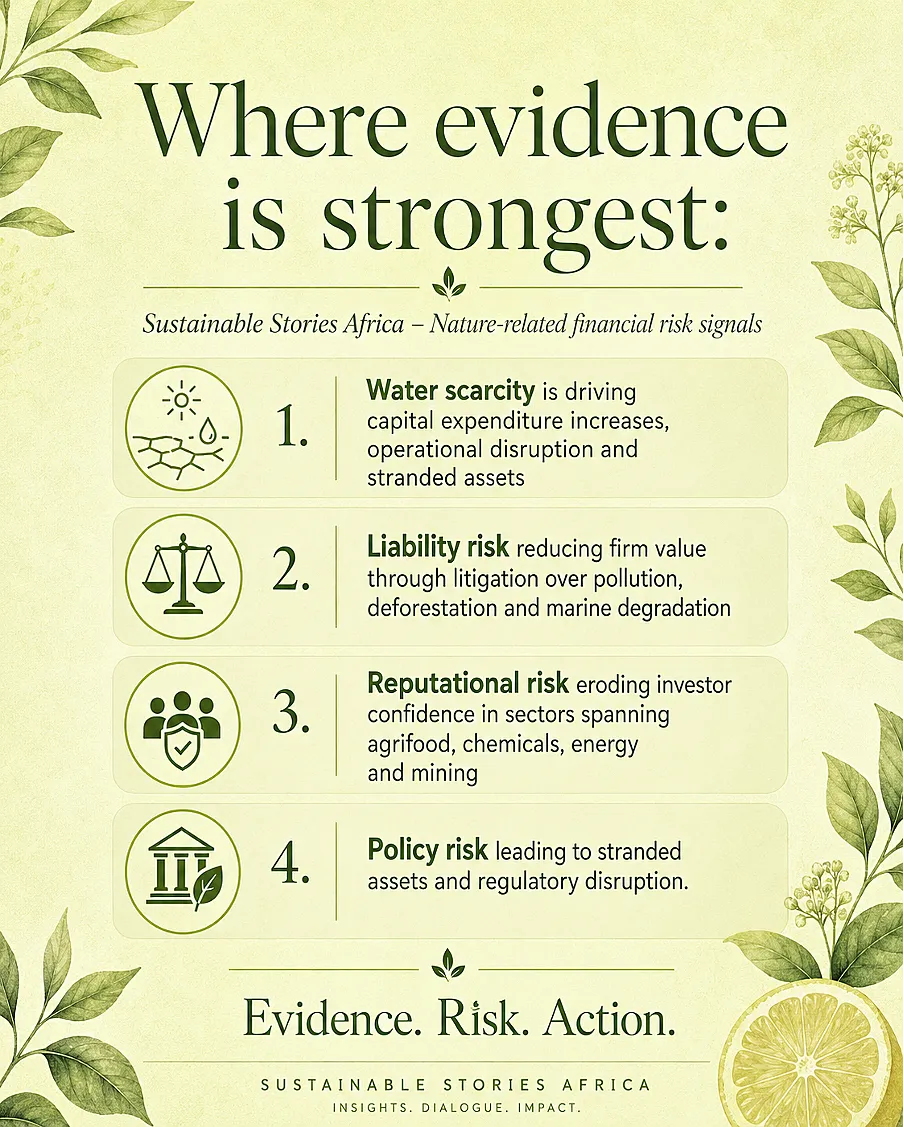
However, the review also exposes a dangerous blind spot: company-specific evidence is largely absent.
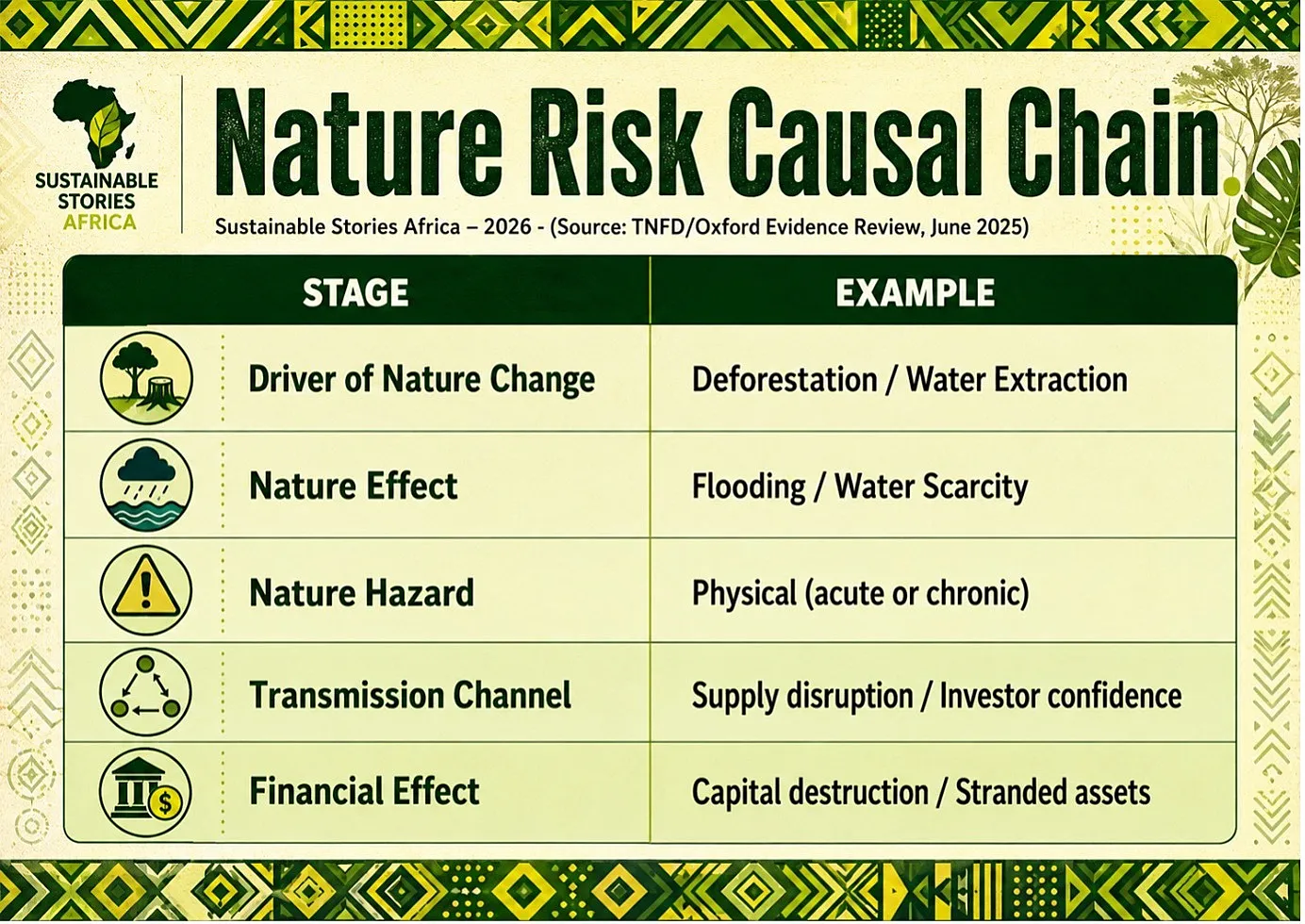
Most studies analyse hazards at national or macroeconomic levels, with full causal chains, from drivers of nature loss to corporate financial loss, that are rarely completed.
Transmission channels remain underexplored.
What Proper Disclosure Could Unlock
Imagine a financial system in which nature risks are priced with the same rigour as credit or market risk. The Oxford-TNFD evidence shows this is both possible and necessary.
When companies in the infrastructure sector manage biodiversity, pollution and water risk effectively, they already demonstrate better refinancing options by 93 basis points in the long term.
Companies with large 'Corporate Biodiversity Footprints' saw measurable losses in stock value following both the Kunming GBF declaration in 2021 and the TNFD launch, showing markets are beginning to price these risks.
African businesses that move early to assess and disclose nature risks stand to attract long-term capital, lower their cost of financing and build operational resilience at a time when water stress, invasive species and land degradation are accelerating across the continent.
Who Needs to Move and How
The review sets out targeted recommendations across four key stakeholder groups:
- Corporations and financial institutions must build internal capability to assess the financial effects of nature-related risks, using structured approaches like TNFD's LEAP methodology and scenario analysis tools from the NGFS
- Standard setters and regulators must provide clear, consistent guidance, mandatory disclosure frameworks and access to credible nature scenarios
- Data providers must improve transparency on coverage and limitations within their nature-risk data products
- Academia must address evidence gaps, particularly at the company level, and across the full causal chain from dependencies to financial outcomes
Path Forward – Beyond Awareness, Towards Action
Pricing Nature: The Next Frontier
The evidence is no longer ambiguous: nature-related risks are financially material, investor-relevant and system-threatening.
The question is whether governments, regulators and companies — particularly across Africa and the Global South will act before these risks fully crystallise into losses.
The Kunming-Montreal Global Biodiversity Framework, now signed by 196 countries, and the Finance for Biodiversity Pledge, backed by 200 financial institutions managing $23 trillion in assets, provide the architecture for change.
The window to act remains open. However, it will not remain open indefinitely.