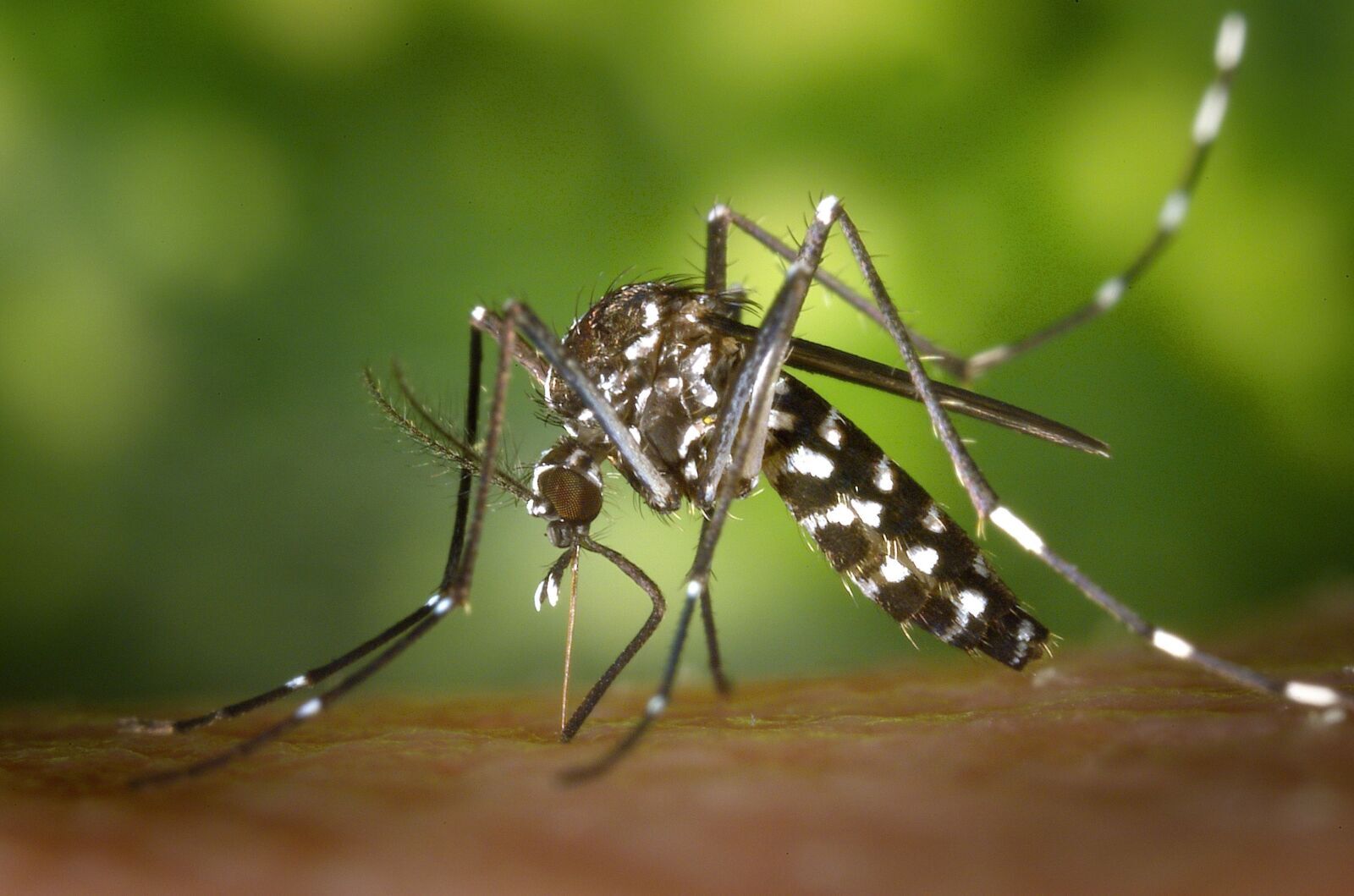
A landmark May 2026 study in Frontiers in Cellular and Infection Microbiology delivers the most comprehensive global risk projection yet for Chikungunya virus, threatening 1.3 billion people worldwide.
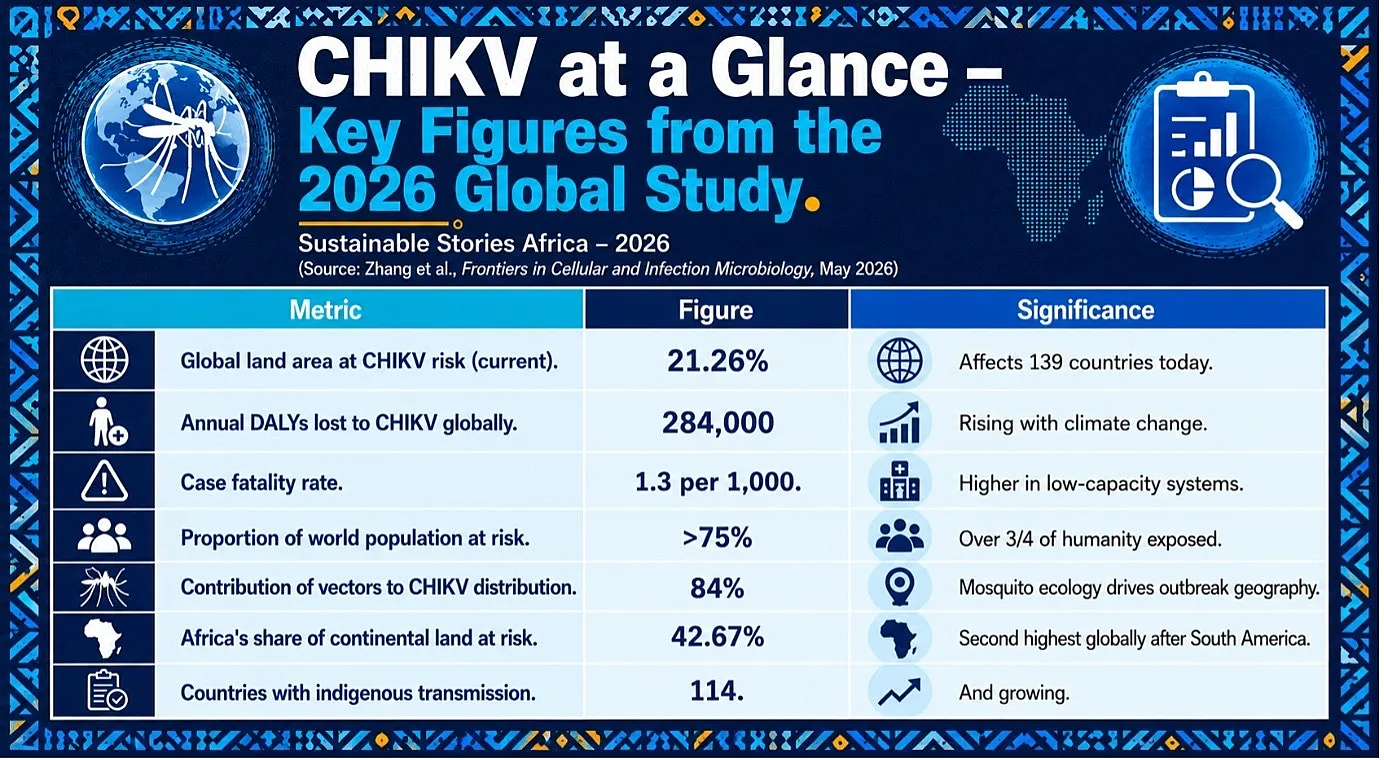
Using hierarchical ensemble modelling across 16 climate scenarios, researchers found that 21.26% of global land area, 139 countries, faces transmission risk, with Africa registering the second-highest continental exposure.
Under moderate-to-high climate scenarios, chikungunya's geographic range is expanding into new regions, intensifying outbreaks in Africa's vulnerable zones before eventual contraction later this century.
A Virus That Bends Bodies and Breaks Health Systems
Chikungunya virus takes its name from the Makonde language of East Africa, "that which bends up", describing the joint pain that forces patients into a crouched posture.
Fever, rash, and muscle pain mark the acute phase, while a chronic phase with persistent joint pain can last months or years.
The case fatality rate stands at 1.3 per thousand, with the virus causing approximately 284,000 Disability-Adjusted Life Years lost annually, a toll set to grow.
For Africa, stakes are particularly high: its climate, urbanisation profile, and vulnerability of health infrastructure intersect with every risk factor the study identifies.
Indigenous transmission now spans 114 countries, placing over three-quarters of the world's population at risk; however, sub-Saharan Africa's surveillance and vector control systems remain fragmented.
The Science Behind the Risk Map
This is not a theoretical warning but a data-grounded projection built on the most rigorous modelling framework yet applied to CHIKV.
Using a hierarchical ensemble approach within the Biomod2 platform, researchers integrated 19 bioclimatic variables and elevation data to first project distributions of the virus's two primary vectors.
Aedes aegypti and Aedes albopictus, then used these as biological predictors to model the virus's spread, capturing the cascading chain from climate to vector habitat to transmission.
The ensemble combined 11 algorithms across 330 models per species, minimising error inherent in single-method approaches.
The final model achieved an AUC of 0.909 and TSS of 0.659, statistically excellent performance, with resulting risk maps aligning closely with known outbreak patterns, including the 2014–2015 Americas epidemic (2.9 million cases) and the 2019 to 2020 East Africa resurgence in Kenya and Tanzania.
 |  |
Africa's Position: High Risk, Under-Resourced
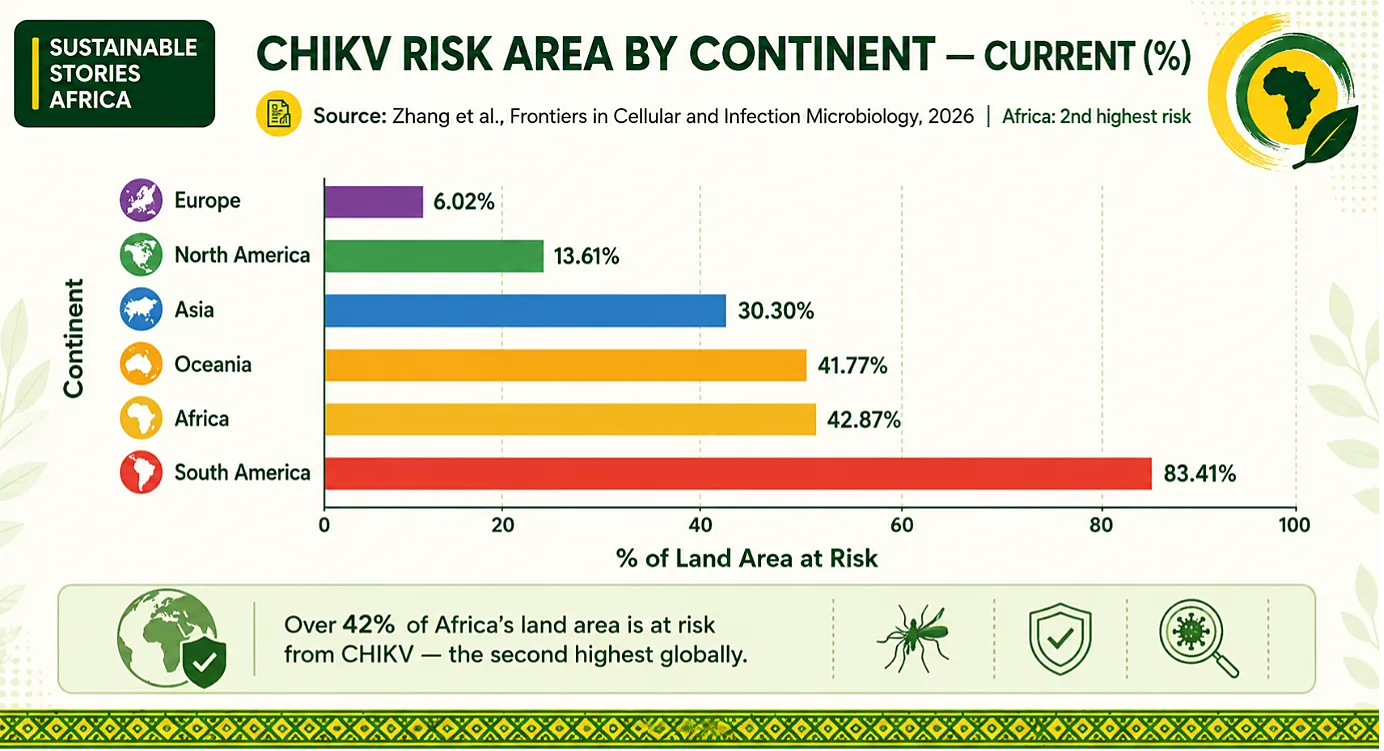
The study's continental analysis shows South America has the highest proportion of land at CHIKV risk (83.41%); however, Africa follows at 42.67%, a figure that translates into enormous human exposure given the continent's population density, urban growth, and climate profile.
High-risk African countries identified include Equatorial Guinea, Ivory Coast, Ghana, Madagascar, and Liberia. Critically, the Gulf of Guinea coast, one of Africa's most densely populated and economically active coastlines, is identified as a core high-risk zone.
What makes Africa's position particularly alarming is not just the current risk footprint but the dynamic it faces over the coming decades.
Under moderate climate scenarios, the Sahel region is projected to experience an "expansion-then-contraction" trajectory: initial warming in the 2021 – 2040 window pushes the previously cooler sub-Saharan fringes into the optimal thermal window for CHIKV transmission, facilitating a transient spatial expansion.
By 2081–2100, however, extreme warming tips temperatures beyond the thermal limits of the mosquito vectors, causing contraction.
Between now and then, millions of people in a band of vulnerability will be exposed to a virus for which Africa's health systems are not adequately prepared.
Time to Build the Defences
Africa's public health institutions cannot wait for the disease to arrive before responding. The study's projections provide a window of preparedness that must be used wisely.
National health ministries, the Africa Centres for Disease Control and Prevention (Africa CDC), and regional economic communities must use this risk-mapping data to target vector surveillance, strengthen diagnostic capacity, and accelerate conversations around vaccine development.
A CHIKV vaccine candidate is now advancing through clinical trials globally, ensuring Africa's participation in those trials and its access to eventual vaccines must be a policy priority.
The 2007 Italy outbreak, cited in the study as a cautionary tale about what happens when an immunologically naive population encounters CHIKV for the first time, resulted in widespread panic and strain on the health system despite Italy's comparatively strong infrastructure.
In West or Central Africa, a comparable outbreak would be far more devastating. This study provides the data to prevent that outcome, if the will to act is present.
Path Forward – Map the Risk, Then Fund the Response
The 2026 CHIKV global risk study gives Africa's health community an unprecedented planning tool.
The next step is to translate its risk maps into national preparedness plans, vector-control investments, and cross-border early warning systems, before the mosquitoes arrive, not after.
Africa's health sovereignty depends on proactive action, not reactive crisis management.