NatureHelm and New Forests have piloted Nature Positive Initiative metrics across major forestry and landscape assets.
The work comes as TNFD, GRI and SBTN examine how state-of-nature metrics can enter mainstream reporting.
For African and Global South markets, the shift could turn biodiversity from a vague ESG promise into measurable evidence of investment.
Nature Reporting Faces Its Proof Test
For years, companies have told investors they are protecting nature. Now, the market is asking a harder question: prove it.
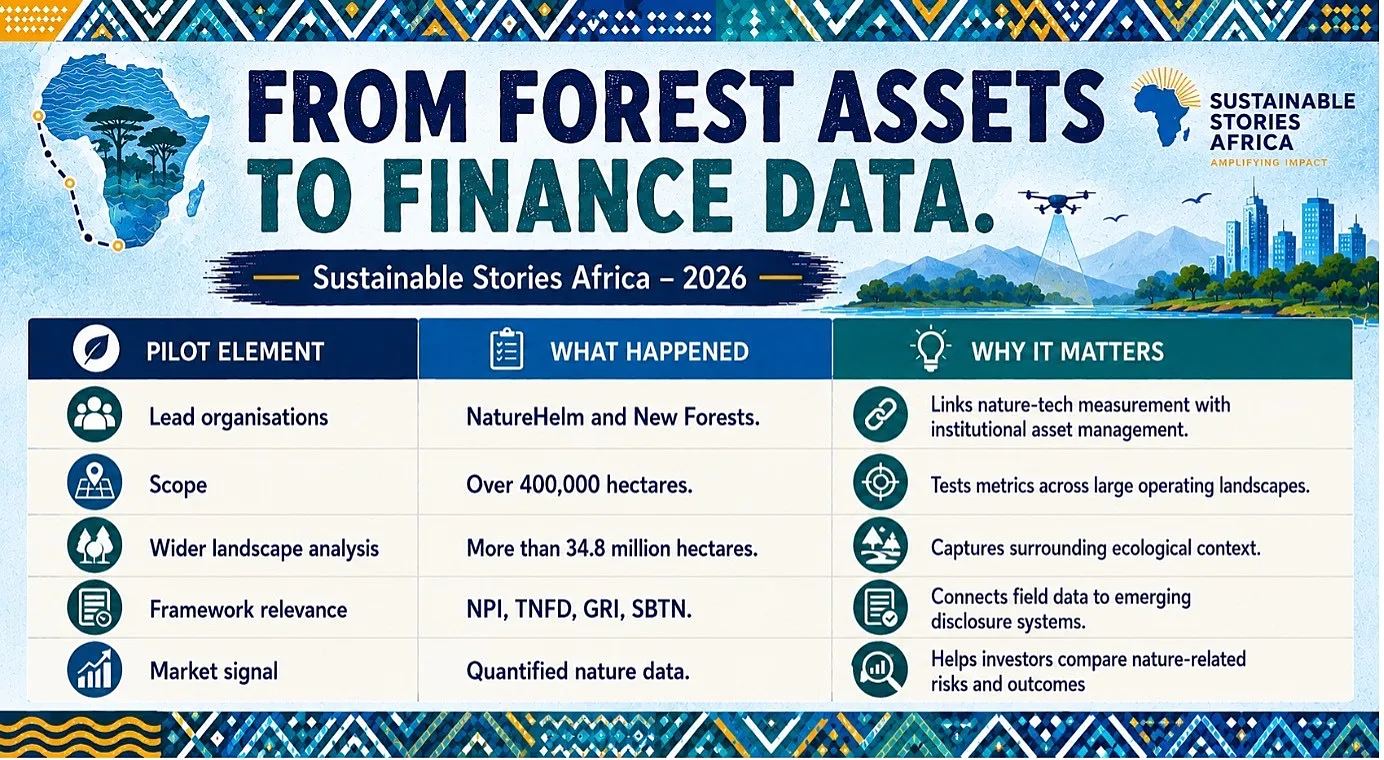
NatureHelm and New Forests have delivered one of the most expansive pilots of the Nature Positive Initiative’s State of Nature metrics, testing how biodiversity and ecosystem condition can be measured across large real-world assets.
The pilot covered more than 400,000 hectares across Australia, the United States and Africa, while also analysing nature metrics across more than 34.8 million hectares surrounding those assets.
The timing is significant. The Taskforce on Nature-related Financial Disclosures is exploring how state-of-nature metrics can be embedded into its reporting architecture, alongside related work by GRI and the Science Based Targets Network.
For investors, regulators and companies, the pilot signals a move from broad nature claims to comparable data.
From Forest Assets to Finance Data
The pilot calculated seven state-of-nature metrics in line with NPI guidance across forestry and agricultural landscapes. Its practical challenge was simple but demanding: can nature be measured at scale without making reporting too expensive, too technical or too fragmented for companies to use?
That question matters far beyond forestry. Banks, insurers, asset managers and agribusinesses are increasingly exposed to nature-related risks: soil degradation, water stress, deforestation, biodiversity loss and ecosystem decline. In African markets, these risks are not abstract. They affect cocoa farms, timber concessions, food systems, water catchments, hydropower assets and rural livelihoods.
The NPI is trying to solve a measurement problem that has long slowed nature finance. Hundreds of biodiversity and environmental metrics exist, but companies often struggle to select a minimum set that is credible, practical and comparable. Its State of Nature metrics aim to provide a more consistent way to track whether nature is declining, stabilising or recovering.
Better Data Can Unlock Better Capital
If this approach matures, it could change how nature-positive investment is assessed. Instead of relying mainly on project narratives, companies could show measurable changes in ecosystem condition.
Investors could compare assets more credibly. Communities could demand stronger evidence that conservation and land-use projects are delivering real benefits.
For Africa, the opportunity is substantial. Natural capital underpins agriculture, tourism, mining, water security and climate resilience.
However, many African economies still lack the data systems needed to price nature risk or attract high-quality nature finance.
Shared metrics could help bridge that gap, especially where satellite data, ecological science and local knowledge are combined.
The promise is not only better disclosure. It is better decision-making.
- A forest manager could identify where restoration is needed.
- A lender could assess whether a land-based investment is reducing ecosystem risk.
- A regulator could compare nature claims across sectors.
- A community could see whether promised environmental gains are materialising.
Turn Nature Claims Into Accountability
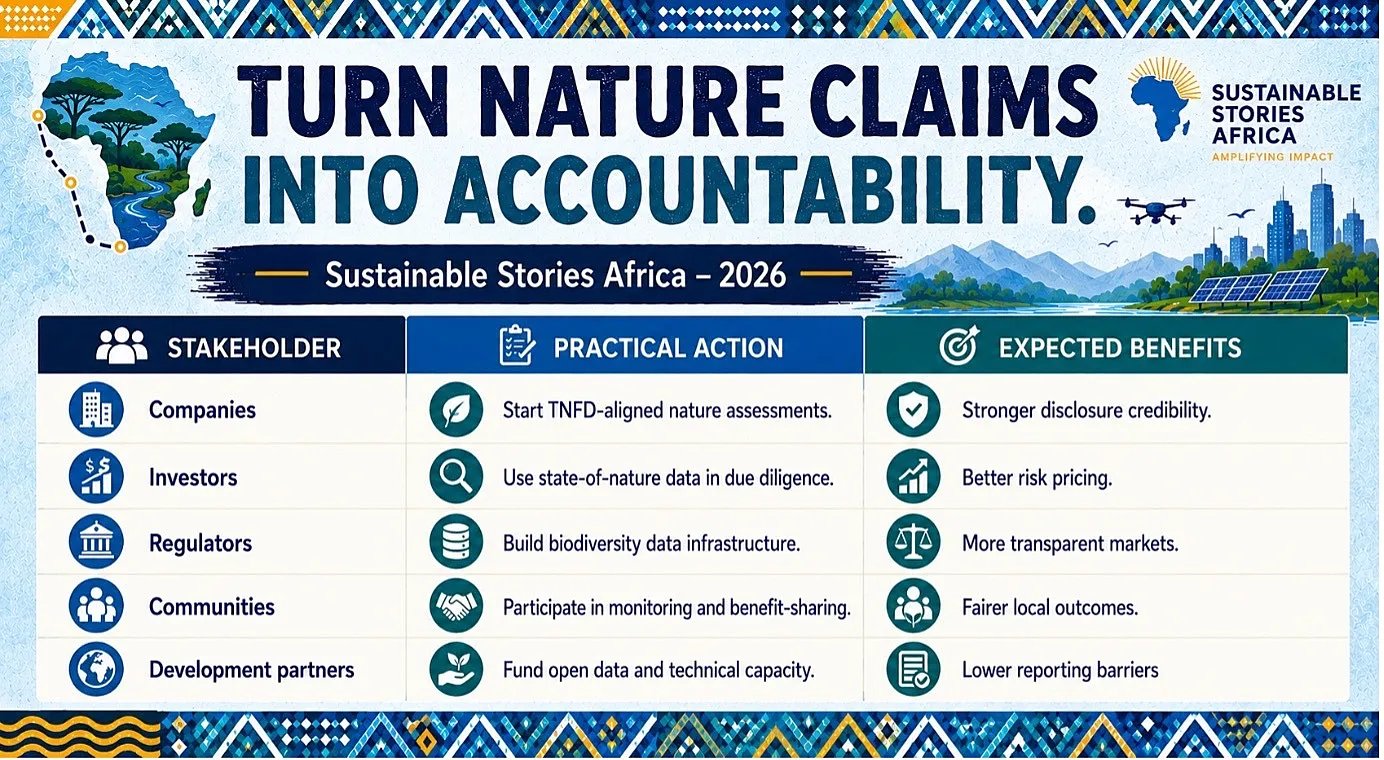
The next step is implementation. Companies preparing for TNFD-aligned reporting should not wait until regulation forces action.
They need to map nature dependencies, assess exposure across value chains, and begin building credible data systems that can track change over time.
Financial institutions should also move beyond broad ESG screening. Nature risk needs to be integrated into every credit decision, portfolio strategy, insurance pricing and investment stewardship.
In practical terms, that means asking whether a project protects water, soil, species and ecosystem function, rather than just whether it has an environmental label.
Policymakers in African markets have a role too. They can support national biodiversity data platforms, clarify land-use rules, strengthen environmental monitoring and ensure local communities are not excluded from nature-related value creation.
Path Forward – Measure Nature, Then Protect It
The NatureHelm-New Forests pilot shows that nature reporting is becoming more operational, measurable and investment-relevant.
The next priority is to make these tools affordable, comparable and usable across different markets.
For African economies, the path forward is clear: build nature data capacity, align with TNFD and NPI metrics, protect community interests, and turn biodiversity from a reporting burden into a foundation for resilient growth.
Culled From: Measuring the State of Nature for TNFD: Inside the NPI pilot with NatureHelm and New Forests