Nigeria has approved a National Research and Innovation Development Fund that could mobilise about $500 million annually for science, technology and commercial innovation.
The move matters because Nigeria’s research ecosystem remains underfunded, fragmented and weakly connected to industry.
If implemented with transparency, valuation systems and market discipline, the fund could turn laboratories, universities and startups into engines of jobs, exports and sustainable growth.
Nigeria Chooses Ideas Over Extraction
Nigeria's next major economic bet may not come from a new oil well or port concession; it may come from the laboratory, the university research desk and the startup prototype that has waited too long for capital.
The Federal Executive Council's approval of the National Research and Innovation Development Fund marks a significant policy shift.
The NRIDF, proposed as a $500 million annual financing mechanism, is designed to support research, innovation infrastructure, commercialisation and capability development across universities, research institutes, startups and industry.
Linked to Nigeria’s ambitions to reach a $1 trillion economy by 2030, the fund will be overseen by a National Council on Research and Innovation, chaired by Vice President Kashim Shettima.
For a country that has long exported crude oil and imported technology, the signal is deliberate:
Nigeria wants to produce the ideas, patents and industrial solutions that define modern competitiveness.
Why The Fund Matters Now
Nigeria's research story has long been one of brilliance without infrastructure, discoveries that rarely move beyond papers, prototypes or small pilots. The gap between innovation and the market remains wide.
The NRIDF is therefore more than a funding announcement. It is a test of whether Nigeria can build a system connecting research to production, intellectual property to investment, and innovation to national development.
- A researcher in Zaria is developing drought-resistant crops
- An engineering team in Lagos is designing affordable diagnostics
- A Port Harcourt startup building clean energy storage.
They should not depend solely on small grants or foreign validation.
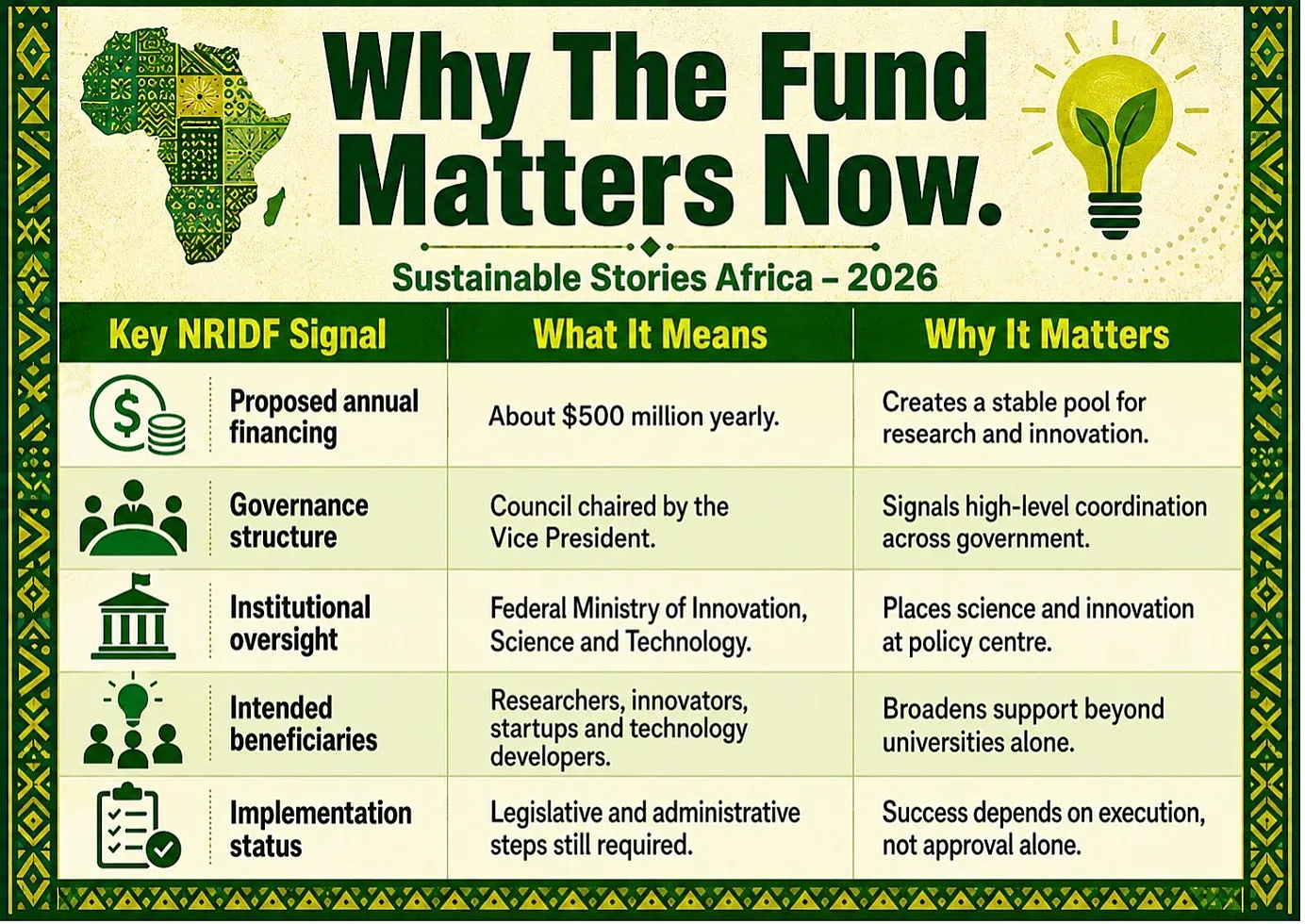
The fund arrives at a critical moment. Climate risk, food insecurity, weak manufacturing, foreign exchange volatility and youth unemployment all point to the same conclusion: countries that do not invest in their own problem-solving capacity will keep paying others to solve their problems.
From Research Papers To Prosperity
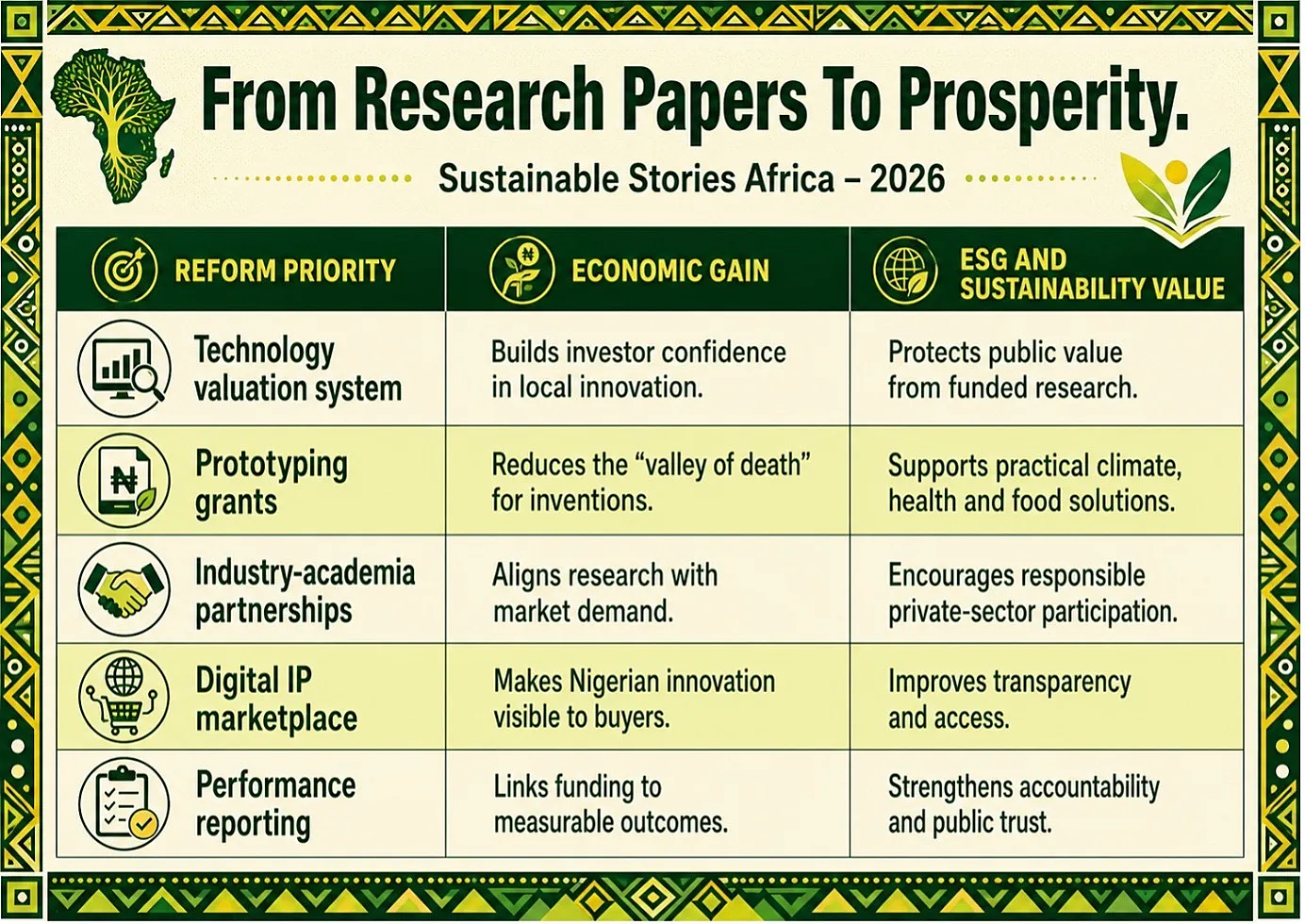
If the NRIDF works, its greatest success will not be measured in published papers; it will be measured in new products, patents, companies, industrial partnerships, jobs and exportable Nigerian solutions. That future requires three practical shifts:
- Technology assessment and valuation: Nigeria needs a credible national system that helps banks, investors, venture capital firms, and manufacturers determine which technologies are viable, protectable and scalable, because not every research output carries the same commercial value.
- Stronger IP and technology transfer offices: Universities and research institutes need fully functional offices staffed with patent lawyers, market analysts, business development professionals and sector experts capable of guiding researchers from discovery through licensing, spin-offs and production.
- Innovation translation grants: Targeted funding must bridge the critical middle stage between idea and market, covering prototyping, field testing, certification, clinical trials and pilot manufacturing, where many promising solutions currently collapse for lack of capital.
The prize is a fundamentally different Nigerian economy: one where cassava waste becomes biodegradable packaging, local science strengthens food security, medical devices are produced domestically, clean energy solutions are engineered for African conditions, and young innovators see a credible pathway from idea to enterprise
Build The Systems Around The Money
Money alone will not rewrite Nigeria’s economic destiny. Without transparency, the NRIDF could become another slow-moving public fund.
Without clear rules, it could reward access over merit. Without commercial discipline, it could finance research that never leaves the shelf.
The next steps should be urgent and practical.
- The legal framework must protect the fund from political capture.
- Grant selection must be competitive, transparent and independently reviewed.
- Beneficiaries should submit performance reports tied to measurable development outcomes, not just administrative compliance.
The government must also bring the private sector closer.
- Matching funds, sector-specific innovation challenges and industry-led research partnerships can help ensure that funded projects solve real market problems.
Banks, manufacturers, agribusinesses, healthcare firms, clean energy companies and digital platforms should not be spectators.
- They should be co-investors, customers and commercialisation partners.
For citizens,
- The fund should be judged by its impact on everyday life: better seeds, safer diagnostics, cleaner energy, stronger local manufacturing, more skilled jobs and more resilient communities.
Path Forward – Turning Research Capital Into Shared Prosperity
Nigeria’s NRIDF can become a relevant economic tool if it is transparent, commercially disciplined and tied to national priorities such as food security, health, clean energy, manufacturing and digital transformation.
The path forward is clear: fund research, value technology, protect intellectual property, connect innovators to industry and report outcomes publicly.
Well done, NRIDF can turn Nigerian knowledge into sustainable growth.
Culled From: How NRIDF can rewrite Nigeria’s economic destiny - Vanguard News