
Nigerian firms are discovering that embracing environmental, social and governance (ESG) practices is more than ethics; it is a business imperative. With global investors directing nearly US$495 billion towards sustainable finance and domestic regulatory frameworks aligning with the International Sustainability Standards Board (ISSB), early adopters have a head start in Nigeria's transition.
By converting compliance into a strategic advantage, companies such as Nigerian Breweries Plc are cutting operational costs, reducing carbon emissions and securing access to premium markets, thus illustrating how sustainability can redefine competitiveness in Africa's largest economy.
Why ESG Is Now Business Critical
Nigeria's corporate sector is facing a structural shift. The country's capital market is aligning with the ISSB framework, and global flows of sustainable investment are mounting.
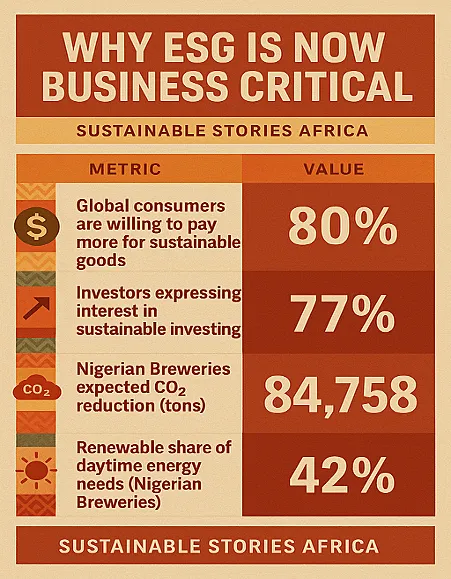
Businesses that previously treated ESG as an optional risk are being left behind. According to the article, 80 % of global consumers say they will pay more for sustainably produced goods, while 77 % of investors now favour sustainable investing.
A good example is Nigerian Breweries' solar-investment programme, which is expected to reduce 84,758 tons of CO₂ and meet 42% of daytime energy needs. (
| Metric | Value |
|---|---|
| Global consumers are willing to pay more for sustainable goods | 80 % |
| Investors expressing interest in sustainable investing | 77 % |
| Nigerian Breweries expected CO₂ reduction (tons) | 84,758 |
| Renewable share of daytime energy needs (Nigerian Breweries) | 42 % |
How Nigerian Corporations Are Turning Sustainability Into Advantage
The article argues that ESG is delivering measurable returns: improved efficiency, cost reductions, and stronger brand loyalty.
Three converging forces drive the opportunity: regulatory change (Nigeria adopting ISSB standards), global capital flows, and consumer preferences. Nigerian firms are already realising gains: for instance, operational cost reductions of 10–15 % through resource and process optimisation.
For local businesses, this means the ESG shift is not simply about avoiding penalties; it is a platform to differentiate, scale and access premium funding.
Making the Business Case – Concrete Benefits and Competitive Edge
Companies that embed ESG strategically stand to benefit across several dimensions:
- Access to capital – ESG-compliant firms are more likely to attract global investors ahead of mandatory reporting deadlines (Nigeria 2028).
- Operational efficiency – Resource-use and energy-efficiency improvements can reduce costs by 10-15 %.
- Brand loyalty & premium pricing – Sustainability is becoming a differentiator—customers increasingly choose brands aligned to their values.
- Resilience & risk mitigation – ESG frameworks help manage regulatory, supply-chain, and reputational risks.
The upshot: sustainability is no longer a cost centre, but a strategic asset.
Steps for Nigerian Firms – What To Do Now
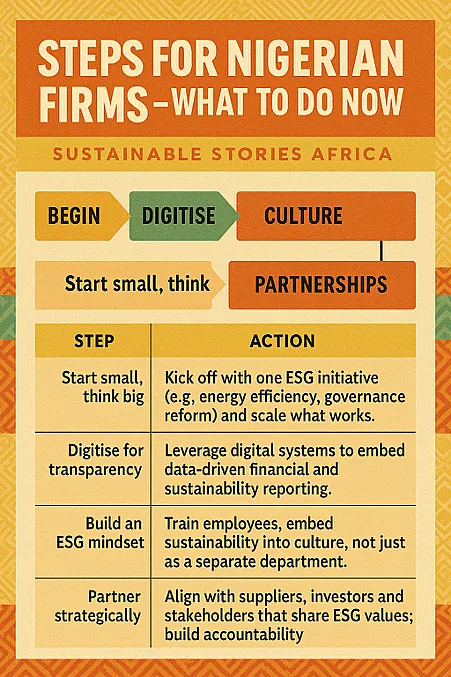
Firms can convert intent into execution by following this roadmap:
| Step | Action |
|---|---|
| Start small, think big | Kick off with one ESG initiative (e.g., energy efficiency, governance reform) and scale what works. |
| Digitise for transparency | Leverage digital systems to embed data-driven financial and sustainability reporting. |
| Build an ESG mindset | Train employees, embed sustainability into culture, not just as a separate department. |
| Partner strategically | Align with suppliers, investors and stakeholders that share ESG values; build accountability. |
Path Forward – Four-Year Head Start Builds Sustainable Market Lead
Looking ahead, Nigerian businesses face a fixed horizon: voluntary ESG adoption to 2027, mandatory reporting by 2028. The window to establish systems, relationships and market positioning is limited. Early movers will capture the best investors, customers and talent; those who stay behind and start late risk paying a premium to catch up.
In the long run, sustainability in Nigeria will be a competitive advantage, and not just about compliance. Companies that act decisively will dominate the next phase of corporate growth.
Culled From: https://punchng.com/turning-sustainability-into-competitive-advantage/