
At a Lagos panel session, business and legal experts warned that Nigeria’s new industrial policy will remain a paper promise unless execution, finance and regulation become more predictable.
The discussion, moderated by Godson Ogheneochuko, focused on turning policy ambition into productive capacity across construction, mining, manufacturing and small business.
The stakes are practical: cheaper production, bankable projects, stronger supply chains and jobs for firms still wrestling with costly delays.

Policy Meets The Productivity Reality Test
Nigeria’s new industrial policy has entered its hardest phase: implementation.
That was the central message from a panel session themed “Translating Nigeria’s new Industrial Policy into Productivity: Navigating Legal & Regulatory Bottlenecks,” where private-sector and legal voices argued that policy ambition must now be tested against the daily realities of financing, infrastructure, regulation, procurement and execution.
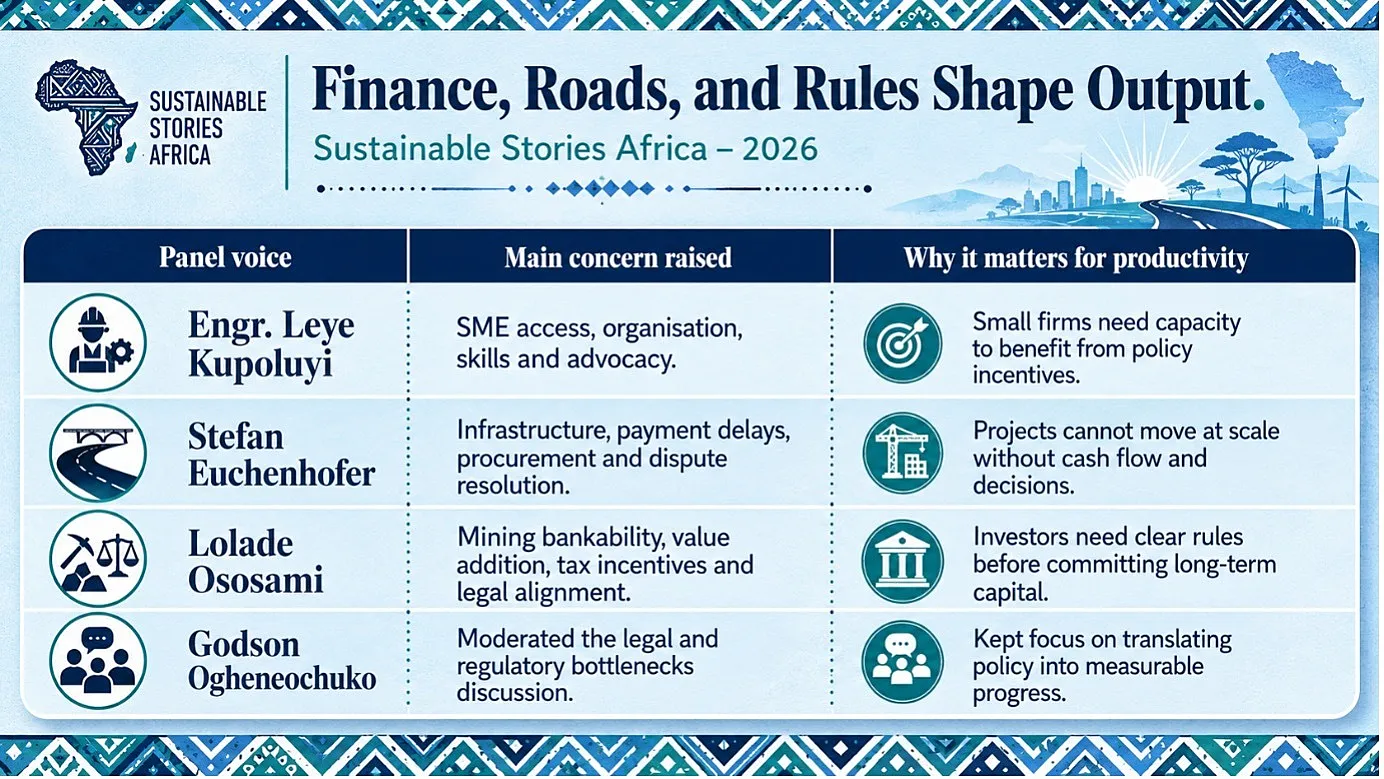
The session brought together Engr. Leye Kupoluyi, President and Chairman, Council of the Lagos Chamber of Commerce and Industry; Stefan Euchenhofer, CEO of Construction Kaiser Limited; and Lolade Ososami, Partner at Udo Udoma & Belo-Osagie. The session was moderated by Godson Ogheneochuko, Partner at Udo Udoma & Belo-Osagie.

The conversation moved quickly from policy language to factory-floor concerns: how to make projects bankable, how to reduce delays, how to align laws with investment needs, and how to ensure that small businesses are not left behind.
Finance, Roads, and Rules Shape Output
For Ososami, the industrial policy’s promise will remain “theoretical” if implementation is weak.
She argued that Nigeria must understand the full value chain of priority sectors, particularly mining, and ensure that laws, incentives and implementation frameworks align with the wider industrial vision.
Her strongest warning was on bankability. Interest from foreign investors exists, she suggested, but interest does not automatically become capital.
Projects need exploration data, reliable power, clear incentives and predictable regulatory treatment before financiers can commit long-term funds.
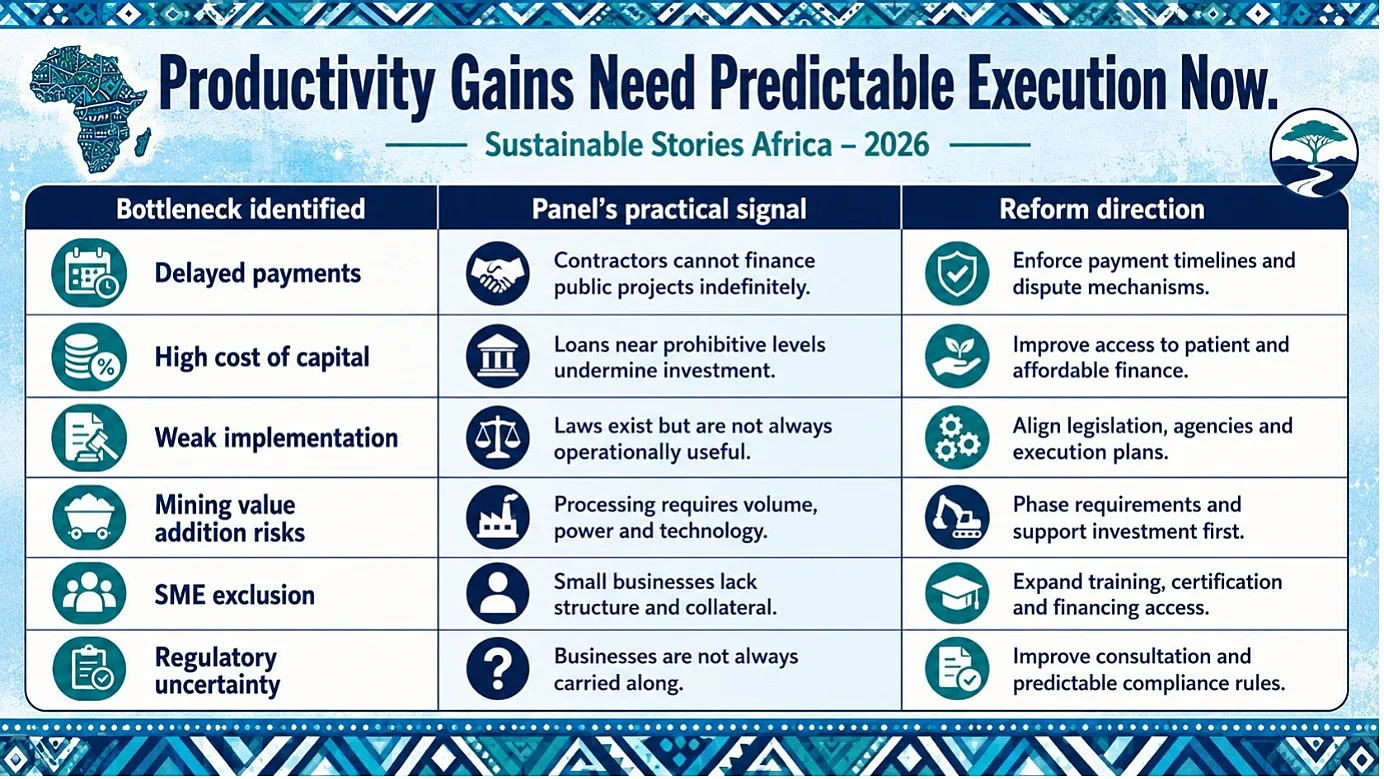
Euchenhofer brought the discussion down to infrastructure and construction. He described public investment as a “kickstarter” for productivity; however, he warned that delayed payments, unresolved disputes and slow decision-making can weaken the entire industrial base.
In one example, he cited a certified payment that took 550 days to settle, a delay that can damage contractors, raise costs and stall infrastructure delivery in an inflationary economy.
Kupoluyi placed small businesses at the centre of the productivity question. He argued that SMEs cannot be treated as an afterthought, given that they account for a major share of jobs and economic activity.
His message was direct: firms need organisation, training, advocacy, access to finance and simpler regulatory guidance if they are to move from survival to scale.
The session’s recurring concern was not whether Nigeria needs industrialisation. It was whether the country could build the institutional muscle to deliver it consistently.
Productivity Gains Need Predictable Execution Now
If Nigeria gets implementation right, the gains could be substantial.
A more coordinated industrial policy could reduce production costs, unlock new investment in mining and manufacturing, support construction supply chains, strengthen local processing and expand formal jobs.
It could also make Nigeria more credible to investors who want policy stability before committing patient capital.
The mining discussion showed both promise and risk. Ososami said value addition is a sound objective because it can help Nigeria retain more of the economic value from minerals.
However, she warned that making processing mandatory too early could create another bottleneck if the country lacks sufficient mining volume, affordable technology, reliable power and competitive costs.
That distinction matters. Development policy is not the same as short-term revenue collection.
A sector such as mining needs exploration, data, infrastructure and incentives before it can mature.
Treating it particularly as an immediate tax or source of royalty could discourage the very investment needed to build it.
The opportunity is not abstract. It is the difference between a policy document sitting on a shelf and a factory receiving reliable inputs, a contractor being paid on time, a miner accessing exploration finance, or a small exporter meeting quality standards.
From Announcements To Measurable Reform Actions
The panel’s message to policymakers was clear: Nigeria does not need more ambition without delivery. It needs measurable reform actions.
First, government agencies must align around implementation.
- A one-stop or coordinated regulatory approach would help firms understand requirements, reduce duplication and shorten approval cycles.
Second, finance must be treated as industrial infrastructure.
- Payment delays, high interest rates and uncertain incentives make productivity expensive. Where projects serve national development goals, financing tools must match the long-term horizon of industrial growth.
Third, dispute resolution should become faster and more commercially realistic.
- Construction, infrastructure and industrial supply chains cannot wait years for clarity when materials, labour, inflation and exchange rates are moving in real time.
Fourth, SMEs must be prepared to participate.
- That means skills development, certification, structured advocacy and practical guidance on available incentives.
Kupoluyi’s intervention was a reminder that industrialisation is not only about large factories; it is also about the smaller firms that feed supply chains, employ people and keep commerce moving.
Finally, fiscal policy must reinforce industrial policy.
- If a sector is expected to develop, its tax treatment, capital allowances and regulatory obligations should support that development rather than undermine it.
Path Forward – Execution, Skills, Finance, and Regulatory Trust
Nigeria’s industrial policy now needs delivery milestones: faster payments, coordinated approvals, SME training, mining incentives, credible value chain data and predictable regulation.
The promise is clear. If institutions move from announcements to execution, the policy can support jobs, local production, ESG-aligned investment and stronger African market resilience.
If not, productivity will remain trapped between ambition and bottlenecks.