The off-grid solar industry has reached a financing milestone with the debut of its first publicly listed green bond, opening capital markets to a sector traditionally funded by development finance and private investors.
The move broadens financing options at a time when demand for affordable, reliable and clean electricity continues to rise across Africa and other emerging markets.
If replicated successfully, the model could accelerate energy access, strengthen investor confidence and unlock larger pools of climate capital.
Capital Markets Meet Energy Access
For years, off-grid solar has transformed lives one household at a time. Now it is attempting to transform capital markets as well.
The sector has reached a landmark moment with the launch of its first publicly listed green bond, marking an important evolution in how decentralised renewable energy companies finance growth.
Rather than relying primarily on grants, concessional finance or private equity, developers are beginning to tap public debt markets to fund the expansion of clean electricity for underserved communities.
The milestone comes as governments, investors and development institutions search for scalable financing models capable of closing one of Africa's biggest infrastructure gaps: reliable electricity access while supporting climate objectives.
- For investors, the bond offers exposure to an industry increasingly recognised as both commercially viable and environmentally significant.
- For millions of households, it represents another step toward faster deployment of affordable clean energy.
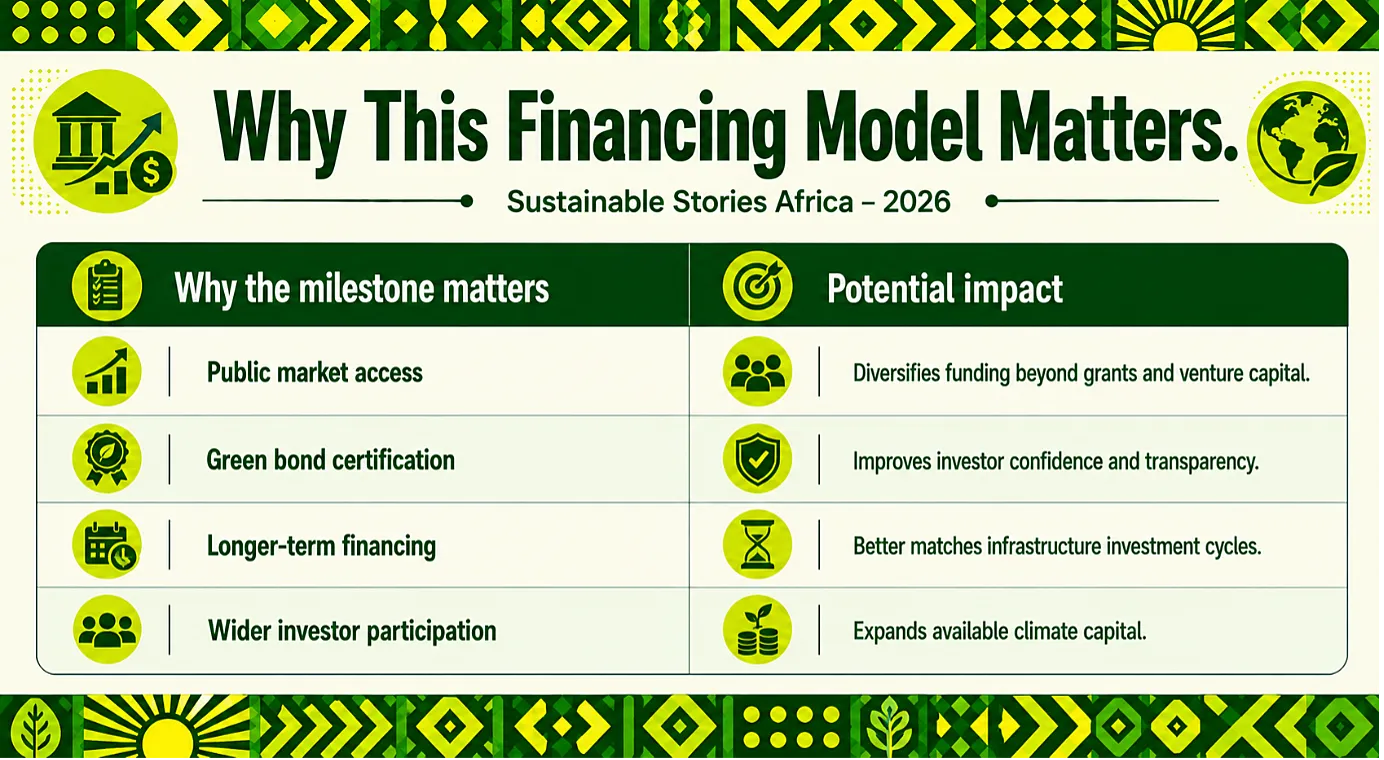
Why This Financing Model Matters
Off-grid solar has become one of the fastest-growing clean energy solutions across Africa, particularly in communities where extending national electricity grids remains economically challenging.
Publicly listed green bonds provide companies with access to a broader pool of institutional investors while improving transparency, governance and reporting standards.
These characteristics increasingly matter as global sustainable finance continues to mature.
The wider green bond market has expanded dramatically over the past decade. However, Africa still represents only a small fraction of global issuance despite facing some of the world's largest climate investment needs.
The continent accounts for roughly 0.3% of global green bond issuance, despite requiring an estimated $190 billion annually to implement climate commitments.
The significance extends beyond a single transaction.
Successfully listed bonds create performance records that may reduce financing costs for future issuers while encouraging pension funds, insurers and asset managers to participate in climate-focused infrastructure financing.
The development also reflects growing confidence that decentralised renewable energy has evolved from a development intervention into an investable infrastructure asset class.
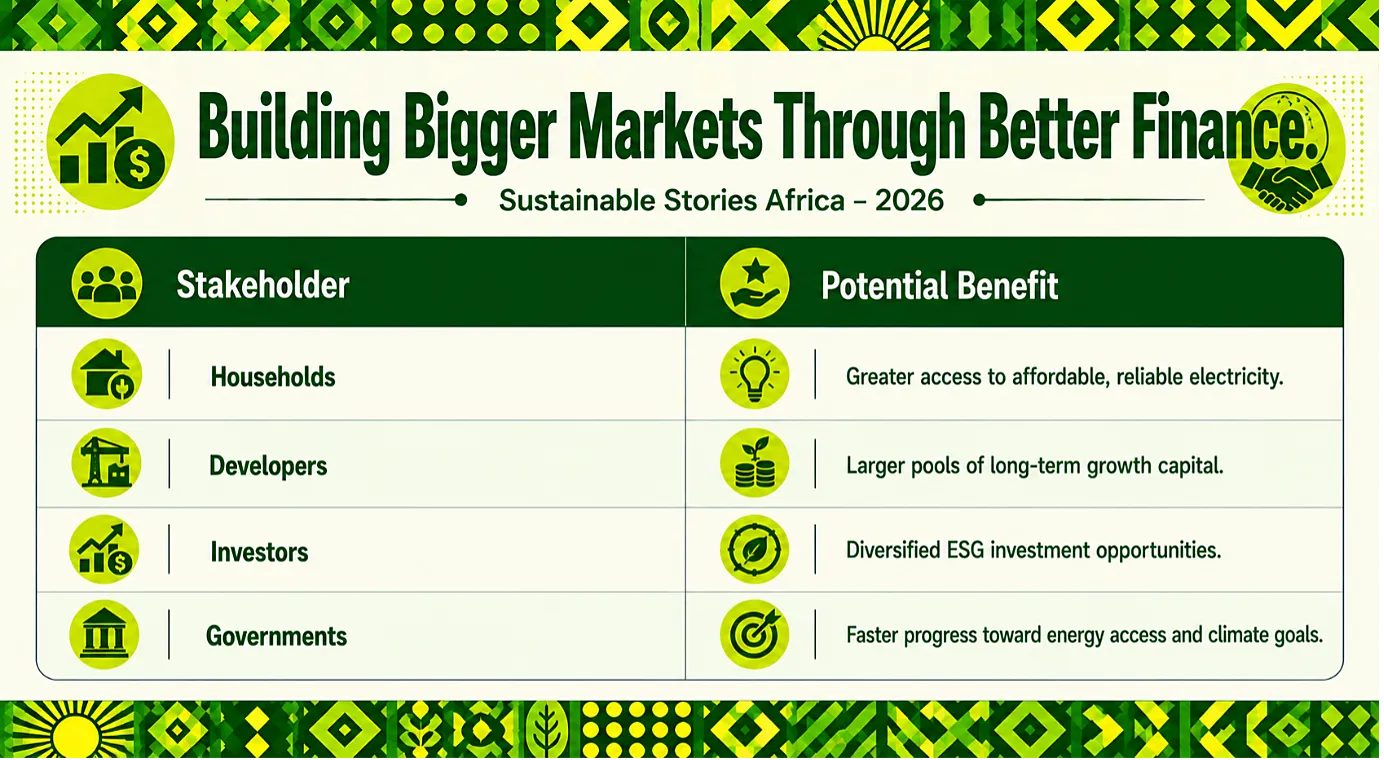
Building Bigger Markets Through Better Finance
Reliable access to long-term capital could fundamentally reshape the pace of off-grid electrification.
Additional financing enables developers to expand distribution networks, introduce more flexible consumer financing and deploy higher-quality solar systems capable of powering homes, schools, healthcare facilities and small businesses.
The broader economic effects are equally significant. Improved electricity access supports education, healthcare delivery, agricultural productivity and digital inclusion while reducing dependence on expensive diesel generators and kerosene.
Conversely, continued dependence on limited concessional funding risks slowing deployment just as electricity demand accelerates across rapidly growing African economies.
If capital markets increasingly recognise off-grid solar as a resilient infrastructure investment, financing constraints could become less of a barrier to universal energy access.
Scaling Finance Beyond Demonstration Projects
The success of this pioneering issuance will likely be measured less by its debut than by what follows.
- Regulators, stock exchanges, development finance institutions and private investors now have an opportunity to establish clearer pathways for future renewable energy issuers.
- Standardised reporting frameworks, robust verification processes and supportive policy environments can lower transaction costs while increasing investor confidence.
African capital markets also stand to benefit. As green finance becomes increasingly mainstream, locally listed sustainable debt instruments could help mobilise domestic savings into climate-resilient infrastructure rather than relying predominantly on international financing.
For policymakers, the lesson is clear: clean energy transitions require financial innovation as much as technological innovation.
The faster sustainable capital markets mature, the faster renewable energy deployment can accelerate.
Path Forward – Expanding Capital For Clean Energy
The listed green bond establishes an important proof of concept for financing decentralised renewable energy through public capital markets.
Its long-term significance will depend on replication, investor confidence and supportive regulatory frameworks.
If additional issuers follow, the model could strengthen sustainable finance ecosystems, accelerate universal electricity access and position African capital markets to play a larger role in financing the continent's clean energy transition.
Culled From: JOff-grid solar sector debuts first publicly listed green bond