
Nigeria’s organised private sector has appealed to President Bola Ahmed Tinubu to intervene in a widening tax transition dispute involving the Nigeria Revenue Service.
The business groups say conflicting filing instructions could undermine the Federal Government’s 2025 tax reforms and disrupt corporate compliance.
At stake are revenue certainty, investor confidence, jobs and the credibility of Nigeria’s transition to a new tax regime.
Private Sector Raises Fiscal Alarm
Nigeria's organised private sector has urged President Bola Ahmed Tinubu to intervene in a growing policy conflict between the Federal Government's tax transition guidelines and directives issued by the Nigeria Revenue Service to corporate taxpayers.
In an open letter, leading business associations under the Organised Private Sector of Nigeria stressed that their position is not opposition to tax reform or legitimate revenue collection, but a call to preserve legal certainty, investment confidence, and the integrity of Nigeria's 2025 tax reform agenda.
Signatories, including MAN, NACCIMA, NECA, NASSI, and NASME, voiced a pointed concern: businesses that structured their 2025 tax filings under existing legislation now face uncertainty over whether returns covering accounting periods ending before January 1, 2026, should comply with the old or new tax framework.
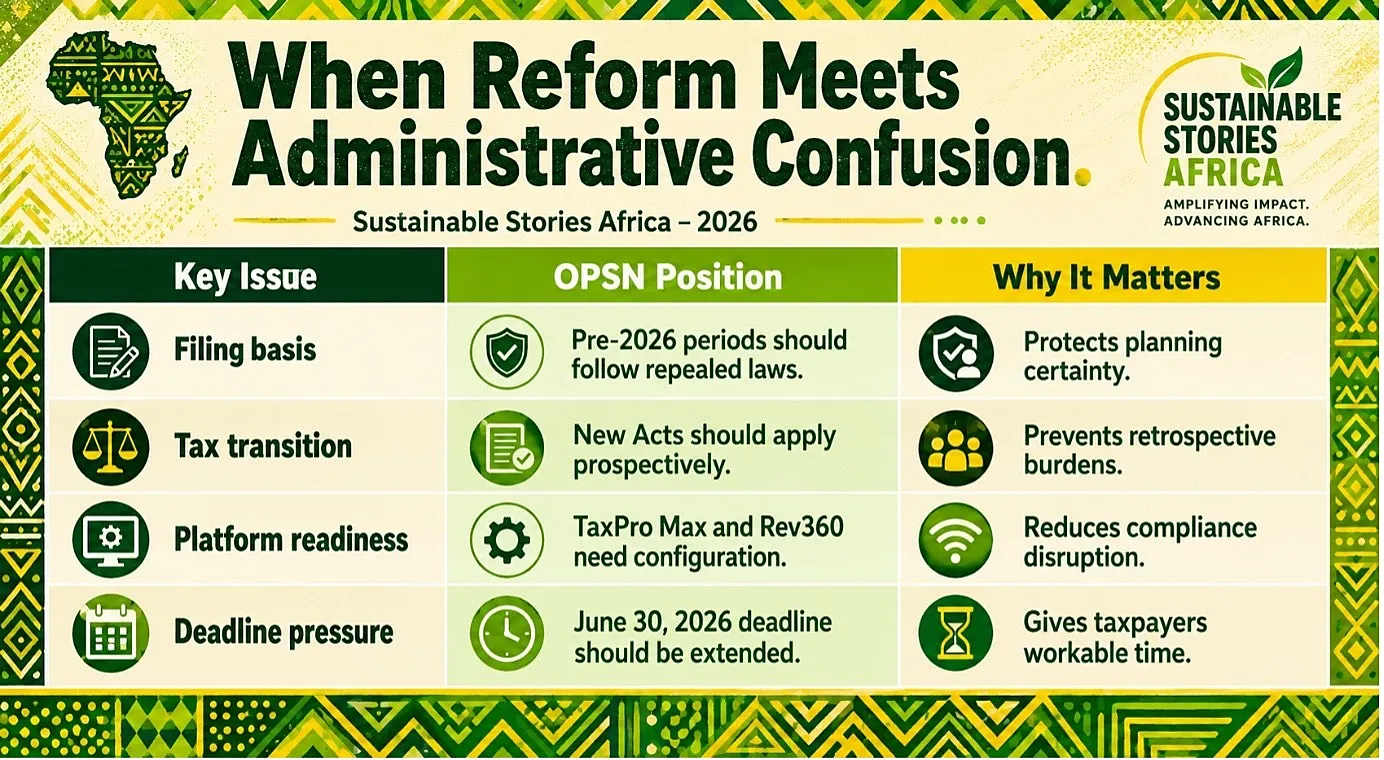
When Reform Meets Administrative Confusion
Nigeria's tax reform programme represents one of the most significant fiscal restructuring efforts in decades.
The Nigerian Tax Act 2025, Nigeria Tax Administration Act 2025, Nigeria Revenue Service Establishment Act 2025, and Joint Revenue Board Establishment Act 2025 were designed to simplify compliance, improve fairness, and strengthen revenue mobilisation, objectives the private sector publicly supported.
The dispute, however, emerged following the Federal Ministry of Finance's issuance of General Transition Guidelines, which state that the new Acts apply prospectively from January 1, 2026.
Under those guidelines, taxes, penalties, and filing obligations should only apply to periods after commencement, meaning company income tax and education tax for accounting periods ending before that date remain governed by repealed legislation.
The controversy deepened when the NRS Large Tax Office communicated to corporate taxpayers that 2026 company income tax returns should be computed and filed under the new framework, directly contradicting the transition guidelines.
For businesses, the consequences are practical and immediate. A company with a December 2025 year-end may have closed its books, completed audits, and structured tax obligations under one legal regime, only to face an entirely different filing expectation months later.
Certainty Can Protect Reform Gains
The private sector’s warning goes beyond tax paperwork. It is about whether reform is experienced by businesses as clarity or as disruption.
At a time when government needs every legitimate naira of revenue, the OPSN argues that confusion could produce the opposite result: delayed filings, avoidable disputes, lower compliance confidence and unnecessary pressure on companies already managing inflation, currency volatility and financing costs.
The groups also warned that Q1 2026 collections were already materially below target, suggesting that a system that prevents willing taxpayers from filing correctly may become fiscally counterproductive.
Their argument rests on three governance principles: non-retroactivity, strict construction of tax statutes and legitimate expectation. In simpler terms, businesses want the rules they relied on to remain valid for the period in which they applied.
For manufacturers, exporters, banks, telecoms operators and SMEs, predictable tax administration is not just a legal issue.
It affects cash flow, audit planning, investor reporting, board decisions and the confidence to continue expanding in Nigeria.
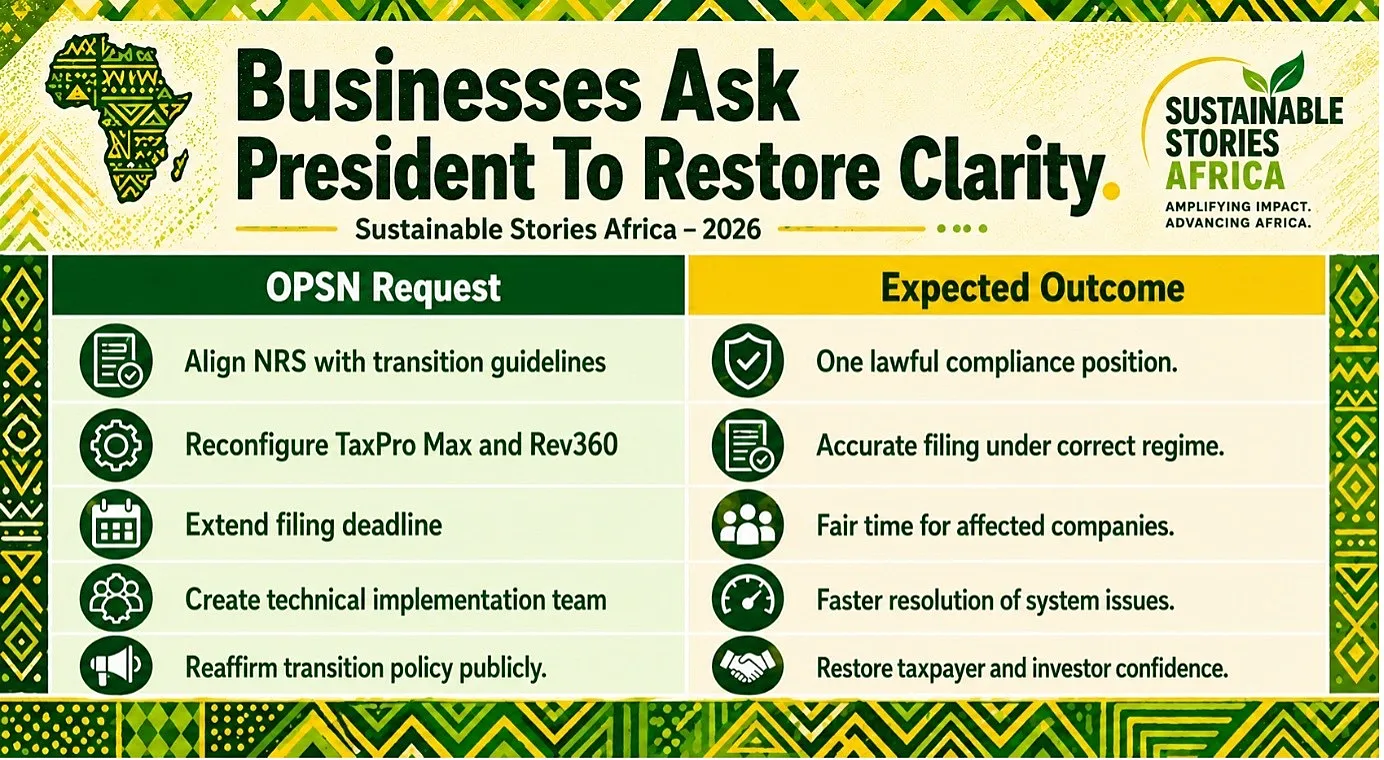
Businesses Ask President To Restore Clarity
The OPSN is asking the President to direct the relevant authorities to restore one coherent national position on the tax transition.
Its requests include requiring the NRS to comply fully with the General Transition Guidelines, reconfiguring relevant filing platforms, issuing a nationwide notice within 24 to 48 hours, and granting an adequate extension of the June 30, 2026, filing and payment deadline.
The groups also want confirmation that no penalties, interest, surcharge, enforcement action or adverse compliance classification will arise where taxpayers are unable to file or pay because of platform unavailability or conflicting official guidance.
The letter’s strongest message is that reform succeeds only when legislation, ministerial direction, administrative practice and digital systems speak with one voice.
For Nigeria’s sustainability and ESG agenda, the issue also carries broader significance.
Strong institutions, transparent governance and predictable regulation are central to investor trust.
When tax systems are clear, businesses can plan better, government can collect better and citizens can benefit from more stable public revenue.
Path Forward – Clarity Must Now Drive Compliance
Nigeria’s tax reform can still strengthen revenue, fairness and competitiveness if implementation is predictable, lawful and coordinated.
The priority now is urgent alignment between policy, platforms and enforcement.
A credible transition will protect businesses, preserve jobs, improve revenue collection and reinforce Nigeria’s wider governance reform story.