The WEF Energy Transition Index 2026 identifies three priorities for restoring global transition momentum: strengthening security and resilience, unblocking delivery through infrastructure, and increasing investability through stable policy and risk-sharing. For Africa, these priorities are equally valid and far more urgent.
However, their implementation demands a fundamentally different set of instruments, actors, and institutional arrangements than those available to the advanced economies which dominate the top ETI rankings.
This is not a critique of the WEF framework. It is an expansion of it, translated into a continental action agenda that is unapologetically African in ambition, shaped by Africa's structural realities, and backed by the political will and international financing commitments the continent's transition potential demands.
Three Priorities, One Continent, A Different Implementation Reality
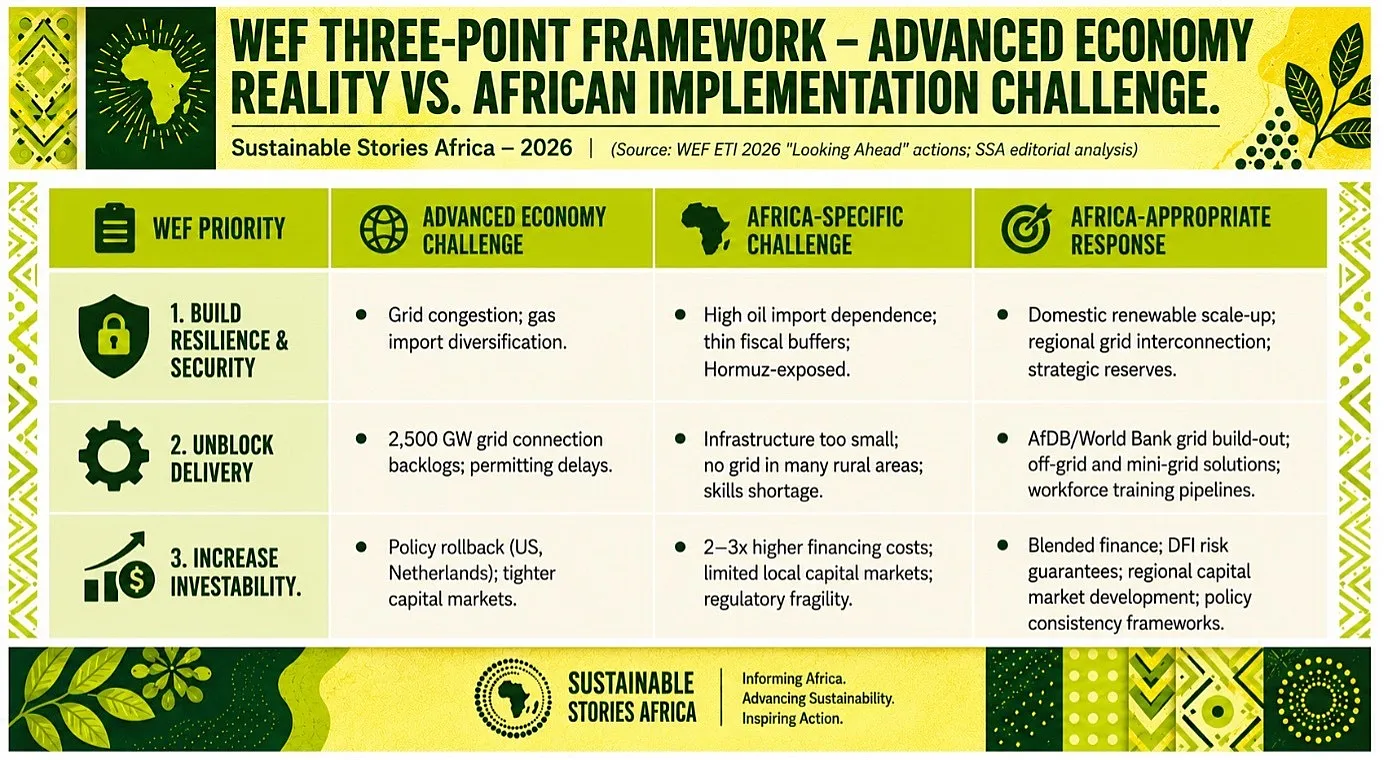
The WEF's three-point action framework for the energy transition is analytically sound and globally relevant. Strengthening security, affordability and resilience; unblocking delivery through grid expansion and streamlined infrastructure; and increasing investability through stable policy, credible regulation and better risk-sharing: these are not optional refinements to an otherwise functional system.
They are structural prerequisites for progress.
However, what do they mean when the country in question is not Germany or Denmark, but Nigeria or Ethiopia?
- What does "stable policy and credible regulation" mean when governance systems are fragile and regulatory institutions are under-resourced?
- What does "grid expansion" mean when the grid barely exists in rural and peri-urban areas where most of the population lives?
- What does "risk-sharing" mean when international capital markets price African energy projects at two to three times the cost of equivalent projects in advanced economies?
The WEF's framework must be stress-tested against African realities, and then rewritten, not discarded, as an African transition agenda.
The Gap Between the Global Framework and Africa's Reality
The WEF's own data documents the gap with precision. In 2025, 75% of global clean energy investment flowed to the US, China and Europe — leaving Africa, which will drive a disproportionate share of global population and energy demand growth, competing for the remaining 25% alongside every other emerging and developing economy. African clean energy projects face financing costs two to three times higher than comparable projects in advanced economies — not because of higher project risk, but because of macroeconomic and country risk premia that often reflect outdated perceptions rather than project fundamentals.
The ETI also reveals a structural irony: 2,500 GW of projects are waiting in global grid connection queues — mostly in advanced economies. Meanwhile, African economies are not suffering from grid connection backlogs. They are suffering from grids too small and underfunded to connect the loads that already exist. These are not the same problem — and they cannot be solved with the same tools.
The Compounding Pressures Africa Cannot Absorb Alone
The WEF's 2025 – 2026 analysis maps compounding global pressures, and Africa is disproportionately exposed to each.
- Geopolitical fragmentation: With $2.6 trillion in trade affected and export controls on over half of critical transition minerals, African mineral exporters and import-dependent economies are squeezed simultaneously. The DRC, Zambia, and South Africa are watching their strategic resources become subjects of international competition and control regimes they had no role in designing.
- AI and digitalisation: Global AI investment reached $1.5 trillion in 2025, with data centre electricity consumption set to nearly double by 2030 and potentially exceed 1,700 TWh by 2035. Nigeria, Kenya, South Africa, and Egypt face surging electricity demand that their grids cannot reliably serve. As Microsoft, Google, and Amazon secure advanced nuclear partnerships for firm clean power, African governments must ask: who is securing Africa's data centre electricity future?
- Capital concentration: With 75% of global investment concentrated in the US, China, and Europe, African projects are systematically excluded — not for lack of merit, but because global risk frameworks and transaction cost structures are not calibrated for African project development.
- COP30 signal: The $1.3 trillion climate finance pledge, announced without fossil fuel phase-out language, is both an opportunity and a governance challenge — deploying that capital to advance transition readiness, rather than deepen debt dependency, demands African institutional capacity and negotiating sophistication at scale.
What Genuinely Applying the Three Priorities to Africa Would Deliver
The WEF's recommended actions for its three transition priorities, read through an African lens, reveal a transformative agenda that the continent's governments, development banks, and private-sector actors have both the mandate and urgency to pursue.
Priority One – Build Resilience and Security:
The WEF prescribes diversifying fuels, supply chains, and critical minerals; stress-testing systems; and pairing variable renewables with firm dispatchable capacity.
- For Africa, this is the most compelling case for accelerating domestic renewable deployment.
- Every solar megawatt built in the Sahel is a barrel of imported oil avoided; every geothermal megawatt online in the East African Rift Valley is a gas shipment Kenya or Tanzania does not need. REPowerEU, the WEF's lead case study, cut the EU's single-supplier gas dependence from 45% to below 12% and grew solar capacity 50% in under three years.
- Africa's renewable programme must be reframed using the same logic: it is not only a climate response, but as part of the continent's energy security strategy.
Priority Two – Unblock Delivery:
In advanced economies, this means clearing backlogs. In Africa, it means building the system itself.
- The West Africa Power Pool, East Africa Power Pool, and AfDB's Desert to Power initiative, targeting 10 GW of solar energy potential in the Sahel, provide the architecture and pipeline.
- The missing ingredient is sustained concessional capital.
- Workforce development is equally critical: Kenya's innovation readiness score jumped 58.7% in a single year, partly on doubled R&D expenditure, demonstrating that Africa's human capital base can build the required technical workforce at scale.
Priority Three – Increase Investability:
Finance and investment readiness declined 1.8% globally in 2026, the sharpest drop in the ETI's history. Record global capital is not reaching Africa because risk assessment frameworks systematically disadvantage the continent.
- The structural solution is blended finance: public and concessional capital absorbing first-loss risk to bring effective financing costs to commercially viable levels.
- Instruments such as the AfDB's SEFA, IFC's Scaling Solar, and the World Bank's DARES programme work at the project level.
- What is missing is their deployment at a scale and speed commensurate with Africa's transition needs.
Africa's Five-Point Rewrite of the WEF Transition Agenda
The WEF's three priorities are the right diagnosis. Africa's five-point rewrite is the continent-specific prescription:
African Energy Security and Transition Resilience Compact:
- A multilateral AU agreement codifying the security-transition nexus, committing members to domestic renewable targets, strategic petroleum reserve building, and mutual crisis-response mechanisms, Africa's equivalent of REPowerEU.
African Transition Delivery Agency:
- Modelled on the UK's National Infrastructure Commission but mandated continentally through the AU Commission and AfDB, with authority to fast-track permitting, coordinate cross-border grid investment, triage WAPP and EAPP pipelines, and publish annual accountability scorecards.
Africa Clean Energy Risk Facility:
- A blended finance vehicle, capitalised by the Green Climate Fund, AfDB, IFC, and bilateral DFIs, providing first-loss guarantees and currency risk coverage to reduce effective financing costs from 12% – 18% to 6% – 8%, unlocking private capital currently unable to reach African projects.
African Critical Minerals Transition Compact:
- Requiring minimum in-country value-addition for cobalt, lithium, graphite, and manganese before export, ensuring Africa is a beneficiary of global supply chain diversification, not merely a raw material supplier.
Africa-WEF ETI Co-Production Partnership:
- Commissioning African research institutions to co-produce transition assessment data, ensuring off-grid solar, mini-grids, and informal energy innovations are systematically captured, not undercounted, across the ETI's 44 indicators.
Path Forward – Africa Must Refuse to Be a Bystander in the Framework That Governs Its Future
The WEF Has Written the Agenda; Africa Must Write the Implementation
The WEF Energy Transition Index 2026 is not abstract policy architecture. Its three priorities, like security and resilience, delivery and infrastructure, and investability and risk-sharing, are the precise conditions under which Africa's transition will either accelerate or stagnate.
Sub-Saharan Africa's over 1.2% overall ETI improvement is the strongest regional gain globally, and its over 3.3% readiness gain is the only significant regional readiness improvement worldwide, confirming that the continent is building momentum on its own terms.
Kenya's 8.7% readiness jump, Namibia's green hydrogen ambition, South Africa's just energy transition partnership, and Morocco's 93%-renewables target are the building blocks of a continental story the world has not yet fully understood.
Momentum, however, is not transformation. The WEF has provided the framework; the ETI has provided the data. Africa's governments, development banks, and private-sector leaders now have both the analytical tools and moral urgency to demand that global climate finance be restructured, proportionate, affordable, and patient, to meet the continent's rising readiness. The window remains open.