Private equity’s next growth story is increasingly being written through power systems, data centres, grids and energy security. KPMG’s latest Pulse reports show that deal values remain large even as volumes soften.
For Africa, the signal is clear: countries that can turn reliable, fairly priced energy into bankable infrastructure may attract capital; those left as energy price-takers risk being left out of the next deal cycle.
Power Becomes Private Capital’s Test
Global private equity entered 2026 with cautious confidence, a deep capital base and a sharper preference for high-conviction assets.
The first quarter then delivered a useful warning: geopolitical volatility can narrow exits quickly, but it does not erase the investor appetite for essential infrastructure.
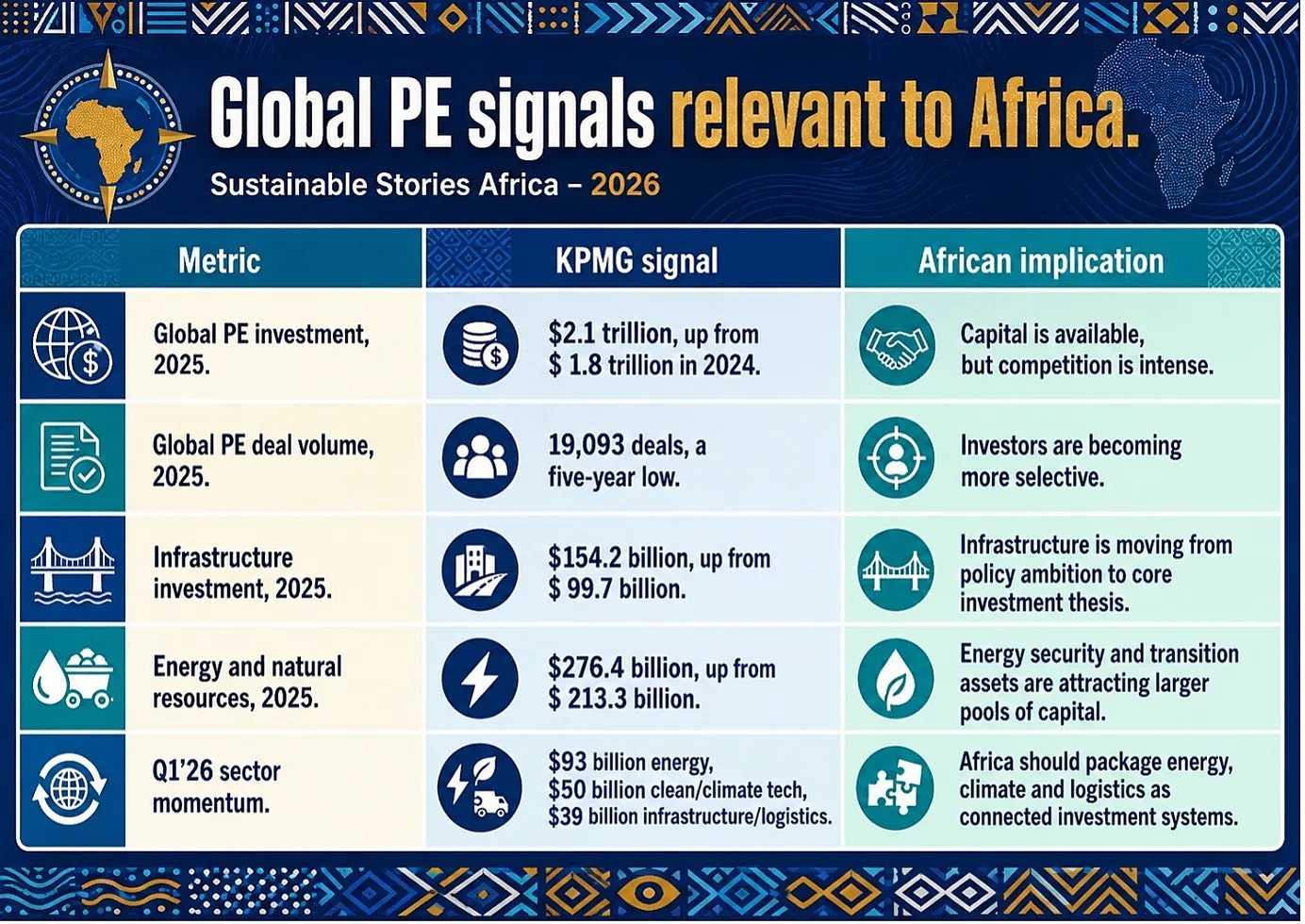
KPMG’s Q1’26 Pulse of Private Equity recorded $436 billion in announced global PE deal value across 4,168 deals.
The rolling 12-month sum stood at $2.1 trillion across 19,682 transactions, highlighting a market that remains large in value even as dealmaking became more selective.
The strongest message for African markets is not simply that capital exists. It is that the capital is following relationships to energy, data, infrastructure and policy certainty.
In that relationship, energy is no longer a background cost. It is becoming the asset that decides who can host growth.
A Selective Market Still Funds Power
The headline from global private equity is a paradox: investors are more cautious, but they are still writing large cheques where they see durable demand.
In Q1’26, KPMG identified energy and natural resources, clean and climate tech, and infrastructure and logistics as the only tracked sectors trending ahead of 2025 results. That is not accidental. AI adoption is creating demand for data centres, grid capacity, cooling systems, backup power and energy generation.
The $41 billion take-private of AES by a consortium including Global Infrastructure Partners and EQT gave the quarter its clearest symbol: energy infrastructure has moved into the centre of the private capital thesis.
For Africa, where power reliability still shapes industrial output and household welfare, this is a strategic opening rather than a distant global trend.
AI Turns Energy Into Deal Flow
KPMG’s Q4’25 report showed global PE investment reaching $2.1 trillion in 2025, up from $1.8 trillion in 2024, even as deal volume fell to a five-year low of 19,093.
It also noted that infrastructure investment rose from $99.7 billion to $154.2 billion year-on-year, while energy and natural resources increased from $213.3 billion to $276.4 billion.
That relationship matters. PE managers are not only buying energy assets because they are “green.” They are buying them because electricity is becoming a constraint on AI, logistics, digital services, industrial parks and urban growth.
The investor question has shifted from whether energy assets are important to whether they can produce predictable revenue, acceptable risk and credible exits.
Africa has a chance to connect three demand pools: power access, clean industrialisation and digital infrastructure.
However, the continent will not capture that opportunity by being merely resource-rich. It must be contract-ready, grid-ready and price-ready.
Africa Can Price Reliability Better
A price-taker energy market absorbs shocks from imported fuel, currency movements, weak utility balance sheets and tariff uncertainty.
A price-setting energy market uses generation diversity, storage, credible PPAs, wheeling rules, regional power trade and transparent tariffs to shape risk. That difference affects valuation.
In African markets, the positive outcome is tangible. Reliable energy can reduce downtime for factories, support cold chains, deepen digital services, and make secondary cities more attractive for data centres and industrial clusters.
For investors, the same reliability can support higher-quality earnings, better leverage terms and a clearer route to exit.
The opportunity is not limited to utility-scale power. Distributed solar, commercial and industrial power, storage, mini-grids, telecom energy services, embedded generation and grid software can all become investable platforms if policy and pricing align.

Policy Must Make Deals Bankable
Governments and regulators should treat energy pricing as an investment framework, not only a consumer bill issue.
- Tariffs must protect vulnerable households, but they must also give credible projects a route to recover capital.
- Off-taker risk must be disclosed, mitigated and priced.
- Grid connection timelines must become predictable.
- Project approvals must be transparent enough for institutional capital to underwrite.
Developers also need to change the offer.
- PE capital will not reward ambition alone.
- It will reward contracted cash flows, reliable governance, tested management, disciplined procurement and data that shows uptime, losses, customer quality and regulatory exposure.
For African pension funds, DFIs and sovereign investors;
- The moment calls for blended structures that reduce early-stage risk and crowd in commercial capital without socialising every loss.
- The objective should be to turn energy infrastructure into a repeatable asset class.
Path Forward – Power Must Become Investable
Africa’s PE opportunity now sits inside its energy transition. The priority is clear: convert energy demand into bankable platforms through credible pricing, stronger utilities, transparent contracts and grid access.
Capital will follow markets that can connect power reliability with growth.
Countries that fix the price signal will not merely attract deals; they will shape the industries those deals finance.