
The Science-Based Targets initiative has released Version 2.0 of its Corporate Net-Zero Standard.
The update shifts the framework from target-setting to practical delivery, affecting more than 11,000 companies using science-based targets.
For African businesses and exporters, the message is direct: climate ambition must now connect to capital, operations, suppliers and measurable transition plans.
Attention: Corporate Climate Promises Face A Harder Test
The Science Based Targets initiative has released Corporate Net-Zero Standard Version 2.0, a major update designed to move companies from climate ambition to credible action.
The revised standard builds on SBTi’s experience supporting more than 11,000 companies to set science-based targets and strengthens its role as one of the world’s most influential corporate climate rule-setters.
It comes at a time when investors, regulators, customers and civil society are asking a sharper question: are companies actually cutting emissions, or only announcing future intentions?
For boardrooms, the shift is significant. Net-zero is no longer just a sustainability statement for annual reports.
It is becoming a test of governance, capital allocation, procurement discipline, energy strategy and supplier accountability.
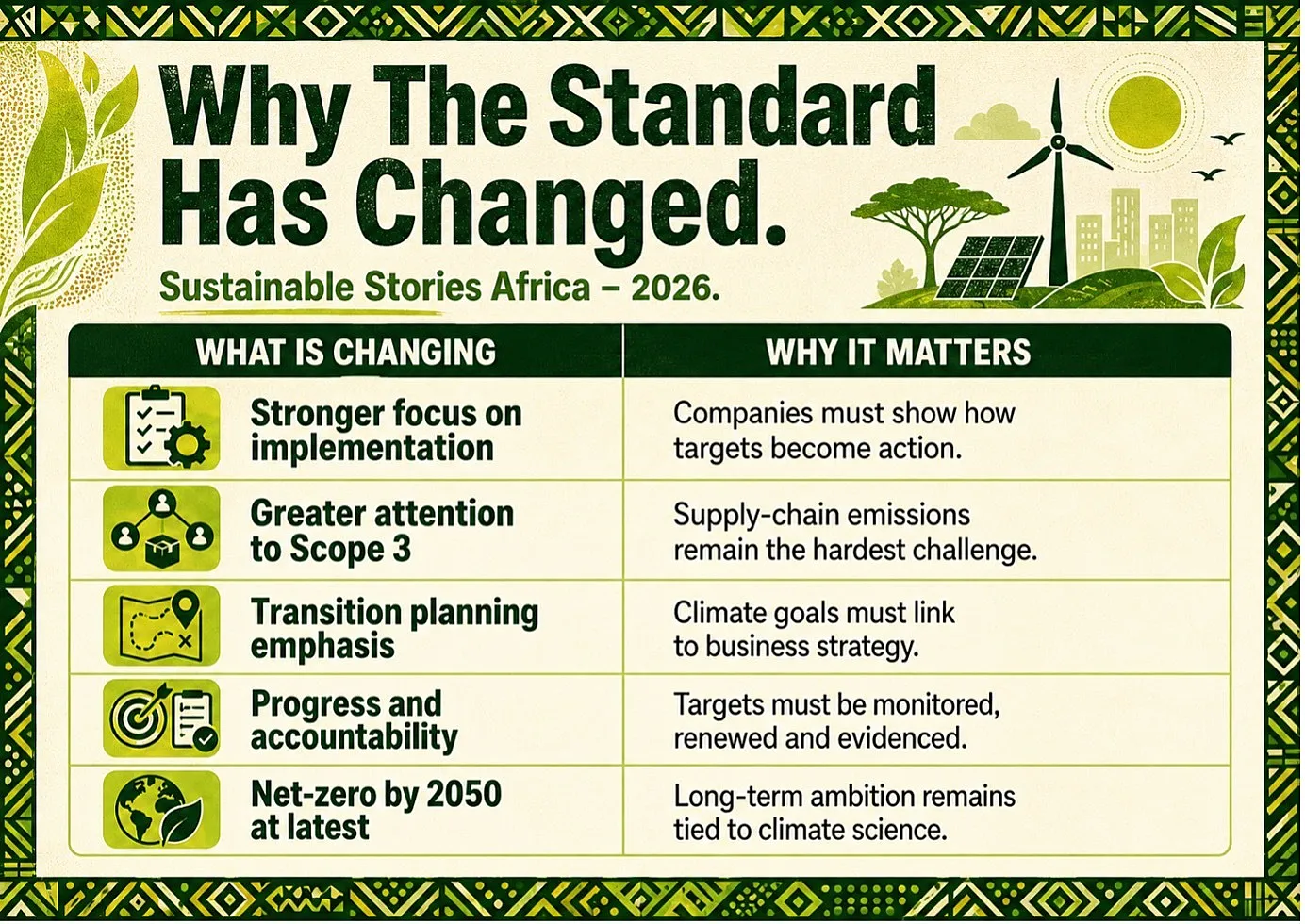
Why The Standard Has Changed
The first Corporate Net-Zero Standard helped create a common definition of science-based net-zero after its launch in 2021.
However, the corporate climate landscape has changed quickly. Disclosure rules have become tougher.
- Greenwashing scrutiny has increased.
- Scope 3 emissions remain difficult to measure.
- Companies face pressure to decarbonise while still managing cost, competitiveness and supply-chain complexity.
Version 2.0 responds to that reality by placing stronger emphasis on implementation.
It is designed to help companies connect climate targets to the decisions that determine emissions: what they buy, how they power operations, how they invest, which technologies they adopt and how they work with suppliers.
For African companies, this matters because climate standards are increasingly becoming market access tools.
Exporters supplying Europe, global manufacturers, banks or multinational buyers may face growing expectations to show credible emissions data and transition plans.
A cocoa processor, cement manufacturer, logistics company or data-centre operator may not see SBTi as a daily operational issue.
However, when a buyer asks for emissions data, a lender prices climate risk, or an investor reviews transition credibility, these standards begin to shape real commercial outcomes.
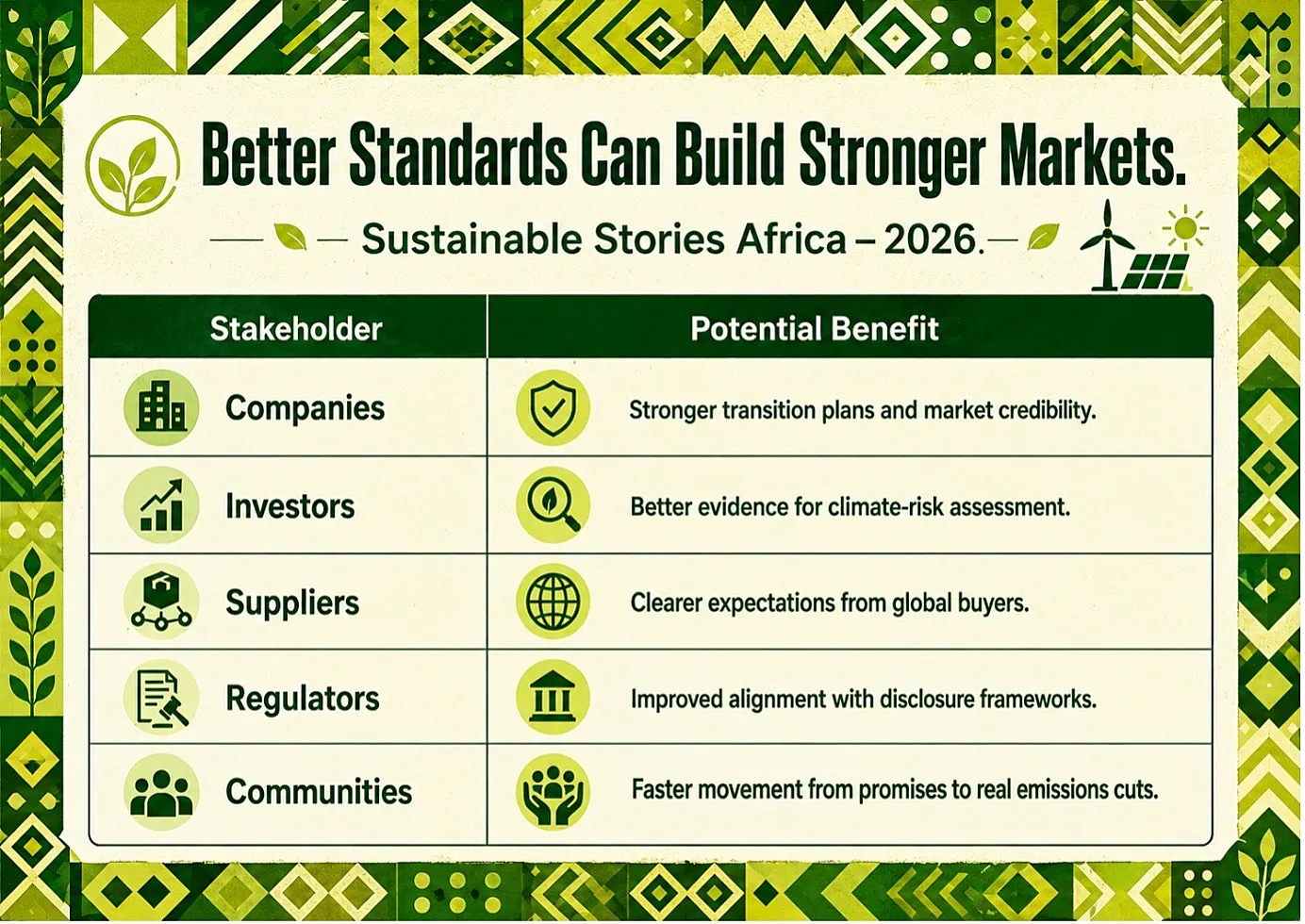
Better Standards Can Build Stronger Markets
The promise of Version 2.0 is to make corporate climate action more practical and less performative.
If implemented well, the standard could help companies prioritise real emissions cuts, avoid weak offset claims, improve supplier engagement and align sustainability commitments with long-term investment decisions.
That could strengthen confidence among investors and customers who increasingly want proof, not slogans.
For African markets, the opportunity is larger than compliance. Better climate planning can help companies reduce energy waste, shift to cleaner power, build resilient supply chains and prepare for future regulation.
It can also help banks and development finance institutions assess which companies are serious about transition risk.
However, the update also carries risk. If flexibility is interpreted too loosely, companies may claim progress without sufficient real-world emissions reduction. That is why transparency, assurance and public accountability will be critical.
The challenge is to make the standard practical.
Boards Must Own The Transition
The next test is not whether companies can publish targets. It is whether boards can govern delivery.
Companies should begin by reviewing emissions inventories, identifying high-impact Scope 1, 2 and 3 categories, and linking net-zero plans to capital expenditure, supplier contracts, product design and energy procurement.
Sustainability teams alone cannot carry this burden. Finance, operations, procurement, strategy and risk functions must be involved.
African businesses should also prepare early. Companies waiting for regulation may find themselves behind customer expectations.
Those that move first can turn climate credibility into a competitive advantage, especially in export sectors, infrastructure, manufacturing, logistics, agriculture and finance.
The call to action is clear: climate targets must leave the PowerPoint deck and enter the budget, the board pack and the supply chain.
Path Forward – Make Net-Zero Delivery Measurable Now
SBTi’s Version 2.0 marks a new phase in corporate climate accountability.
The priority now is implementation: better data, credible transition plans, stronger supplier engagement and board-level oversight.
For African markets, the standard offers both a warning and an opportunity.
Companies that act early can protect market access, attract climate-conscious capital and build stronger ESG credibility.
Culled From: SBTi Releases Corporate Net-Zero Standard Version 2.0 Shifting from Ambition to Action Framework for 11,000 Companies