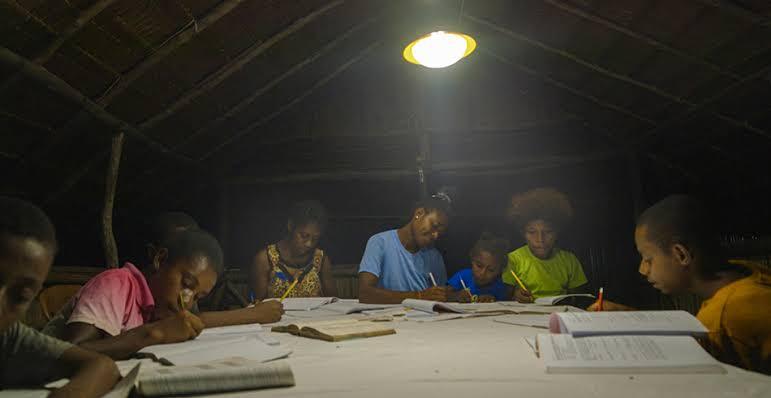
Solar power is beginning to change the daily rhythm of rural classrooms, where learning has long been constrained by darkness, heat, and unreliable electricity.
The shift matters now because Africa’s education challenge is also an infrastructure challenge.
For pupils, teachers, governments, and investors, solar-powered schools are a practical solution to improving learning, expanding digital access, and building climate-smart public services.
A New Light Enters Rural Classrooms
In a rural classroom, electricity determines whether learning ends with the sun or extends into opportunity.
Across Africa and the wider Global South, solar power is emerging as one of the most practical tools for keeping schools open, connected and fit for modern learning.
The story has moved beyond rooftop panels. It is now about children reading after dark, teachers charging devices, girls feeling safer during extended hours, and communities experiencing education as part of the clean energy transition.
The urgency is real. Hundreds of millions across sub-Saharan Africa, the region carrying the largest share of the global electricity access deficit, still live without power.
- For rural schools, this means learning without lighting, digital tools or basic health infrastructure.
- Decentralised solar is now giving these classrooms a genuine chance to leapfrog unreliable grids entirely.
Why Power Shapes Learning Outcomes
Electricity is not a luxury in education; it is enabling infrastructure. Without power, schools cannot run computers, projectors, internet routers or security lighting.
- Teachers struggle to prepare lessons.
- Pupils cannot access technology-based learning.
- Administrators remain trapped in paper systems.
The development case is compelling: reliable energy improves learning conditions, strengthens teacher retention, supports digital education and makes rural schools more attractive to families.
A powered classroom can also become a shared civic asset, hosting adult literacy programmes, community meetings and local entrepreneurship.
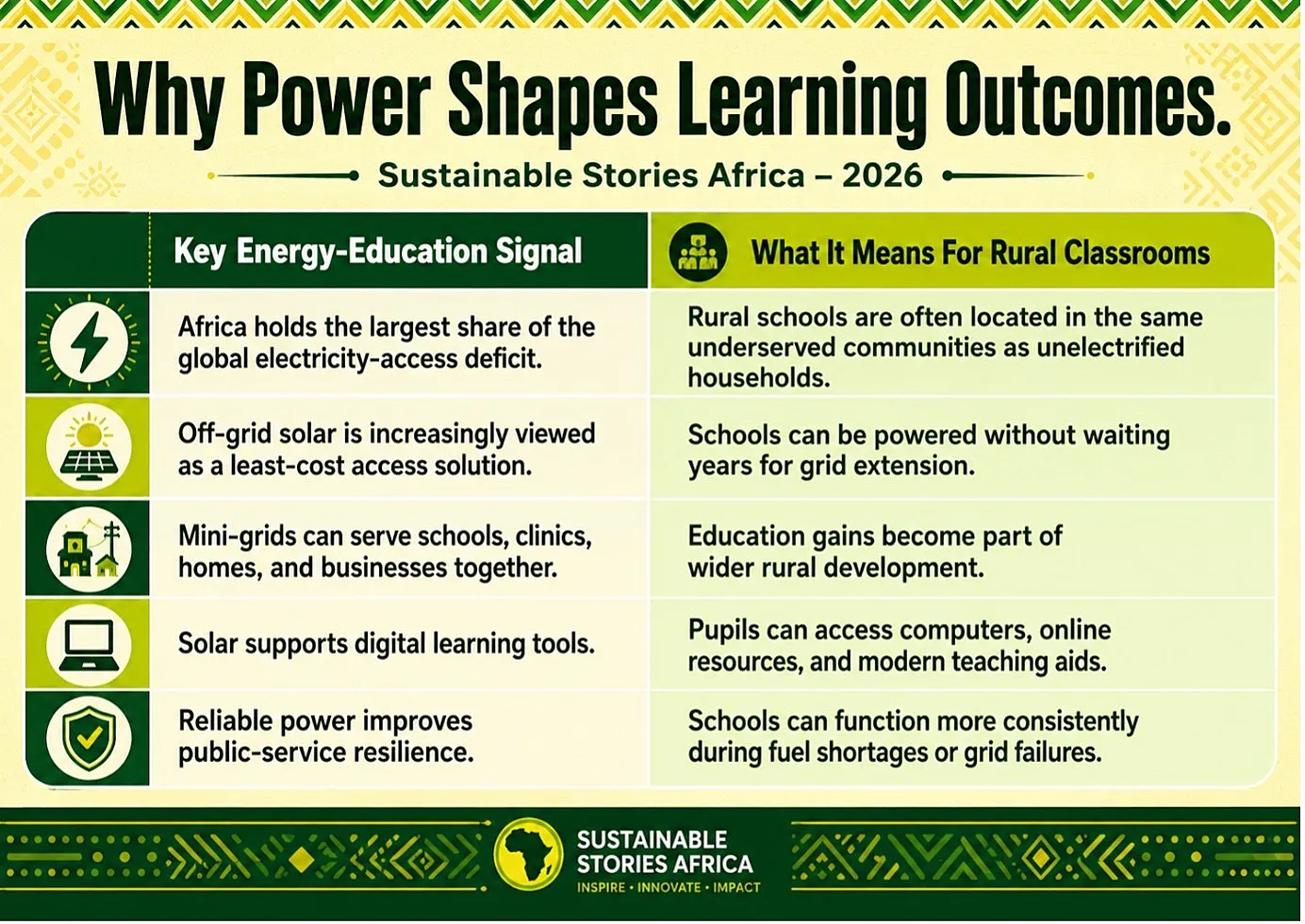
The classroom impact can be immediate and transformative, extended learning hours, powered science equipment, safe revision lighting and functional digital labs, even in communities hours from the nearest urban centre.
However, installation alone is insufficient. Many school electrification projects fail without sustainable maintenance, battery management, security and governance frameworks.
Solar can quickly light the first classroom; keeping it lit requires commitment.
What Solar-Powered Schools Can Unlock
When designed well, solar-powered rural classrooms deliver impact beyond the school fence.
- For pupils, the gain is time, safety and access to digital tools.
- For teachers, it means better working conditions and stronger motivation to remain in rural postings.
- For governments, it connects education, climate action and social equity in one visible intervention.
- For investors and development finance institutions, schools provide a stable anchor demand that strengthens mini-grid viability.
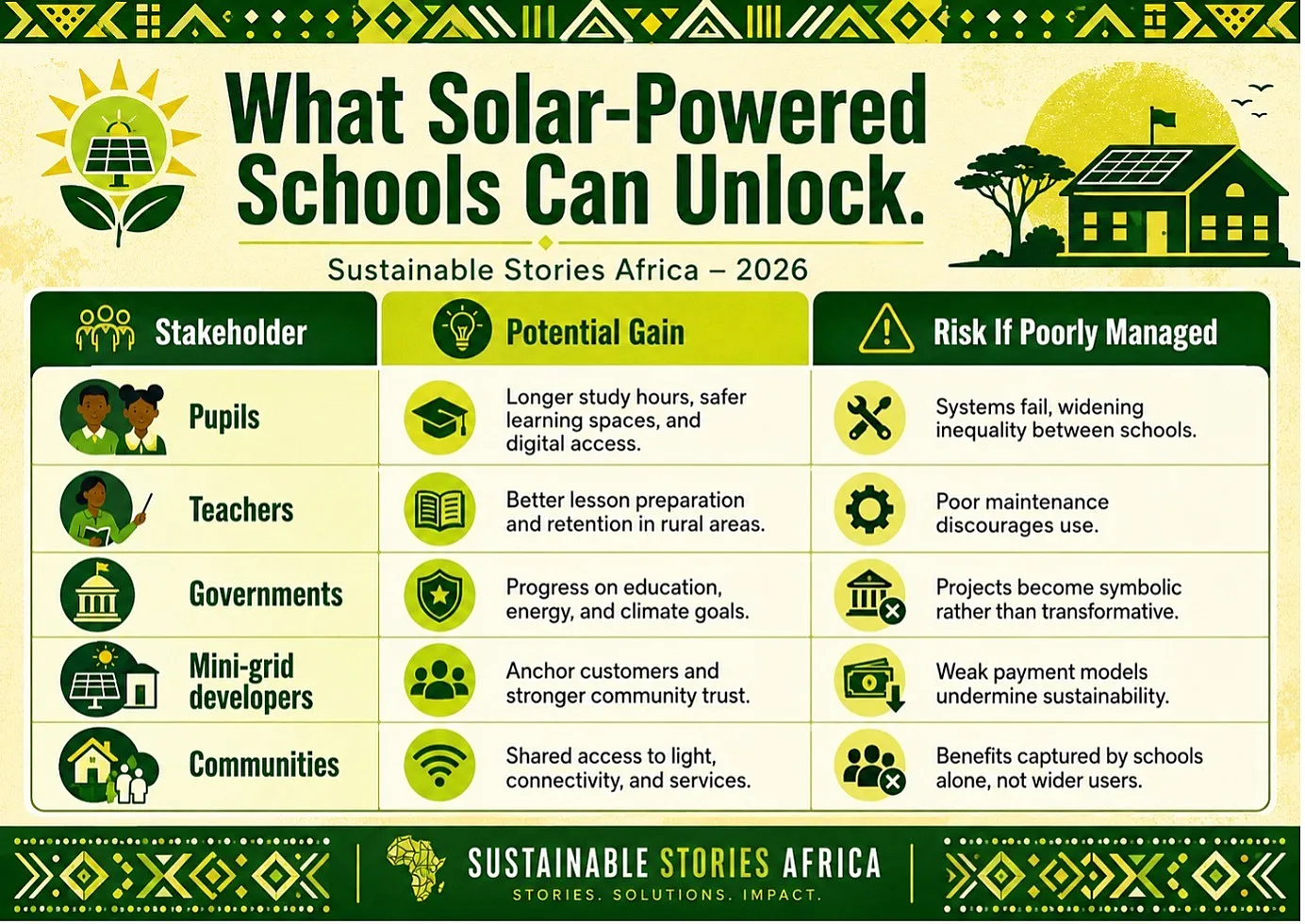
The opportunity is sharpest for girls and low-income learners, where electricity improves safety, sanitation and school reliability, barriers keeping vulnerable children out of class begin to fall.
The real risk is that solar becomes another pilot story rather than a scaled public-service system.
Panels can be installed in a day, but sustained impact requires maintenance budgets, trained local technicians, community ownership and enforceable quality standards.
Make Energy Access A Learning Policy
Africa’s school electrification push should now move from charity-style interventions to integrated public policy.
Ministries of education, energy, finance, and digital economy must plan together.
- Solar for schools should be embedded in rural electrification strategies, teacher deployment policies, digital learning plans, and climate finance pipelines.
Development partners and investors should prioritise models that power schools alongside clinics, homes, small businesses, and public lighting.
This creates stronger economics and deeper social value.
Governments should also track outcomes, not just installations: attendance, study hours, teacher retention, device usage, exam preparation, and community access.
The message for policymakers is simple. A classroom without electricity is not only an educational problem.
- It is an energy, equity, productivity, and climate resilience problem. Solar offers a practical response, but only if it is financed, maintained, and governed as essential infrastructure.
Path Forward – Keep Classrooms Bright Beyond Installation Day
The next phase should prioritise durable systems, local maintenance, transparent procurement, and school-based digital learning plans. Solar must be treated as a foundation for education quality, not a one-off donation.
For African markets, the opportunity lies in turning rural schools into clean-energy anchors. If classrooms stay powered, communities gain more than light.
They gain learning time, public trust, and a stronger pathway into inclusive growth.
Culled From: Solar lights up rural classrooms