
South Africa’s Free State High Court has upheld a R50,000 compensation award against a politician who forwarded discriminatory and harmful WhatsApp messages.
The ruling shows that republishing content can create liability even when the sender was not its original author.
It is a civil judgment under existing equality law; possible imprisonment relates to separate hate-speech legislation when its criminal provisions take effect.
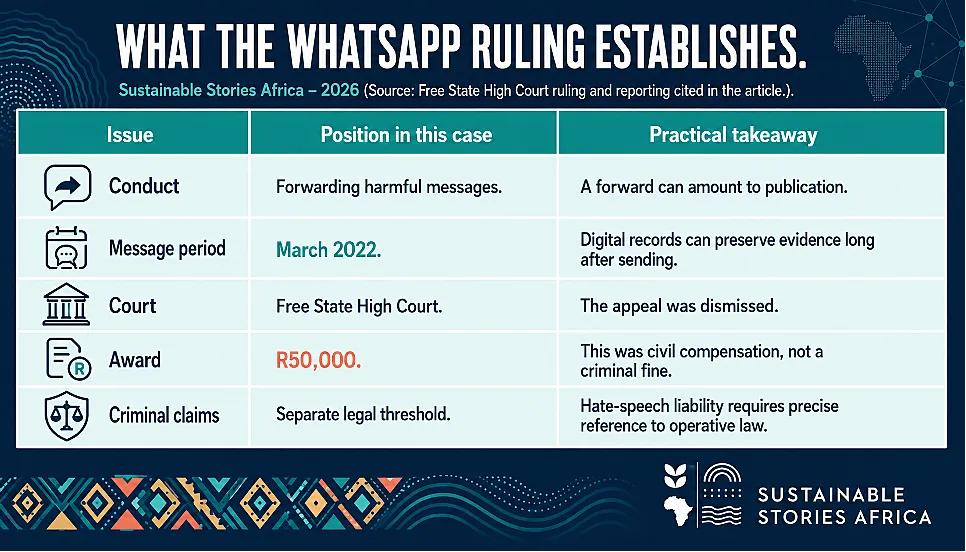
Forwarding is still publication
A South African court has reinforced a simple principle for the digital age: a person who forwards harmful content cannot automatically escape responsibility by saying somebody else wrote it.
The Free State High Court dismissed an appeal by municipal councillor and former member of parliament Sibongile Tsoleli, leaving in place a R50,000 compensation award for WhatsApp messages sent to an African National Congress “Women Coordinators” group in March 2022.
The messages targeted Mangaung councillor Stephanie Lockman-Naidoo, her husband and members of the Indian community.
They contained allegations involving corruption, adultery and sexual innuendo, alongside discriminatory remarks.
The court rejected the main defences
The Equality Court had found that the messages amounted to hate speech, harassment and unfair discrimination under the Promotion of Equality and Prevention of Unfair Discrimination Act.
It ordered compensation, an unconditional apology and attendance at a race-sensitisation programme approved by the South African Human Rights Commission.
On appeal, Tsoleli argued that she had not authored the messages, that they formed part of political conflict and that her communication was protected expression.
The High Court was not persuaded. It found that a reasonable reader would regard the language as discriminatory and harmful, and upheld the award with costs.
The judgment also noted the humiliation and reputational damage experienced by Lockman-Naidoo and her family.
The court criticised the refusal to retract and apologise, observing that earlier corrective action might have avoided some consequences.
Fine and jail claims need precision
The R50,000 amount in this case is a civil compensation order, not a criminal fine.
BusinessTech linked the ruling to the Prevention and Combating of Hate Crimes and Hate Speech Act, under which qualifying hate speech that incites harm could attract criminal penalties once the relevant provisions are in operation.
That difference matters.
- The judgment demonstrates existing civil liability for hate speech, harassment and discrimination.
- It should not be reported as though every offensive WhatsApp forward automatically produces a criminal conviction or imprisonment.
The legal boundary will depend on content, context, harm, intention and the law under which a claim is brought.
Freedom of expression remains protected, but it does not provide blanket immunity for discriminatory or reputation-damaging publication.
Digital citizenship begins before sending
WhatsApp groups often feel private and informal; however, messages can be copied, stored and used as evidence.
- Employers, political parties, community groups and schools should update policies to cover forwarding, group administration and corrective action.
- Users should pause before sharing allegations, dehumanising language or content aimed at a protected group.
- If a message may be false, discriminatory or harmful, the safest action is not to amplify it.
- Where harm has occurred, prompt retraction, apology and cooperation can matter.
There is a parallel duty for group administrators.
- Moderators cannot reasonably pre-screen every message, but they can set rules, remove harmful content, retain records where a complaint arises and act consistently.
- Organisations should provide clear escalation routes instead of encouraging public retaliation inside the same group.
Media literacy also matters:
- Political allegations and edited screenshots can travel faster than corrections.
- A culture of checking sources and challenging discriminatory language early can prevent both legal exposure and the more serious social damage that comes when private hostility is normalised through repeated sharing.
Path Forward – Treat every forward as a publication
The path forward is stronger digital literacy built around responsibility, not fear.
South Africans should understand that reach can create harm even without authorship.
Institutions should train staff and members, preserve fair complaint processes and distinguish civil remedies from criminal offences.
The lasting lesson is clear: forwarding is an active choice, and accountability can travel with the message.
Culled From: South Africans face R50,000 fine or jail time for these WhatsApp messages – BusinessTech