South Africa’s mergers and acquisitions market is gaining momentum as companies pursue scale, regional reach and stronger control of strategic assets.
The shift matters now because dealmaking is returning as investors search for resilience in telecoms, finance, retail, mining and infrastructure.
For workers, suppliers and communities, the test is whether bigger balance sheets translate into better jobs, fairer markets and sustainable growth.
Deal Momentum Returns With Bigger Stakes
South Africa's mergers and acquisitions market is accelerating, not through speculation, but as a means of strategic survival.
Across Johannesburg boardrooms, Cape Town advisory firms and regional capital markets, a new deal cycle is reshaping corporate Africa.
Major companies are consolidating assets in telecoms towers, banking, retail supply chains, mining logistics and regional finance.
- The signal is clear: businesses are no longer waiting for ideal macroeconomic conditions.
- They are using M&A to secure growth, cut costs and control the systems that determine competitiveness.
As global deal values recover, South Africa's momentum is driven by energy insecurity, logistics bottlenecks, demand for digital infrastructure, and ambitions for regional expansion.
This is more than a capital markets story; it is fundamentally about who owns the platforms, supply chains, payment systems and infrastructure that will define the country's next growth phase.
Why Buyers Are Moving Faster Now
South Africa's most significant recent deals reveal how defensive and offensive strategies are converging.
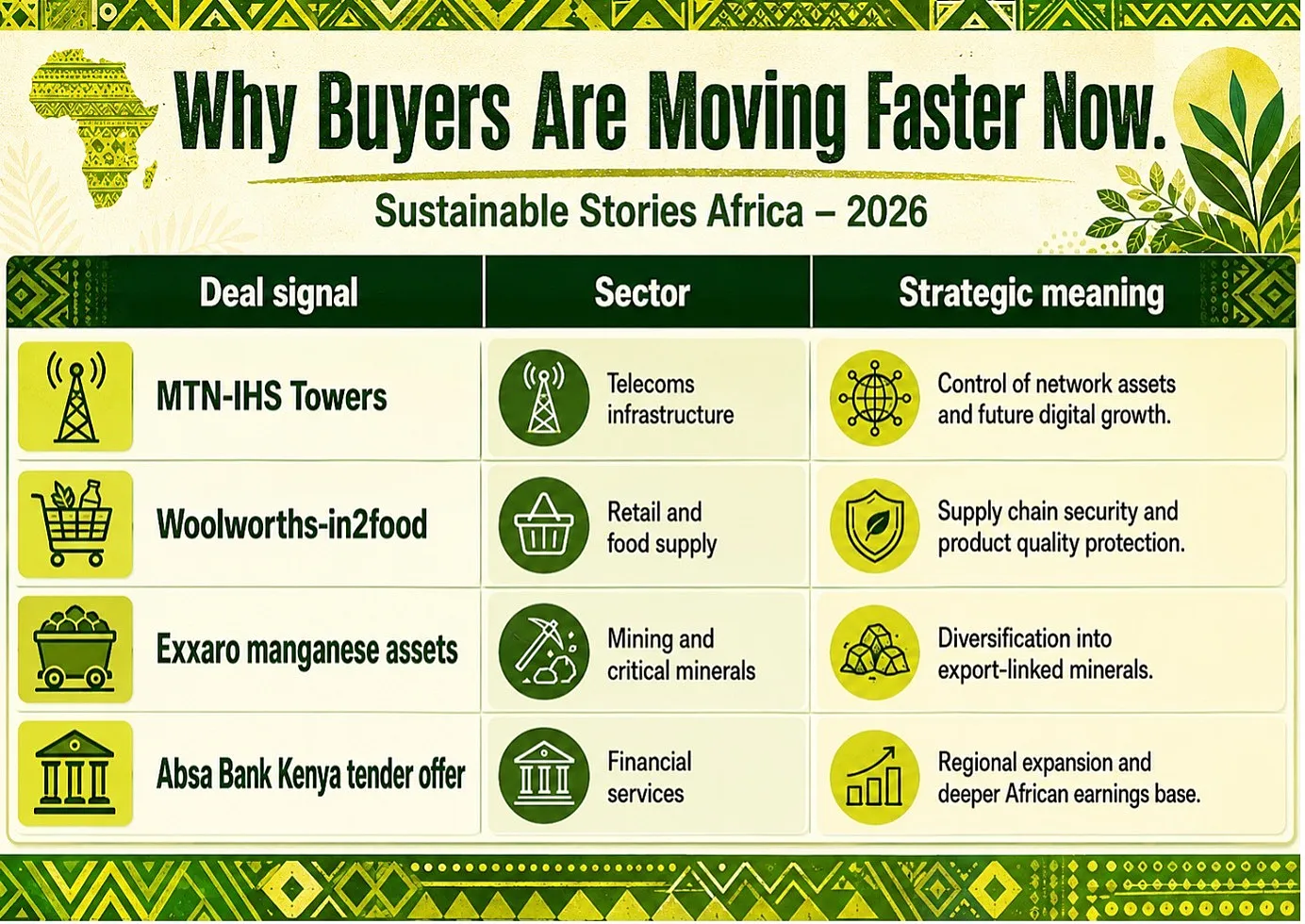
- MTN's move to take full control of IHS Towers, valued at approximately $6.2 billion, signals a broader shift in telecommunications: owning critical infrastructure reduces long-term rental costs while strengthening control over 5G and fibre expansion.
- In retail, Woolworths' acquisition of in2food prioritises supply chain resilience, protecting product standards against persistent logistics, inflation and affordability pressures.
- Mining is equally repositioning. Exxaro's manganese acquisition reflects diversification beyond legacy assets while confronting chronic rail inefficiency that forces producers onto costlier road networks.
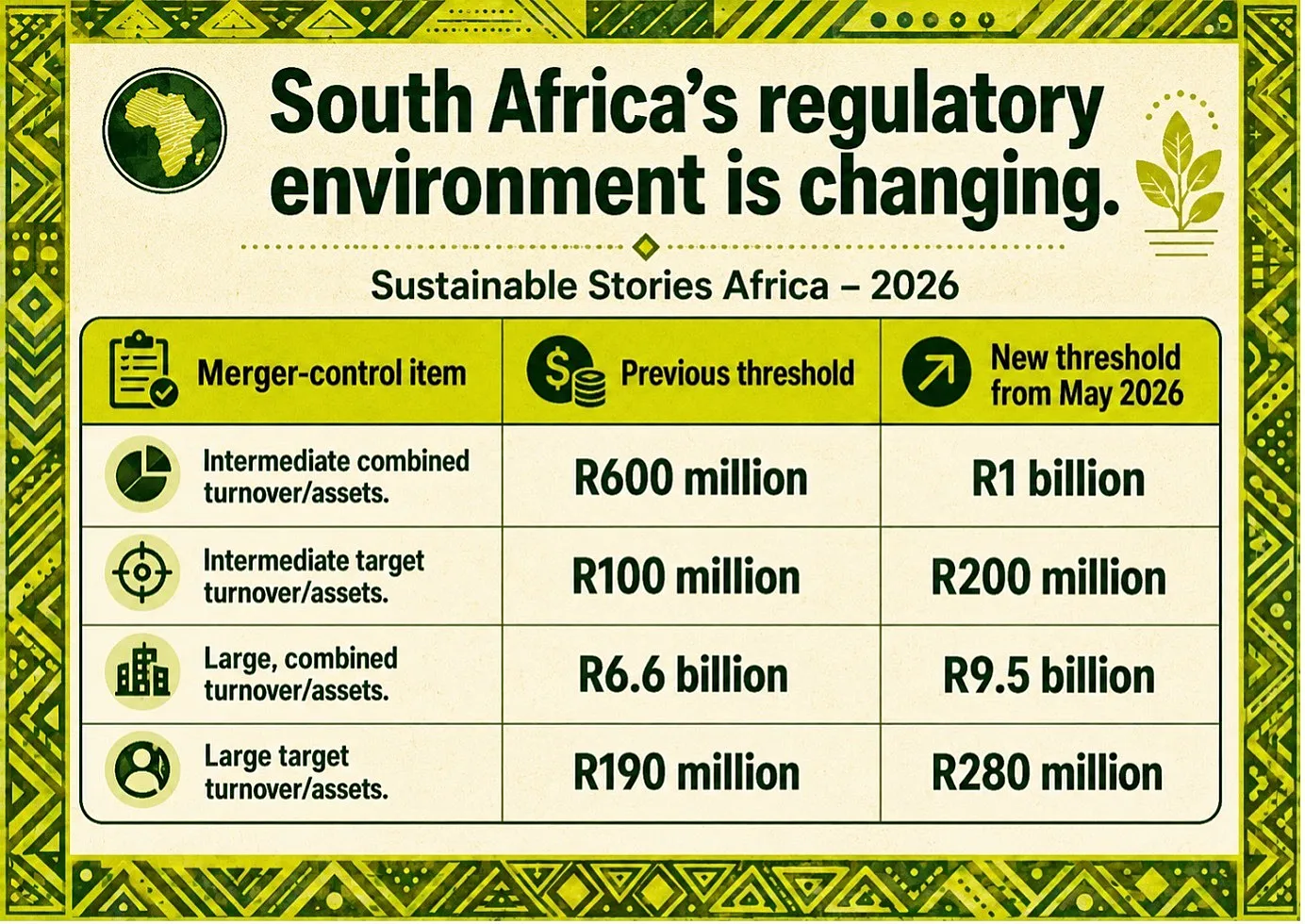
Regulatory conditions are also evolving. From May 2026, higher merger notification thresholds mean fewer mid-market deals require mandatory Competition Commission approval, potentially accelerating smaller transactions while focusing regulatory scrutiny where competition and public-interest implications are greatest.
What Smarter Consolidation Could Unlock
If managed well, South Africa’s M&A acceleration could unlock more than shareholder value.
It could strengthen corporate balance sheets, modernise infrastructure, support regional expansion and make African companies less dependent on fragmented systems.
- For a small supplier in Durban, a stronger parent company may mean more stable orders.
- For a telecoms customer in Soweto, infrastructure ownership could support better data services.
- For mine workers in the Northern Cape, a better-capitalised operator may improve investment in logistics, safety and productivity.
- For investors, a more efficient deal environment could restore confidence in South Africa as a platform for African growth.
However, the risks are real. Consolidation can reduce competition, weaken small businesses, increase market concentration and leave workers exposed if cost-cutting becomes the dominant logic.
The difference between value creation and extraction will depend on how boards, regulators and investors define success.
The best M&A outcomes will be measured not only by deal value, but also by what happens after closing: integration discipline, job protection, supplier inclusion, governance quality, climate resilience and public-interest commitments.
What Dealmakers Must Do Next
South Africa’s next M&A phase must be built on discipline. Companies pursuing acquisitions should be clear about why they are buying: cost efficiency, infrastructure control, regional scale, technology capability or long-term resilience.
Deals that lack strategic logic may destroy value in a slow-growth economy.
Regulators also have a crucial role.
- Higher thresholds can improve efficiency, but merger review must still protect competition, employment, localisation and transformation.
- Faster approval should not mean weaker scrutiny in cases where market power, public interest or essential services are involved.
Financiers and investors should demand stronger ESG-linked deal theses. Every major transaction should answer four questions:
- Will it improve productivity?
- Will it protect or create decent work?
- Will it strengthen climate and infrastructure resilience?
- Will it expand opportunities for smaller firms and communities?
For South Africa, M&A should not be treated as a narrow boardroom exercise. It is now part of the country’s economic renewal toolkit.
The challenge is to make consolidation serve competitiveness without sacrificing inclusion.
Path Forward – Make Deals Deliver Wider Market Value
South Africa’s M&A momentum should be channelled into productive investment, stronger governance and responsible consolidation.
Policymakers must keep approval processes efficient while protecting competition, workers and public interest.
The priority now is quality, not just quantity. Deals should strengthen infrastructure, deepen links to African markets, improve supply chain resilience, and advance ESG goals.
If that happens, M&A can become a bridge between private capital and sustainable economic renewal.
Culled From: M&A accelerates in South Africa