South Africa’s solar installations have surged to record levels, but the country’s factories remain largely idle.
A wave of rooftop systems and utility-scale projects has eased power shortages, yet imported panels dominate supply chains, limiting domestic job creation.
The paradox is stark: Africa’s most industrialised economy is buying clean energy technology faster than it is building it.
South Africa’s Solar Boom Leaves Factories Idle
South Africa has installed gigawatts of solar capacity in response to persistent electricity shortages; however, the expansion has failed to catalyse a robust local manufacturing base.
Industry analysts warn that without targeted industrial policy, the renewable surge risks entrenching import dependence rather than stimulating domestic production.
The country’s energy crisis, intensified by Eskom’s load shedding, drove households and firms to adopt rooftop solar at unprecedented rates.
Utility-scale projects also accelerated under government procurement programmes.
However, most photovoltaic (PV) modules and key components have been sourced from Asia, particularly China.
Record Installations, Limited Industrial Spillover
Solar capacity additions in recent years have positioned South Africa as one of Africa’s leading renewable markets.
However, local panel assembly plants have struggled to compete with cheaper imports.
Below is a summary of the imbalance:
Indicator | Solar Deployment Trend | Industrial Outcome |
|---|---|---|
Rooftop installations | Rapid growth | Minimal local content |
Utility-scale projects | Accelerating | Import-dominant supply |
Panel pricing | Falling globally | Local producers squeezed |
Employment impact | Installation jobs rise | Manufacturing jobs stagnant |
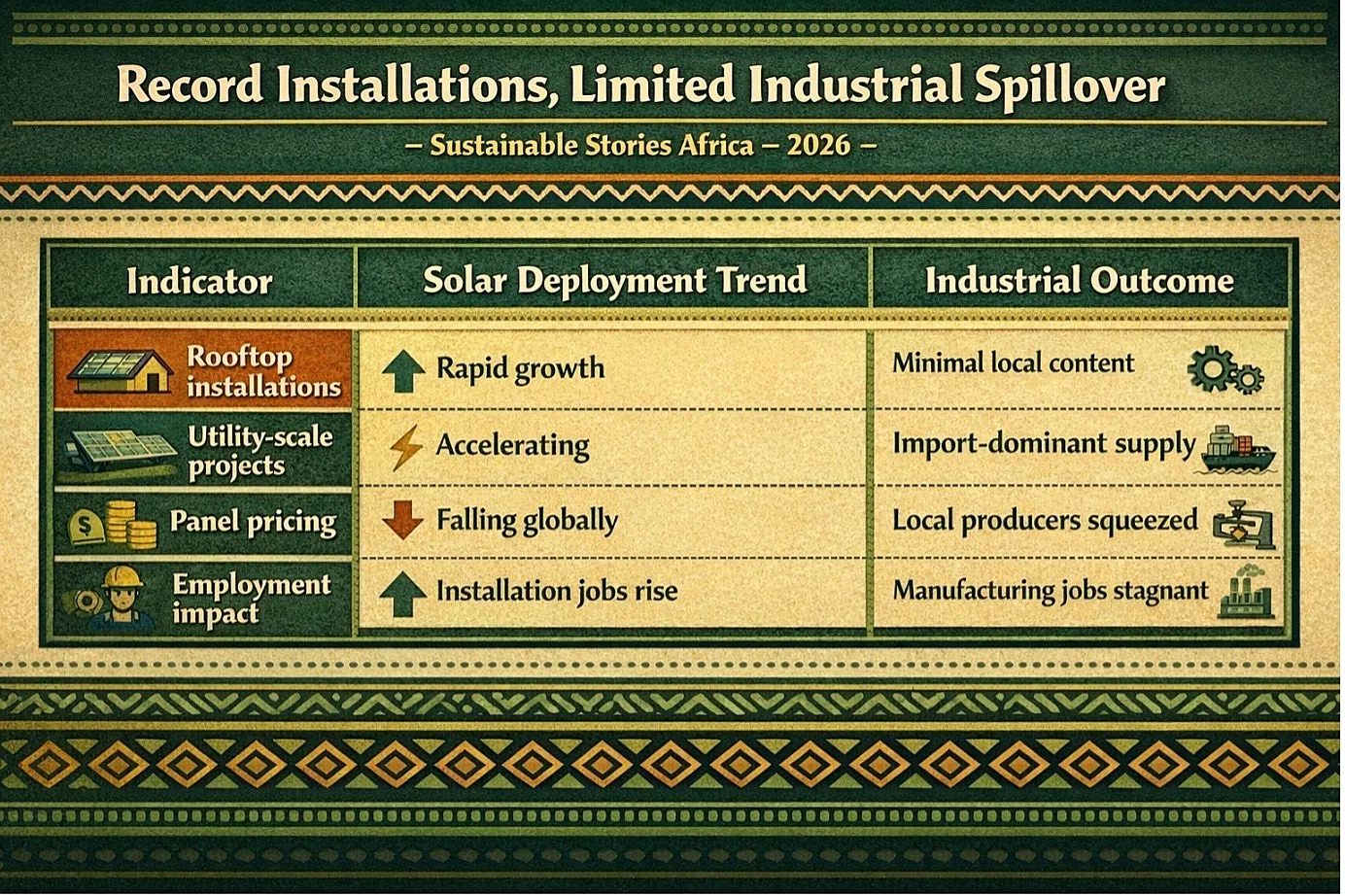
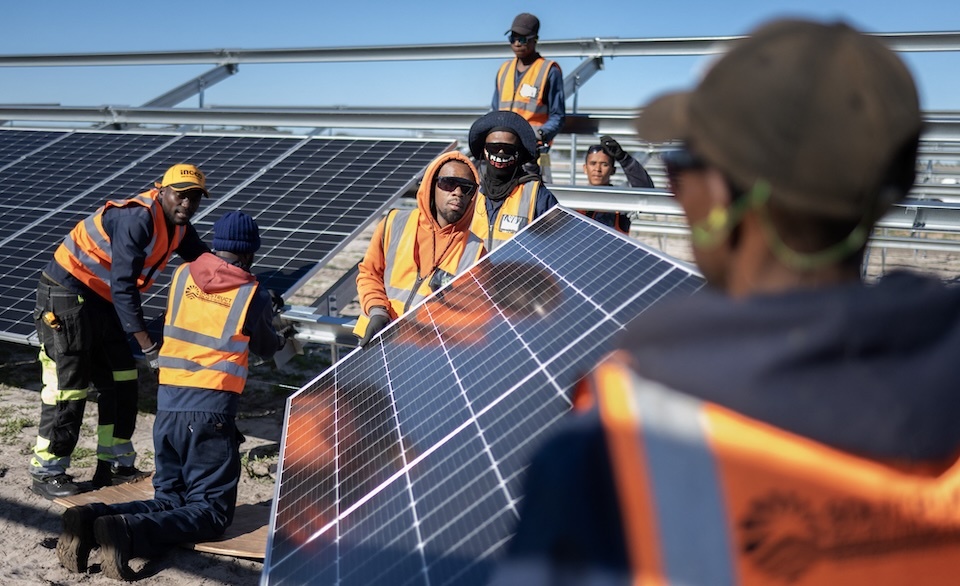
Energy analysts note that while installation and maintenance roles have expanded, high-value manufacturing, such as cell production and wafer processing, remains limited.
Cost Competitiveness Versus Policy Alignment
The price of imported solar modules has dropped sharply due to global overcapacity and economies of scale.
Domestic manufacturers argue that without protective measures or incentives, they cannot compete against international pricing.
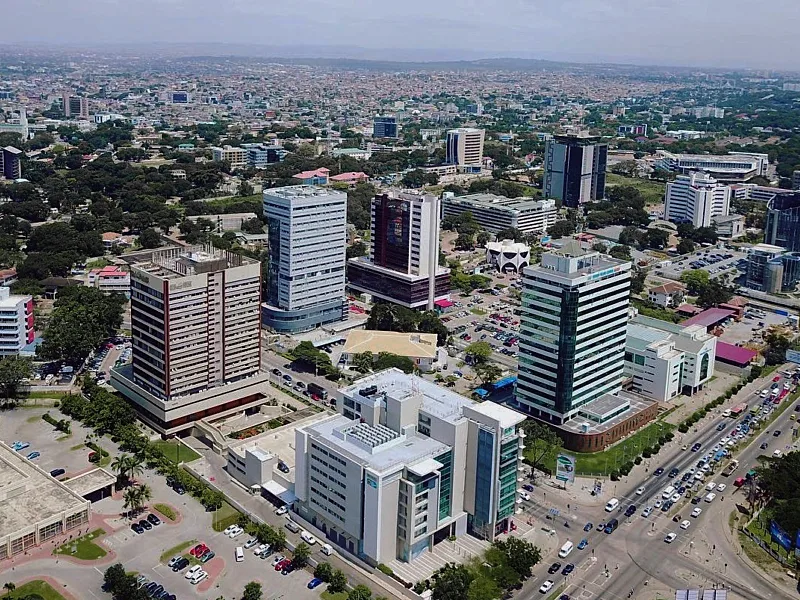
The images reflect the disconnect; installations are visible across cities and rural areas, yet local factories operate below capacity.
Industry groups say procurement frameworks have prioritised speed and affordability over industrial localisation.
While some renewable tenders included local content thresholds, enforcement and long-term certainty have been inconsistent.
Deployment Versus Domestic Manufacturing
Segment | Current Status | Structural Challenge |
|---|---|---|
PV Module Imports | Dominant market share | Price undercutting local firms |
Local Assembly Plants | Limited scale | High capital costs |
Grid Expansion | Ongoing upgrades | Infrastructure bottlenecks |
Industrial Policy | Fragmented incentives | Policy uncertainty |
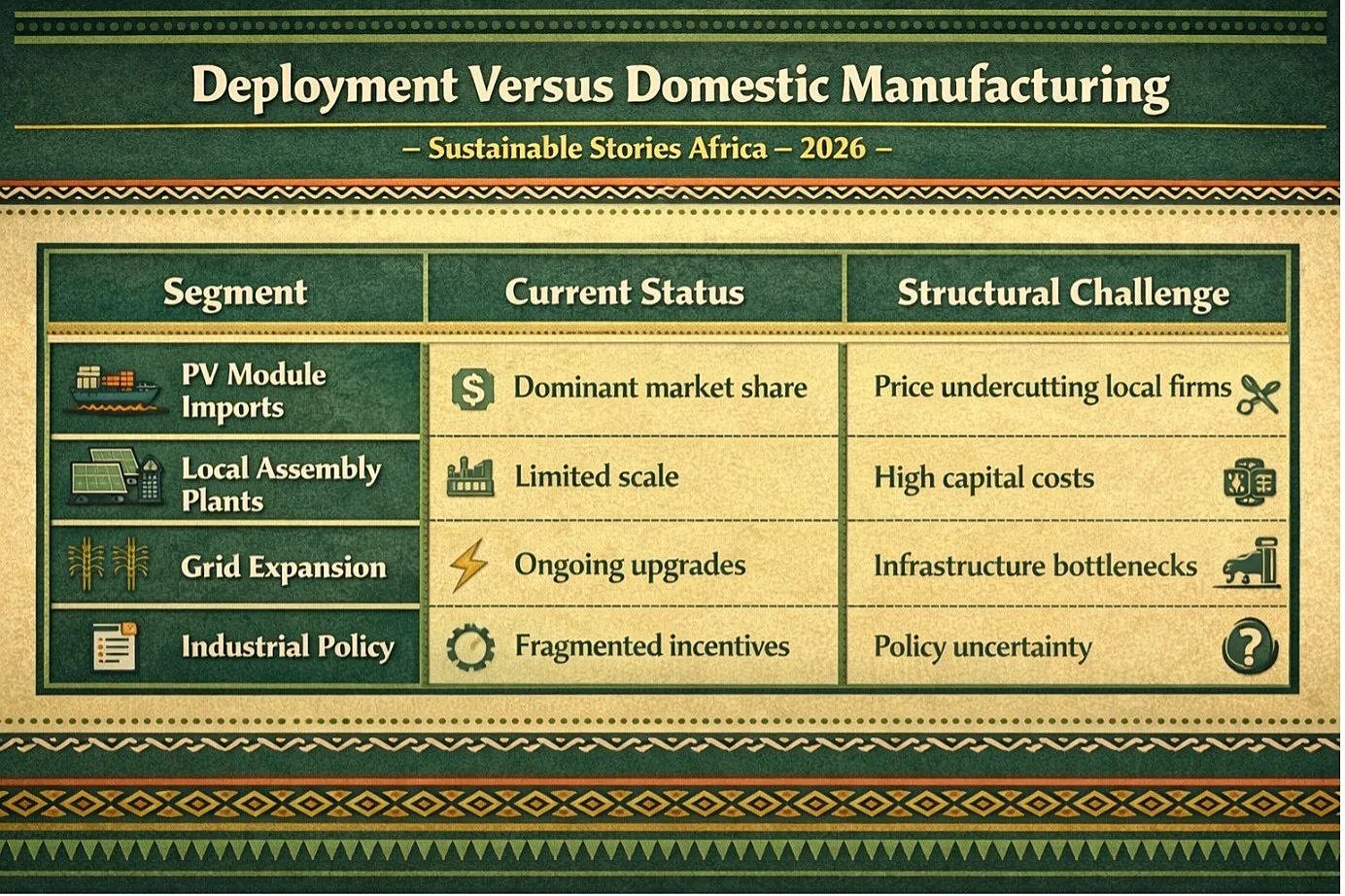
Economists caution that without alignment between energy and trade policies, South Africa risks becoming primarily an end-market rather than a production hub.
Align Energy Expansion With Industrial Strategy
Policymakers face a strategic decision: maintain low-cost imports to accelerate decarbonisation or introduce calibrated measures to nurture local industry.
Options include production tax credits, concessional financing for manufacturers, public procurement guarantees, and integration into regional value chains under the African Continental Free Trade Area.
Business leaders argue that industrialisation and decarbonisation need not be mutually exclusive.
“The opportunity is not just megawatts installed, but megawatts manufactured,”
one industry executive noted, calling for predictable policy frameworks and long-term localisation roadmaps.
Path Forward – Localise Value Chains, Stabilise Policy Signals
South Africa must synchronise renewable deployment with targeted manufacturing incentives and infrastructure upgrades.
Clear procurement rules, financing support and regional export strategies can convert solar growth into sustained industrial capacity, ensuring the energy transition builds factories as well as power plants.
Culled From: Why the SA solar boom fails to spark local industry