Sustainability is moving from voluntary corporate positioning into the systems that determine market access, financing, insurance and operational resilience.
African businesses that prepare before 2030 can turn stronger governance and environmental data into a competitive advantage.
Those that delay may face higher capital costs and restricted supply chain access.
ESG moves into everyday economics
By 2030, sustainability is likely to be less a corporate differentiator than a condition of doing business in major markets.
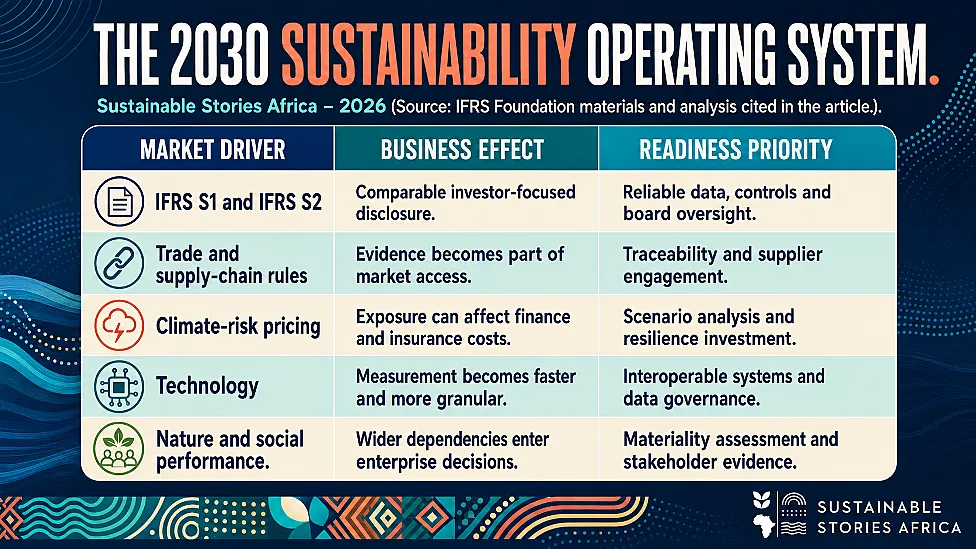
Disclosure standards, trade requirements, climate-risk pricing and investor scrutiny are moving environmental and social performance into ordinary economic decisions.
For African companies, the transition affects more than annual reports.
- Banks are assessing climate risks in lending, insurers are pricing physical exposure, buyers are asking for supply chain evidence
- Regulators are demanding more consistent sustainability-related financial information.
Businesses that treat these changes as a communications project may discover that the real work lies within procurement, capital expenditure, product design, workforce management and risk control.
Disclosure rules raise the evidence standard
The International Sustainability Standards Board’s IFRS S1 and IFRS S2 have helped establish a common investor-focused baseline for reporting sustainability-related risks and climate information.
Jurisdictions are adopting or adapting these standards at different speeds.
The commercial direction is nevertheless clear: broad commitments unsupported by reliable data are losing value.
Investors want comparable information, governance oversight, defined methodologies and evidence that material risks influence decisions.
African companies should begin by identifying the sustainability issues most likely to affect cash flows, access to finance and enterprise value.
They then need accountable owners, internal controls and data systems capable of producing information that can withstand assurance.
Climate risks are already operational
Floods, droughts, heat and coastal pressures are disrupting agriculture, transport, infrastructure and labour productivity across the continent.
These events can damage assets, interrupt supply chains, raise food and energy costs and weaken customer demand.
The economic consequences make climate adaptation part of business continuity.
- A manufacturer may need alternative water sources
- A bank may need to map borrower exposure
- A logistics company may need route redundancy
- An employer may need heat protection for workers.
Companies that incorporate these risks into asset design and investment decisions can reduce losses and recover faster.
Those who wait for disclosure deadlines may report risks accurately; however, they remain operationally unprepared.
Technology can reduce the measurement gap
Artificial intelligence, satellite data, sensors and digital platforms are making it easier to monitor emissions, land use, water, safety and supply chains.
African businesses can use these tools to build more efficient systems without reproducing every manual process used in older reporting markets.
Technology is not a substitute for governance.
- Poor definitions, weak controls or biased inputs can produce precise-looking but unreliable results.
- Boards must know which data matters, who owns it and how exceptions are investigated.
The strongest digital systems will connect sustainability measures to operational indicators such as energy cost, downtime, yield, worker safety and customer retention.
That turns reporting from a year-end exercise into a management tool.
Nature and social performance gain value
Forests, wetlands, soil and water systems are increasingly recognised as economic assets because they support agriculture, infrastructure, health and resilience.
Carbon markets and emerging nature-related frameworks are bringing parts of that value into investment analysis.
The social dimension is also becoming more material.
- Labour standards, human rights, community relations and occupational safety can affect licences, productivity, project delays and access to international buyers.
African companies should avoid a narrow carbon-only approach.
- A low-emissions project that harms communities, undermines biodiversity or lacks credible governance can still destroy value and lose investor confidence.
Early preparation creates options
Businesses do not need to predict every 2030 rule.
They need systems that can adapt: board oversight, materiality assessment, reliable data, scenario analysis, stakeholder engagement and investment criteria that account for long-term environmental and social effects.
Smaller companies can begin proportionately by focusing on the few issues most relevant to their sector and customers.
Large companies should extend controls to subsidiaries and supply chains rather than limiting work to headquarters.
Sustainability is becoming an economic operating system because it increasingly shapes who receives capital, enters supply chains, secures insurance and maintains public trust.
Preparing early gives African businesses more time to improve performance before evidence becomes a market-entry requirement.
Path Forward – Boards, Governments Must Enable Credible ESG Readiness
African companies should assign board accountability, identify material risks and build controlled sustainability data into finance and operating systems now.
Governments and industry bodies should provide proportionate guidance, digital tools, and skills support so smaller enterprises can meet emerging market requirements without prohibitive costs.