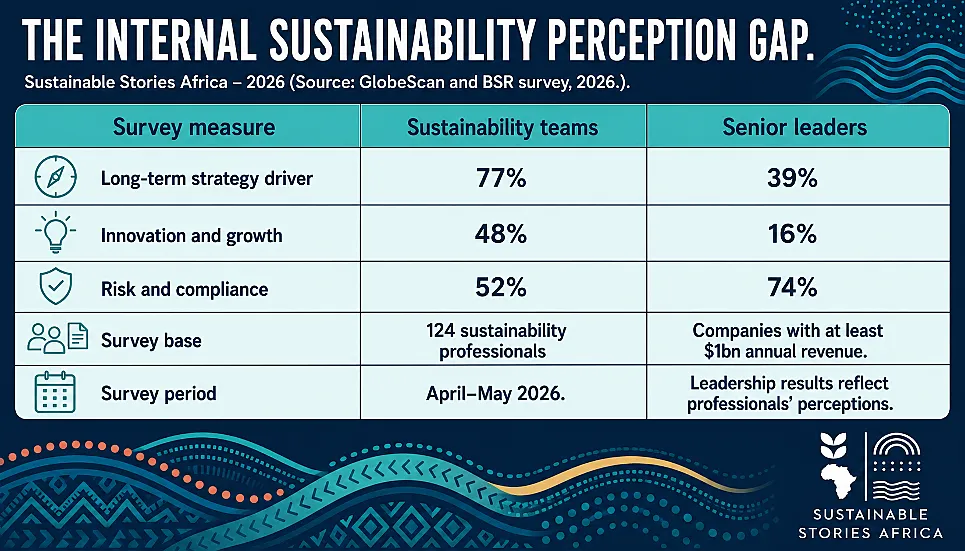
A GlobeScan and BSR survey finds a sharp perception gap inside large companies: 77% of sustainability professionals say their teams view sustainability as a driver of long-term strategy, but only 39% believe senior leaders do.
Executives are seen as more focused on risk and compliance.
Closing that divide matters because budgets, innovation and business transformation depend on leadership seeing sustainability as both protection and value creation.
One company, two sustainability stories
Corporate sustainability teams and senior executives appear to be operating with different definitions of the same agendas, according to new research from GlobeScan and BSR.
The survey of 124 sustainability professionals at companies with annual revenue of at least $1 billion found that 77% said sustainability teams viewed their work as a core driver of long-term business strategy.
Only 39% believed their senior leadership teams held the same view.
The distance was even wider around innovation and growth. 48% associated those opportunities with the sustainability function, compared with 16% who believed senior leaders did so.
By contrast, 74% said executives primarily viewed sustainability through the lens of risk management and compliance, while 52% of sustainability teams did.
Regulation has changed the conversation
The findings reflect a period in which mandatory disclosure, supply -chain rules and climate regulation have moved sustainability closer to legal, finance and audit functions.
That shift has strengthened accountability, but it may also have narrowed internal conversations to deadlines, controls and exposure.
Both groups were perceived to recognise the role of sustainability in protecting corporate reputation, giving companies a shared starting point.
The challenge is to build from reputational protection toward operational resilience, product design, market access and long-term competitiveness.
The study, conducted online in April and May 2026, records sustainability professionals’ perceptions of leadership rather than a separate survey of chief executives.
That limitation matters, but the result still points to a practical management problem: teams responsible for sustainability do not feel that the strategic case has landed at the top.
Africa cannot afford a compliance-only lens
For African companies, a narrow compliance approach could be particularly costly.
Climate exposure, energy insecurity, water stress, changing export requirements and the cost of capital already affect everyday business decisions.
- A manufacturer that treats energy efficiency only as a reporting metric may miss lower operating costs.
- A bank that sees climate only as disclosure may overlook credit concentration in vulnerable sectors.
- An exporter that waits for regulation may lose access to markets demanding traceable, lower-carbon supply chains.
The strongest sustainability teams therefore translate environmental and social performance into the language of revenue, margin, asset life, customer trust and risk-adjusted returns.
That does not weaken impact; it connects impact to the decisions that determine whether programmes receive capital.
Boards need one integrated business case
Companies should require major sustainability proposals to state both downside protection and value-creation potential.
Finance teams can test assumptions, operations can establish delivery metrics, and boards can track whether promised benefits are evident in cash flow, resilience or market access.
Senior leaders also need incentives that extend beyond annual compliance.
- Linking executive scorecards to credible transition milestones, worker outcomes and resource productivity can make sustainability part of performance management instead of a parallel reporting exercise.
The practical bridge is cross-functional ownership.
- Sustainability teams should not carry the agenda alone; business-unit leaders need responsibility for delivery and finance teams must validate claimed savings or revenue.
- Companies can use a small number of enterprise measures, including energy productivity, exposure to transition-sensitive revenue, workforce outcomes and resilient capital expenditure, rather than creating an unwieldy dashboard.
- Regular board review can then focus on decisions and trade-offs.
This approach makes sustainability visible in budgeting and strategy, where leadership commitment becomes measurable rather than rhetorical.
Path Forward – Make sustainability strategically indispensable in business
The path forward is not to choose between compliance and growth.
Good sustainability management should reduce risk while improving innovation, efficiency and competitiveness.
Boards and management teams should create a shared value map, assign financial owners and review progress alongside core strategy.
When sustainability is expressed in the language of enterprise decisions, the internal divide becomes easier to close.
Culled From: Sustainability Professionals See a Divide in How Sustainability Is Viewed Internally