A new methodology guidebook accompanying the updated Global Financial Safety Net (GFSN) Tracker, a first-of-its-kind interactive database co-produced by Boston University's Global Development Policy Centre, Freie Universität Berlin, UNCTAD, and Hochschule für Technik und Wirtschaft Berlin, confirms that global crisis finance resources stand at a staggering minimum of $4.5 trillion as of the end of 2025.
However, for most low- and middle-income countries in Africa and the Global South, this safety net remains more theoretical than real.
The Tracker, updated in January 2026, maps four distinct layers of crisis finance: own reserves, bilateral swap arrangements, regional financial arrangements, and IMF lending.
The data reveal not only how vast the system is but also how unevenly it is structured, and why that unevenness matters enormously when the next shock arrives.
When a Safety Net Has Holes, Someone Falls Through
The global economy has experienced three seismic shocks in the space of a decade: the 2015 – 16 commodity price crash, the COVID-19 pandemic, and the cascading inflationary pressures of 2022 – 24.
In each case, countries scrambled for emergency finance, and the distribution of support was profoundly unequal.
A January 2026 Methodology Guidebook published alongside the Global Financial Safety Net (GFSN) Tracker puts a number on the architecture designed to prevent such crises: at least $4.5 trillion in available resources. But architecture, as this data makes clear, is not the same as access.
The GFSN Tracker, described in the guidebook as the first global, interactive database to measure the annual lending capacity of the IMF, regional financial arrangements (RFAs), and central banks simultaneously, was co-developed by Boston University's Global Development Policy Centre, Freie Universität Berlin, UNCTAD, and Hochschule für Technik und Wirtschaft Berlin.
It represents the most comprehensive publicly available dataset of crisis finance flows since the COVID-19 pandemic began.
The Four Pillars of Crisis Finance
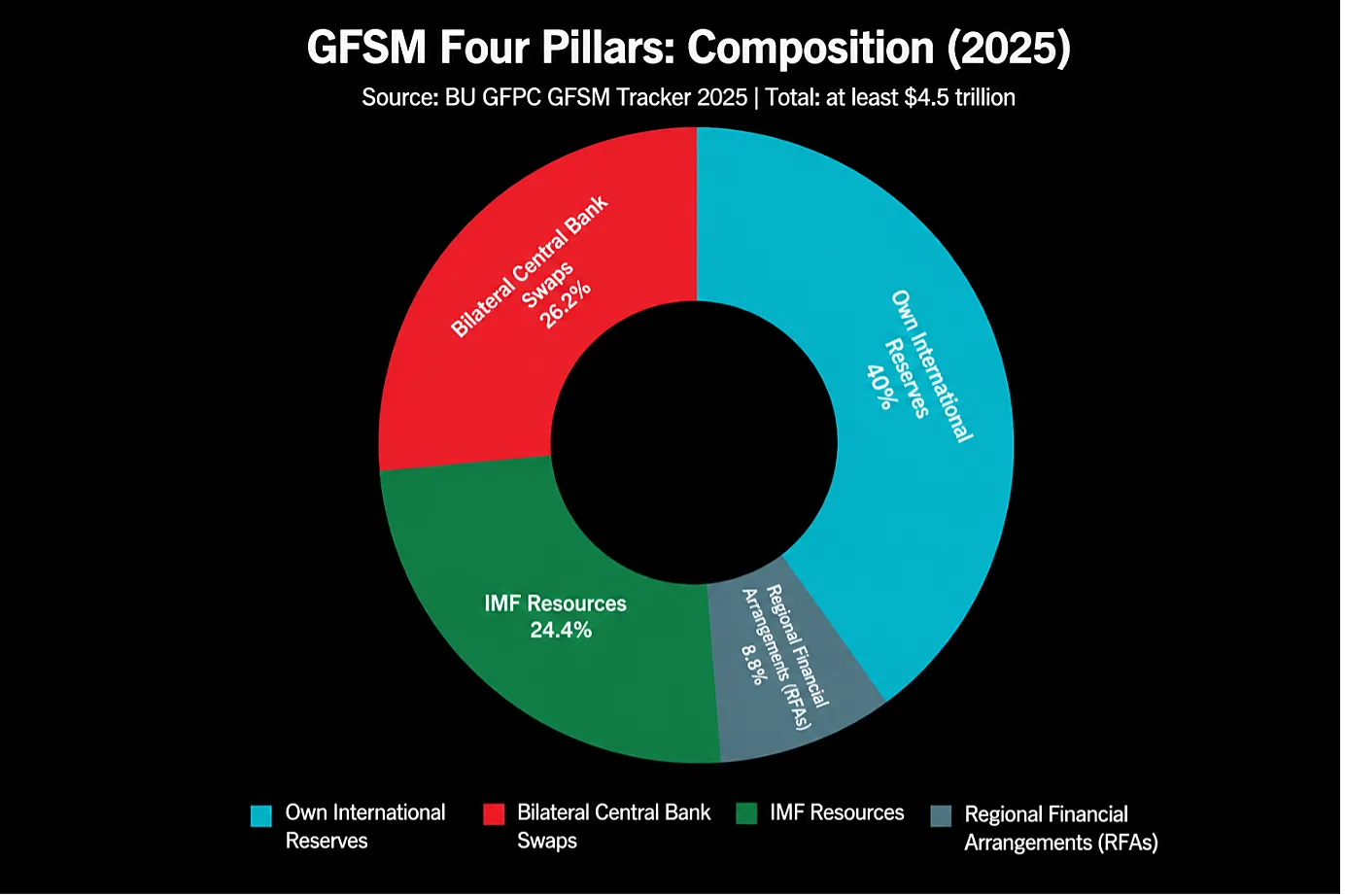
The GFSN rests on four structural pillars, each fulfilling a distinct function in the crisis finance ecosystem:
- Own international reserves — the largest pillar, representing sovereign foreign exchange buffers accumulated over time.
- Bilateral swap arrangements — agreements between central banks to exchange currencies, providing immediate liquidity in crises.
- Regional Financial Arrangements (RFAs) — pooled reserves among groups of countries, from the Arab Monetary Fund to the Chiang Mai Initiative Multilateralization.
- IMF resources and lending — the only multilateral, rules-based mechanism charged with maintaining global financial stability.
Together, these four layers create a comprehensive buffer against financial shocks. In practice, however, access to each layer depends heavily on a country's income classification, geographic location, geopolitical relationships, and IMF quota, variables that systematically disadvantage low-income and sub-Saharan African nations.
A First-of-Its-Kind Transparency Tool
The GFSN Tracker's January 2026 update is significant precisely because it closes a long-standing transparency gap. Before this tool, no single source allowed policymakers, researchers, or the public to see total annual lending capacity across all three primary sources, the IMF, RFAs, and central bank swaps, for any given country.
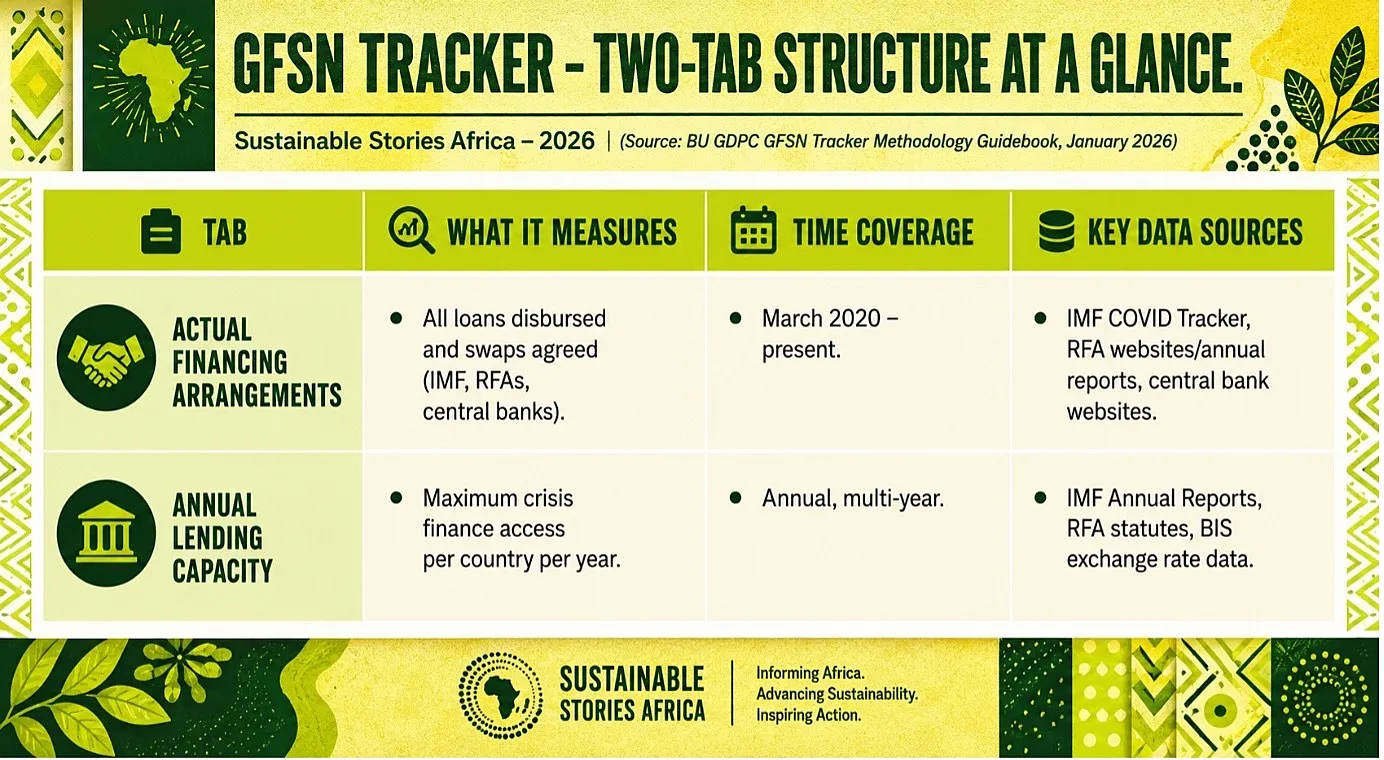
The Tracker now does exactly that, through two interactive tabs: the Actual Financing Arrangements tab, which tracks all COVID-era and post-COVID lending and swaps since March 2020, and the Annual Lending Capacity tab, which shows the maximum crisis finance a country could theoretically access in any given year.
For African policymakers and regional finance bodies, the Tracker offers a powerful diagnostic: it can show, in a single interface, whether the RFA covers a country, what its IMF access limit is, and whether its central bank holds any bilateral swap lines.
Historically, this analysis required weeks of research across dozens of sources.
Why This Data Matters for Africa Right Now
Africa enters 2026 under acute fiscal pressure. Dozens of African governments are managing debt servicing costs that consume a disproportionate share of government revenues, even as the continent faces mounting climate adaptation costs, post-pandemic health system rebuilding, and infrastructure investment deficits.
The GFSN, in theory, exists to cushion exactly these pressures. Yet most African nations are not members of any major RFA, hold limited reserves, relative to their external financing needs, and access IMF resources almost exclusively through conditional lending programmes, the most demanding and politically sensitive tier of crisis finance.
The GFSN Tracker's value to African institutions, the African Development Bank, African Export-Import Bank, and the nascent African Monetary Fund discussions within the African Union, is that it provides a data-driven baseline for understanding what Africa's access to global crisis finance actually looks like, compared to what it could look like if institutional coverage were equitable.
Making the Invisible Architecture Visible
The GFSN Tracker is a tool, but tools only matter if policymakers use them. African finance ministries, central banks, and regional economic communities should integrate the Tracker's data into their fiscal planning and crisis preparedness frameworks.
Researchers and civil society organisations should use it to hold international financial institutions accountable for the inequity in the distribution of financial resources.
International reform conversations, at the G20, the IMF Board, and within the African Union, should be anchored in this evidence.
The first step is visibility. The GFSN Tracker provides it. The next steps are political.
Path Forward – From Data to Determined Reform
The GFSN Tracker's January 2026 update is both a milestone in financial transparency and a challenge to the global community.
With at least $4.5 trillion in crisis financial resources mapped and verified, the conversation can no longer focus on whether resources exist.
It must focus on whether those resources are distributed equitably, speedily, and with genuine accessibility, especially for the African nations that need them most.