TotalEnergies has filed for authorisation of its 1.5 GW Centre Manche offshore wind project off Normandy.
The €4.5 billion project could power nearly one million French homes and support thousands of construction jobs.
For African markets, the lesson is clear: clean-energy scale depends on policy certainty, patient capital and industrial supply chains.
France’s Offshore Wind Moment Arrives
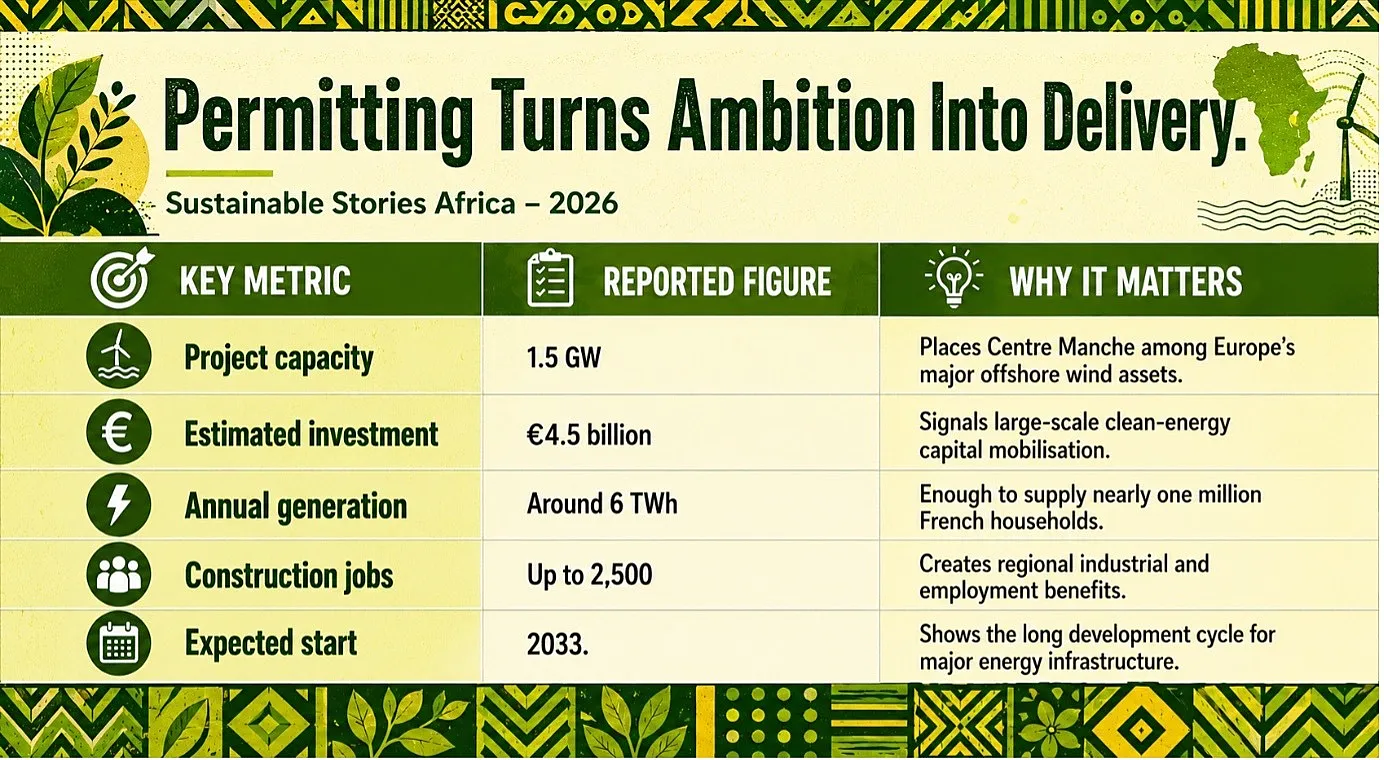
TotalEnergies has moved France’s largest renewable energy project into formal permitting, filing for authorisation of the 1.5 GW Centre Manche offshore wind farm off the coast of Normandy.
A €4.5 billion investment that could reshape the country’s clean-power pipeline.
The filing, submitted through TotalEnergies’ wholly owned project company Centre Manche Énergies, comes eight months after the French State awarded the project.
It marks a decisive step from ambition to regulation, placing environmental review, technical design, public consultation and grid planning at the centre of France’s offshore wind expansion.
The project is expected to generate around 6 terawatt-hours of electricity a year, enough to supply nearly one million French households.
During its three-year construction phase, it could employ up to 2,500 people, creating demand for engineers, port workers, technicians, suppliers and local service providers.
For Europe, Centre Manche is an energy-security project. For African markets watching from across the Mediterranean, it is a case study in how large-scale renewables move from policy target to bankable infrastructure.
Permitting Turns Ambition Into Delivery
Offshore wind is not built by announcement. It is built through seabed surveys, grid connections, marine planning, supply chain contracts, finance structures, environmental assessments and local trust.
That is why the authorisation filing matters. It brings together the project’s technical and environmental studies, preliminary designs of the wind farm and planned installation programme.
It also opens the next stage of government examination and stakeholder engagement with authorities, communities, environmental groups and maritime users.
Thierry Muller, Project Director for Centre Manche Énergies, described the filing as a “major milestone,” saying the company intends to develop a competitive project that creates value for Normandy and delivers renewable electricity to nearly one million French homes.
The location is significant. Normandy has deep maritime experience, industrial capacity and proximity to European power demand.
However, offshore wind projects also face competing ocean uses, including fishing, shipping, biodiversity protection and coastal community concerns.
The success of Centre Manche will depend not only on turbines, but on how well those interests are managed.
Clean Power Can Build Industry
The case for offshore wind extends well beyond decarbonisation. TotalEnergies' Centre Manche project in Normandy frames it plainly: renewable energy development is simultaneously climate policy, industrial strategy and jobs creation, with procurement deliberately anchored to European suppliers.
For African markets, the lesson is direct. The continent holds formidable renewable resources: Sahel solar, North African wind corridors, and coastal and highland potential across Kenya and South Africa.
However, resource endowment alone builds nothing. Bankable procurement frameworks, transmission planning, permitting capacity and local industrial participation are what convert resource maps into functioning power systems.
Centre Manche also illustrates the long horizon that complex infrastructure demands.
A final investment decision is expected around 2029, with generation beginning in the early 2030s, reflecting a hard reality: decisions made today determine electricity security a decade from now.
Well done, offshore wind delivers grid resilience and clean manufacturing clusters.
Delayed, it compounds energy costs and misses industrial opportunity.
Investors Need Certainty And Trust
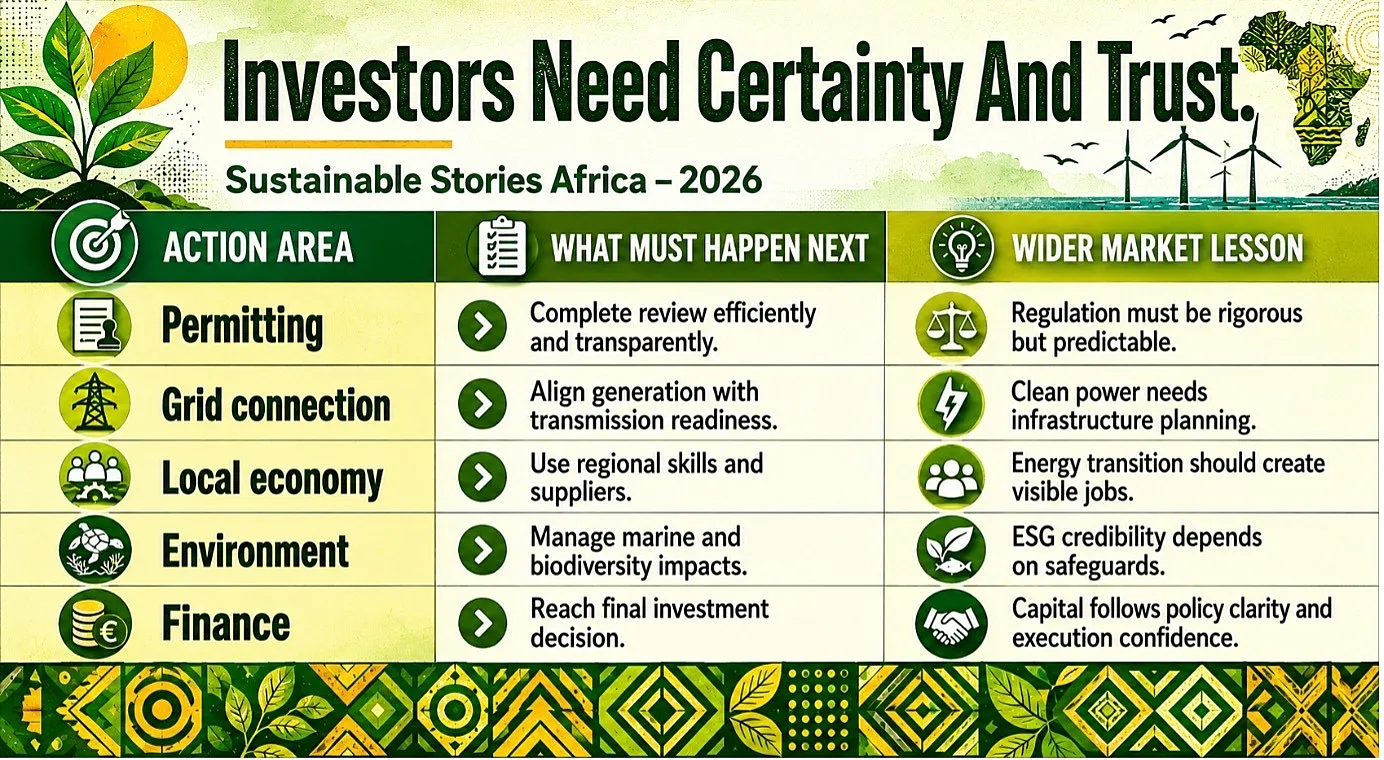
The next task is execution. TotalEnergies, the French authorities, and the regional stakeholders must now move the project through review without weakening environmental safeguards or losing momentum.
That requires clear permitting timelines, credible community engagement and transparent environmental management.
It also requires grid readiness. Offshore infrastructure is only useful at scale if power can translate from sea to households, factories and businesses.
African policymakers can draw a practical lesson from this. Renewable energy targets are not enough
Markets need institutions that can run competitive auctions, approve projects responsibly, mobilise long-term finance and connect new power to real demand.
For businesses, Centre Manche reinforces a wider point: the energy transition is becoming an infrastructure race.
Companies that understand permitting, local value creation and grid integration will shape the next generation of clean-energy markets.
Path Forward – Build Scale With Certainty And Inclusion
The path forward is disciplined delivery. Centre Manche must now prove that offshore wind can be built at scale while protecting communities, ecosystems and long-term value.
For African markets, the signal is powerful: clean-energy ambition becomes real when regulation, finance, local industry and public trust move together. That is where ESG shifts from promise to infrastructure.
Culled From: TotalEnergies Files Authorization for €4.5 Billion Centre Manche 1.5 GW Offshore Wind Project off Normandy