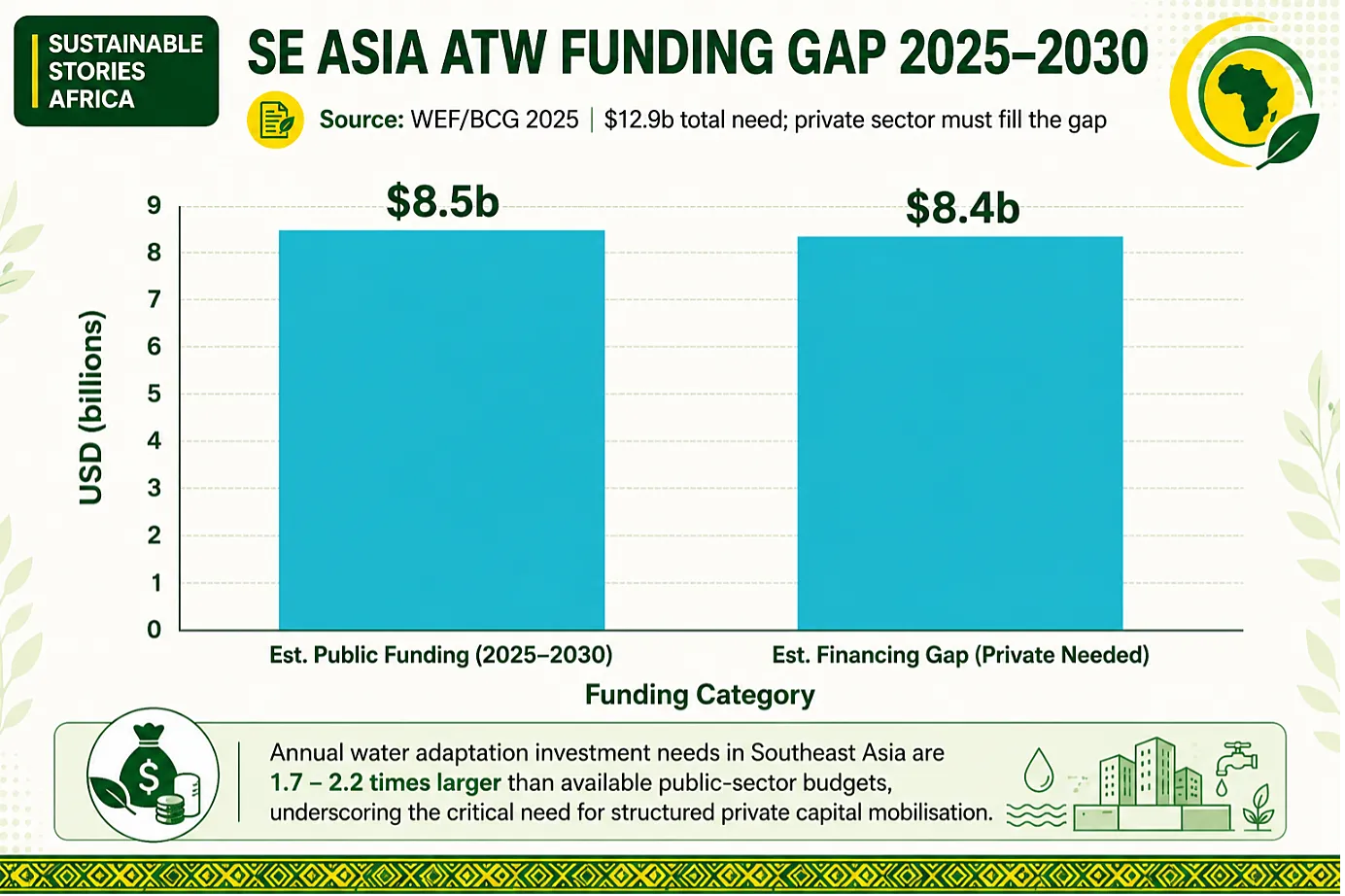
The World Economic Forum, in collaboration with the Boston Consulting Group, has released a landmark white paper warning that $6.4 billion in water-adaptation financing remains unmet in Southeast Asia through 2030, a gap that public budgets alone cannot close.
The report, published in May 2026, calls on private sector actors to move from bystanders to builders of climate resilience.
The question is no longer whether water-related climate risks are real. Floods, droughts, and rising water stress are already disrupting economies, supply chains, and communities.
The urgency now is structural: how to translate resilience value into investable, bankable opportunities that unlock private capital at scale, a lesson as critical for Africa as it is for Asia.
A Watershed Moment for Global Climate Finance
A new World Economic Forum white paper has placed water at the centre of the global climate finance debate, warning that Southeast Asia's adaptation investment needs of $12.9 billion for 2025 – 2030 far outpace available public budgets, leaving a $6.4 billion gap that only private capital can fill.
The report, Adaptation through Water: Scaling Private Sector Finance for Climate Adaptation in Southeast Asia, was developed in collaboration with Boston Consulting Group and the Singapore International Foundation, through the Southeast Asia Partnership for Adaptation through Water (SEAPAW), a multistakeholder platform launched in 2024.
A Defining Crisis – Water Risks Escalating Fast
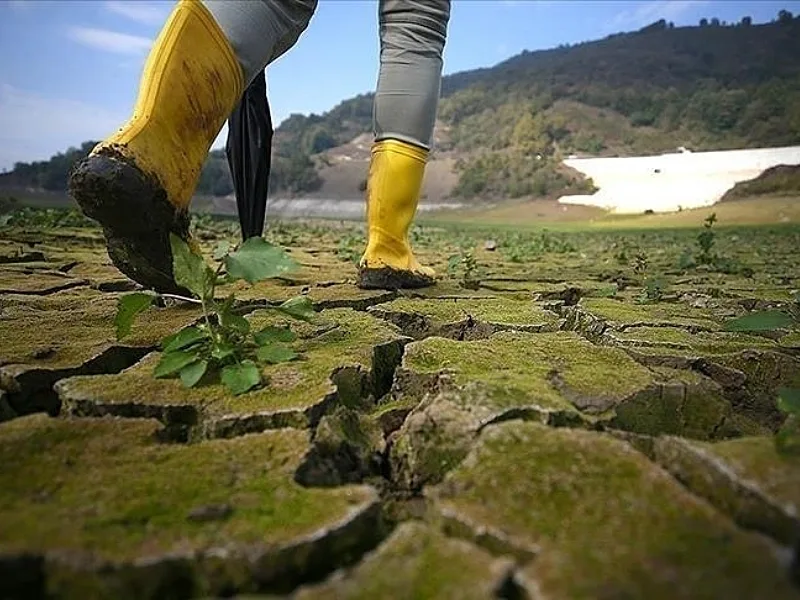
Climate change accounts for around 90% of global extreme weather events, such as floods, droughts, and intensified rainfall.
However, adaptation financing remains critically underfunded globally, with 88% of adaptation demand going unmet annually across Southeast Asia.
The WEF paper frames this not as a humanitarian deficit alone, but as a systemic financial risk: water underpins an estimated $58 trillion in annual economic value globally, making its protection a business imperative, not just a moral one.
"Water sustains communities and ecosystems globally and drives economic activity," said Eric White, Head of Climate Resilience at the World Economic Forum. "Southeast Asia is highly exposed to climate risks through its water systems, creating an urgent need to strengthen resilience through adaptation that safeguards communities and ecosystems, while supporting long-term growth and development."
The Investment Case – Strong but Structurally Blocked
Despite growing recognition of water risks, the investment case for adaptation remains structurally constrained. Private impact funds in Southeast Asia typically offer financing of only $2 – $20 million per project.
Most water adaptation interventions require system-level investment far beyond that threshold.
The problem, according to the WEF, is not a lack of solutions but a lack of structure: benefits are diffuse, revenue pathways uncertain, and risk-return profiles misaligned with commercial capital expectations.
The report identifies four key enablers needed to unlock private participation: translating resilience into financial value; aggregating fragmented projects into investable portfolios; matching risk-return profiles to different capital types; and establishing credible measurement, reporting, and verification (MRV) systems.
Underpinning all four is governance, coordinated platforms that can bridge public mandates with private incentives.
A Better Future – Resilience as a Value Creation Opportunity
When structured correctly, AtW projects deliver measurable financial and social returns.
The Blue Alliance, for instance, established a $62 million blended finance vehicle to protect 3.4 million hectares of marine ecosystems across Indonesia, the Philippines, and Tanzania, supporting the livelihood of over 48,000 people and generating reef-positive businesses with revenues above $1.2 million annually.
In Viet Nam, a national Payment for Forest Ecosystem Services programme has collected $554 million in total revenue, benefiting over 500,000 forest-owning households, by simply connecting downstream water users to the upstream conservation they depend on.
The Call to Act – Structure, Finance, Deliver
Governments must establish clear policy mandates, regulated tariff frameworks, and risk-sharing instruments that give private investors the certainty they need to participate.
Financial institutions must develop blended structures, climate adaptation bonds, concessional layers, and guarantees to crowd commercial capital into currently avoided projects.
Corporations, particularly in water-intensive sectors such as food, energy, and digital infrastructure, must internalise water risk as a material balance-sheet concern requiring proactive co-investment.
Path Forward – Water Is the New Climate Currency
The WEF's latest white paper is a call to restructure how the world finances climate resilience, with water as the primary entry point.
With the right combination of revenue mechanisms, risk-sharing structures, and governance platforms, AtW solutions can move from fragmented pilots to private-led interventions at scale.
For emerging markets, including Africa, where water stress, flood exposure, and chronic underinvestment converge, the frameworks, tools, and case studies assembled in this report offer a direct template for action.
The financing gap is real. The solutions exist. What remains is the political will and structural creativity to deploy them.