
Nearly half of US employees now say their organisation has integrated artificial intelligence, up six percentage points in one quarter.
Gallup finds that writing and research remain the most common uses, but coding, automation, presentations and analytics produce stronger reported productivity gains.
The next challenge is not access alone; it is governed, job-specific capability that workers can use confidently.
Adoption Accelerates Across Workplaces
Organisational artificial intelligence made its sharpest recent move in the second quarter of 2026.
Gallup found that 47% of US employees said their organisation had integrated AI tools to improve productivity, efficiency or quality, up from 41% in the previous quarter.
More than half of workers, 52%, use AI in their roles.
The six-point jump signals that AI is moving from individual experimentation into company systems.
However, one in five employees still does not know whether their employer has adopted AI.
That gap is a governance and communication problem: tools may be available, but policies, training and accountability are not always visible to the people expected to use them.
Common Uses Are Not Strongest
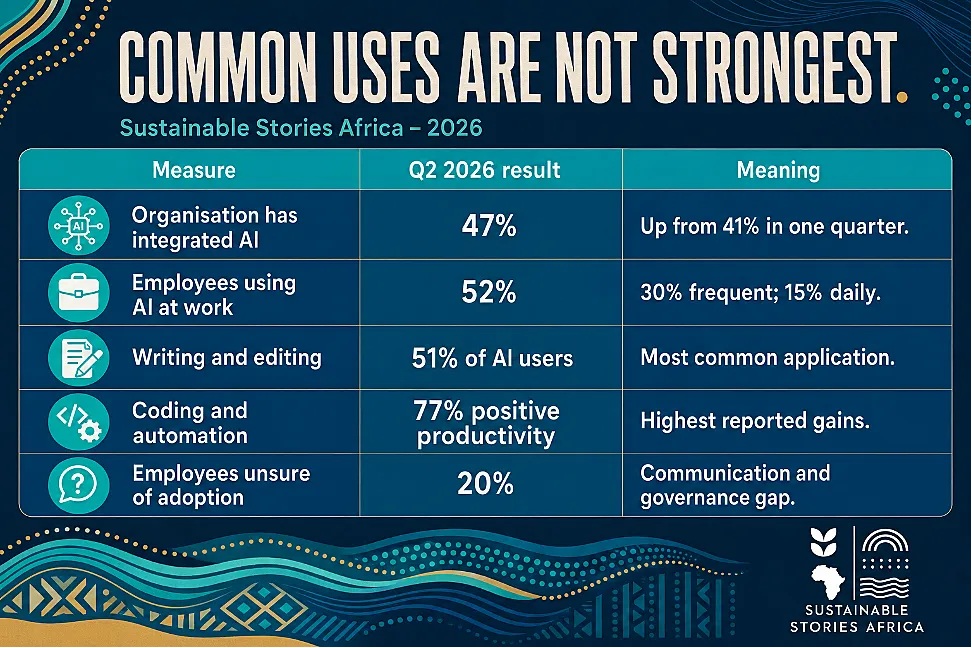
Writing and editing is the most common use among AI users, cited by 51%, followed by search or research at 49% and general assistance or problem-solving at 39%.
These are accessible entry points because they cut across roles and require systems integration.
30% of employees use AI a few times a week or more, while 15% use it daily.
Specialised applications remain less common. Data science or analytics is used by 18%, presentation creation by 17%, and coding assistance and automation by 16% each.
However, these narrower tasks are where employees report the strongest productivity effects.
77% of coding and automation users say AI has had a positive effect on productivity, followed by 76% for presentations and 75% for analytics.
Frequent users also work across a wider range of tasks.
- They are nearly three times as likely as infrequent users to apply AI to coding.
- 22% against 8%, and to automation, 21% against 8%.
- This suggests that productivity rises when workers move beyond a single chatbot habit and connect AI to repeatable work processes.
Capability Can Spread More Fairly
For employers, the opportunity is to turn scattered experimentation into an operating capability.
Clear use cases, protected data environments, human review and role-based training can help staff move from drafting texts to improving processes, analysing information and reducing administrative friction.
The lesson travels beyond the United States. African organisations often operate with tighter budgets, uneven connectivity and fewer specialist staff, making productivity tools potentially valuable but also increasing the cost of poor implementation.
Deliberate adoption can free scarce professional time; unmanaged adoption can amplify bias, expose confidential information and deepen gaps between digitally confident workers and everyone else.
Govern Tools Around Real Work
Leaders should identify high-volume tasks where accuracy can be checked, then measure time saved, quality, error rates and employee experience.
- Procurement teams should assess privacy, security, model limitations and vendor dependence.
- Workers need permission to question outputs and clear routes for reporting harm or mistakes.
- Boards should ask who benefits, who is excluded and what evidence supports productivity claims.
The goal is not the highest adoption figure. It is useful, safe and inclusive application. Organisations that pair experimentation with governance will be better placed to convert the current six-point jump into durable value.
Path Forward – Turn Experimentation Into Governed Workplace Capability
Employers should pair role-specific training with secure tools, clear accountability and measurable use cases.
Staff need transparent policies and the freedom to challenge unreliable output.
African organisations can adapt the lesson to local infrastructure, languages and labour markets.
The prize is not automation for its own sake, but more capable workers and better services.
Culled From: Organizational AI Adoption Jumps Six Points