The World Economic Forum's May 2026 white paper on water adaptation finance is ostensibly about Southeast Asia.
However, every page reads like a diagnosis of Africa's most urgent structural challenge: water systems overwhelmed by climate change, adaptation finance chronically underfunded, and private capital stuck at the sidelines because the enabling conditions don't yet exist.
Africa's water crisis is real, accelerating, and underfunded in exactly the ways the WEF identifies.
The continent has basins, communities, project opportunities, and ESG investor interest. What Africa lacks are the governance structures, MRV systems, and blended finance architectures that would make water resilience investable.
The WEF has written the playbook. Africa must now use it or pay a far steeper price later.
Africa's Water Finance Moment Has Arrived
Africa is the world's most climate-vulnerable continent, yet it receives less than 5% of global climate adaptation finance.
Water is the primary channel through which climate risks develop, including floods, droughts, water stress, and ecosystem collapse; however, the infrastructure of water adaptation finance on the continent remains fragmented, undercapitalised, and invisible to institutional investors.
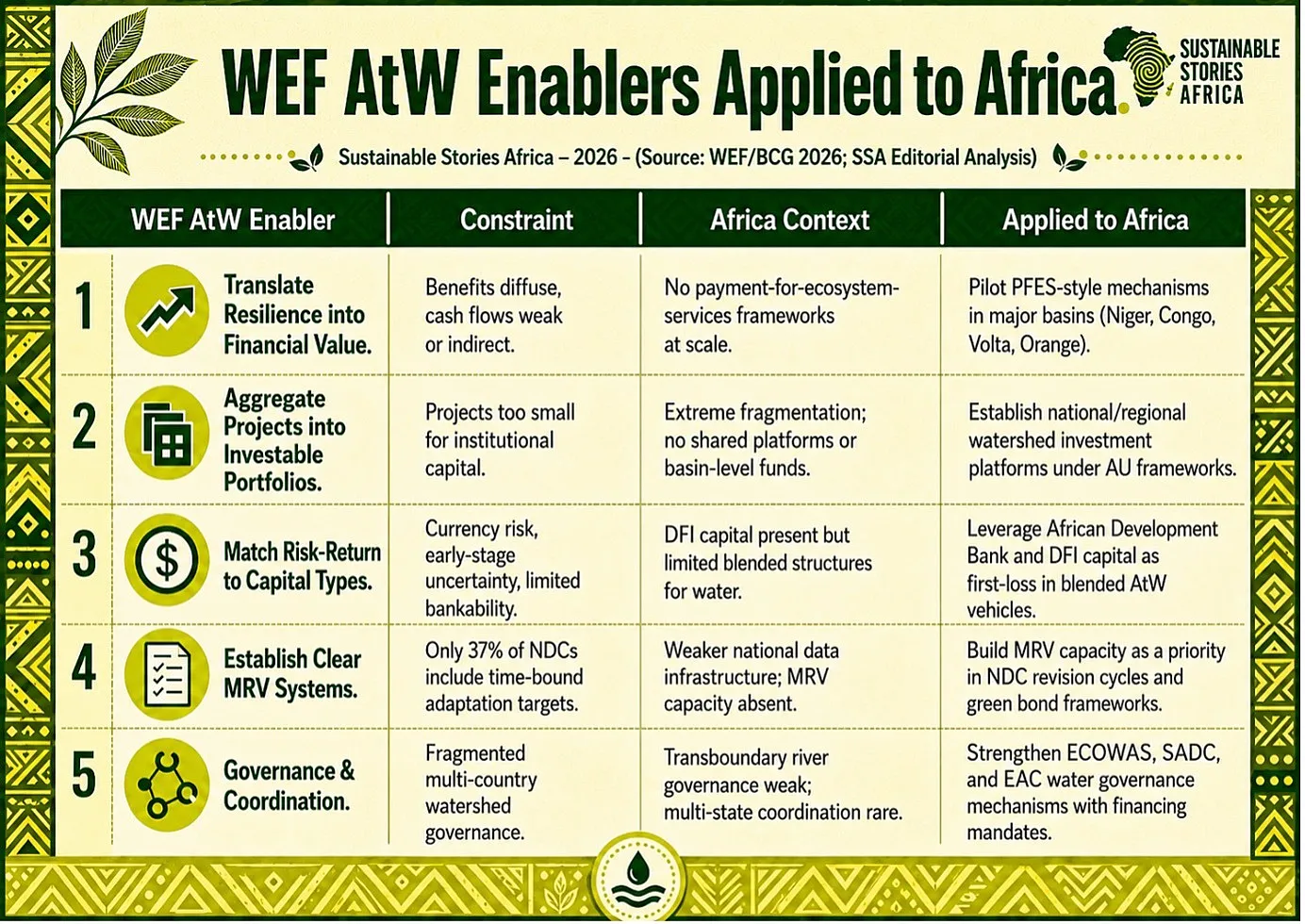
The WEF's Adaptation through Water white paper, published in May 2026, is a Southeast Asia-focused document. But its four-enabler framework, translating resilience into financial value, aggregating projects, aligning risk-return, and establishing MRV, is a universal prescription for what African water adaptation finance needs right now.
Africa Shares Southeast Asia's Water Finance Crisis and Then Some
Southeast Asia faces a $6.4 billion adaptation financing gap through 2030, with water investment needs running at 1.7–2.2 times public budget capacity. Africa's financing gap is proportionally larger and less acknowledged.
The continent accounts for a disproportionate share of flood-displaced populations and drought-affected agricultural communities; however, it receives a fraction of global climate adaptation finance.
The WEF's core argument, that "the challenge is not a lack of solutions, but the ability to structure, finance, and deliver them effectively", applies with full force to Africa.
From the Congo Basin to the Sahel, the Niger Delta to the Zambezi watershed, the solutions exist: watershed restoration, agricultural water efficiency, nature-based coastal defence, urban water reuse. What is missing is the financial architecture.
The Case Studies Africa Must Study
The WEF white paper's appendix contains six global case studies, and at least two are directly relevant to Africa, not as aspirations, but as operational templates.
The Nouakchott Coastal Resilience project in Mauritania is, strikingly, an African case study.
A €60 million ($70 million) investment, structured through a semi-public special purpose vehicle, Société d'Aménagement du Littoral de Nouakchott, deployed concessional finance from the British International Investment's Climate Innovation Facility, development bank debt, and equity from the Urban Resilience Fund managed by Meridiam.
The result: 75,000 residents protected from flooding, 12 km of dunes restored, and a cost-recovery mechanism built on land sales and lease revenues from new coastal development zones.
This model is replicable. Lagos, Accra, Dar es Salaam, Maputo, and Dakar all face accelerating coastal flood risk. All have real estate and land markets that could support land-value-capture financing.
All governments have been seeking blended finance solutions. The Nouakchott template is not a foreign lesson; it is an African proof of concept.
The Blue Alliance model, a $62 million blended vehicle that protects 3.4 million hectares of marine ecosystems and supports over 48,000 livelihoods across Indonesia, the Philippines, and Tanzania, similarly maps directly onto Africa's coastal economies.
Blue economy opportunities across East Africa, West Africa, and island states remain largely untapped by structured impact finance.
What Africa Gains If It Acts Now
If African governments and development finance institutions adopt the WEF's four-enabler framework, the potential returns are transformative.
Structured watershed payment mechanisms could unlock sustained private investment in forest protection, reducing flood risk for downstream cities while supporting rural livelihoods.
Climate adaptation bonds, modelled on AIIB's AUD 1.5 billion issuance, could be structured in African currency markets, potentially as sustainability sukuk in North Africa or as green bonds in African capital markets.
An aggregated approach to agricultural water adaptation, pooling smallholder farmers across basins into standardised resilience programmes, as Viet Nam's Mekong Delta MSVC programme did for rice farmers, could simultaneously address food security, rural incomes, water efficiency, and ESG supply chain requirements for global agri-food buyers sourcing from Africa.
The Mekong Delta programme achieved a 40% reduction in water use, a 17% increase in income, and access to European and US markets for 10,000 smallholder farmers.
The West African rice belt and East African highlands offer analogous opportunities.
Five Steps Africa Must Take Now
The WEF framework demands concrete translation. African governments, development financiers, and private sector actors should act on five immediate priorities:
- Embed water resilience metrics in NDC revisions – quantify, time-bound, and link to financial value targets.
- Establish basin-level investment platforms for Africa's major transboundary watersheds, modelled on SEAPAW, governed through the African Union and regional economic communities.
- Deploy first-loss DFI capital to catalyse private investment in water adaptation, specifically through African Development Bank, IFC, and bilateral DFI facilities.
- Issue green/blue bonds with water-resilience use-of-proceeds across African capital markets, learning from Malaysia's Sustainability Sukuk and Singapore's PUB green bonds.
- Build national MRV infrastructure – data platforms, independent verification bodies, and catchment monitoring systems, as a prerequisite for performance-based water finance.
Path Forward – Africa's Water Adaptation Moment Is Now
The WEF has done the analytical work. The case studies prove the models. The financing tools exist.
What remains is African ownership, governments willing to build the governance frameworks, institutions ready to structure the deals, and a private sector prepared to see water resilience as a business opportunity, not a charity.
Africa cannot afford to wait for the next decade of climate shocks to force this conversation. The blueprint is written. The moment is now.