A global survey of Norges Bank Investment Management's investee companies in 2025 found that while 48% of companies consider nature risks financially material "already today", only about 20% believe investors currently assess how these risks affect forecasted cash flows or cost of capital.
The gap between knowing and disclosing is not merely a reporting failure — it is a systemic financial governance crisis.
For Africa, where economies are most exposed to the physical risks of nature degradation while simultaneously holding the least mature nature-risk disclosure frameworks, this crisis is not distant.
It is unfolding right now, in every quarterly earnings report that fails to account for water stress, soil depletion or biodiversity loss.
The Disclosure Gap Is a Governance Emergency
There is a moment in every major financial risk evolution, climate, cyber, pandemic, when the evidence becomes undeniable enough to shift from voluntary best practice to regulatory obligation. For nature-related financial risk, that moment is arriving faster than most African institutions are prepared for.
The June 2025 Oxford-TNFD evidence review is unambiguous: nature-related risks are financially material, investor-relevant and already creating measurable losses across sectors. The report confirms that 70% of investor respondents consider biodiversity risks at least moderately financially material.
- It confirms that companies with large biodiversity footprints have already seen stock value declines following regulatory announcements.
- It confirms that liability risks from environmental pollution are generating billion-dollar settlements.
However, only one in three environmental risks can currently be quantified in financial terms by large corporations.
Small and medium enterprises remain even more distant: only one in ten of their risks carries a financial value.
In African boardrooms, where nature risk assessment frameworks remain at their earliest stages, the gap between material exposure and disclosed risk is even wider. This must change.
The Evidence Is No Longer Ambiguous
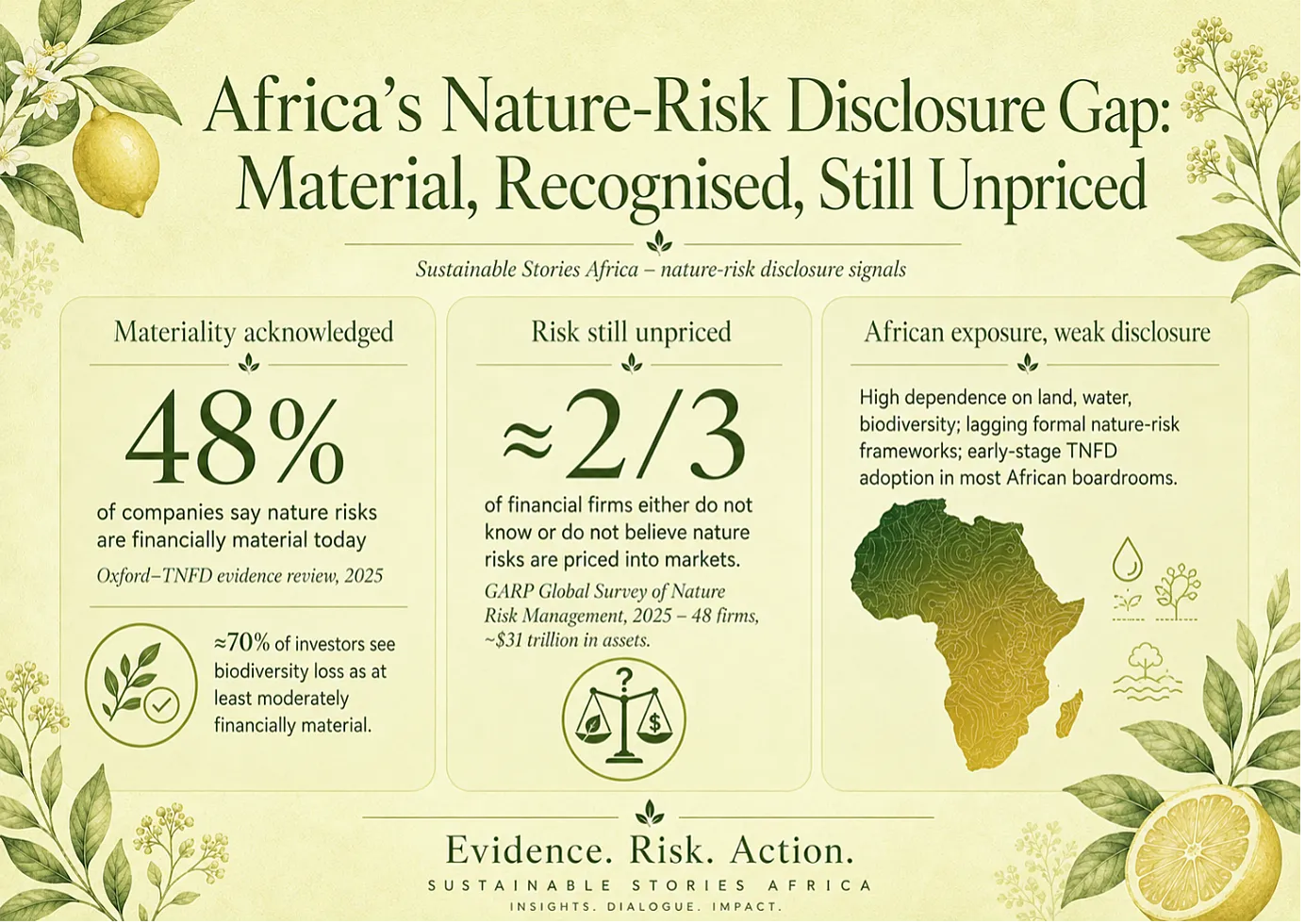
The GARP 2025 Global Survey of Nature Risk Management at Financial Firms captures both the progress and the paralysis. Of 48 financial institutions surveyed, representing $31 trillion in balance sheet assets, 42% have identified nature-related risks or opportunities, up from 25% in 2024.
The proportion of companies assessing these risks within risk management functions has doubled in a single year.
However, here is the critical problem: while nearly three-quarters now regard nature loss as a risk, two-thirds either do not know or do not believe that physical and transition nature risks are currently priced in the market.
This is not financial sophistication; it is financial avoidance. Unpriced risk does not disappear.
It accumulates, compounds and eventually reprices violently, the same lesson learned from climate, from sub-prime mortgage risk and from pandemic exposure.
The Methods Gap Is as Large as the Disclosure Gap
The Oxford-TNFD interviews with five global corporates and financial institutions reveal a striking divergence in capability between financial institutions and corporations.
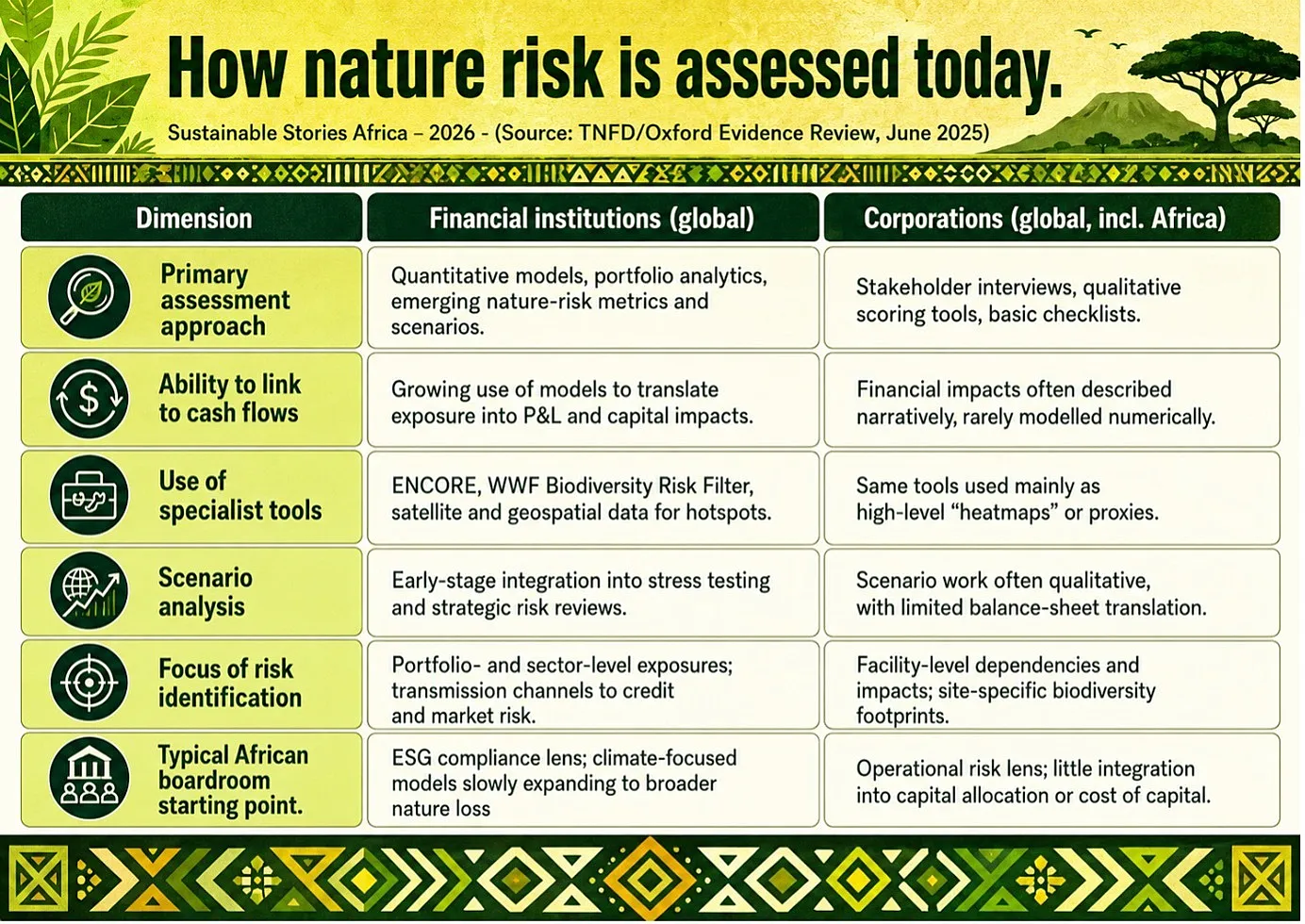
- Financial institutions are generally more advanced in applying quantitative methods to assess nature-related financial materiality.
- Corporations, by contrast, tend to rely on stakeholder interviews and qualitative scoring tools.
Even where more sophisticated approaches are used, such as scenario analysis, corporates frequently estimate financial implications qualitatively, without the rigour needed to influence capital allocation or strategy.
Tools like ENCORE, Global Forest Watch and the WWF Biodiversity Risk Filter are used, but often as proxies rather than as the basis for full causal-chain analysis linking nature dependencies to financial outcomes.
The TNFD-GRI case study evidence shows that corporates are better at identifying where nature risks originate, particularly how their own dependencies and impacts on nature create risks, than financial institutions, which often rely on portfolio-level heatmaps that cannot capture company-specific nuances.
For African businesses, operating in ecosystems that are simultaneously among the world's most biodiverse and most degraded, the stakes of this methods gap are disproportionately high.
- A South African mining company, a Nigerian agribusiness, a Kenyan energy utility, each sits at the centre of measurable, documented nature dependencies.
However, few have deployed the frameworks to translate those dependencies into balance-sheet risk assessments.
What Leadership on Nature Disclosure Would Deliver
African companies that move first on nature risk disclosure will not merely satisfy incoming regulatory requirements. They will:
- Lower their cost of capital as investors reward transparency and risk management rigour
- Attract long-term institutional capital from the 200 financial institutions managing $23 trillion that have signed the Finance for Biodiversity Pledge
- Build supply chain resilience by proactively identifying nature dependencies before they become operational crises
- Shape global standards by providing the African case studies and evidence that the global database currently lacks
- Establish competitive advantage in sectors where environmental liability and reputational risk are becoming mainstream investor screening criteria
The alternative, continued silence in sustainability reports, continued underpricing of nature risk, is not neutral. It is an active choice to absorb preventable losses.
A Five-Point Agenda for African Disclosure Leadership
Opinion without an agenda is merely commentary. Here is what must happen:
- African securities regulators – including the Securities and Exchange Commission of Nigeria, the Financial Sector Conduct Authority of South Africa and the Capital Markets Authority of Kenya must initiate formal consultations on mandatory nature-risk disclosure, aligned with TNFD recommendations and the Kunming-Montreal GBF Target 15
- African stock exchanges – which have made progress on ESG listing requirements, must include nature-related financial risk disclosure in their next generation of sustainability reporting requirements
- Corporate boards must mandate that risk committees integrate nature risk alongside climate risk in annual materiality assessments, with TNFD's LEAP approach adopted as the minimum standard
- Development Finance Institutions operating across Africa, including AfDB, IFC and the Development Bank of Southern Africa, must require nature-risk assessments as a condition of lending to high-exposure sectors
- African ESG researchers and journalism platforms, including Sustainable Stories Africa, must build the regional evidence base that currently constrains informed investor and policy decision-making on nature risk
Path Forward – Africa Must Write Its Own Nature Risk Story
Disclosure Is Not a Burden; It Is a Lever
The evidence review is explicit: omitting, misstating or obscuring nature-related risk information could reasonably be expected to influence investor decisions.
In the language of securities law, that is the threshold for material disclosure. African institutions do not need to wait for international regulators to set the pace.
The continent faces some of the world's highest concentrations of nature-related financial risk, holds some of the world's most critical biodiversity, and stands to gain the most from early, credible leadership on nature-risk disclosure.
The time to act is not at the next regulatory cycle. It is now.