Research from the Diligent Institute reveals that public company directors rate current risk levels at 6.8 out of 10, highlighting deep concerns, but they are not always prepared.
Across African boardrooms, the gap between risk awareness and operational readiness is even sharper, with governance blind spots compounded by talent shortages and regulatory fragmentation.
Boardroom resilience in 2026 is not about reacting to shocks. It is about building organisations that can see risk coming and respond with agility.
Africa's boards, from Lagos to Johannesburg, must make this transition now, or remain perpetually behind the curve.
African Boards Must Lead, Not Lag
The global business environment has never demanded more from boards.
Over the past decade, geopolitical realignments, AI advances, supply chain fragility, armed conflicts and a global pandemic have collectively entrenched uncertainty as a structural, rather than a temporary feature of the operating environment.
In Africa, these pressures are layered over existing structural vulnerabilities: infrastructure deficits, currency instability, regulatory inconsistency and governance gaps that make organisational resilience both more difficult to achieve and more critical to maintain.
However, the continent's boards, overseeing financial institutions, telecoms, energy companies, public entities and development agencies, remain among the least resourced and least equipped for the complexity ahead.
This is not a neutral observation. Boards that fail to build integrated resilience frameworks are not merely underperforming; they are creating systemic risk for their organisations, their stakeholders, and the communities they serve.
Risk Is Rising, Preparedness Is Not
Public company directors globally rate current organisational risk at 6.8 out of 10, a "deeply concerned" outlook, per the Diligent Institute.
More troublingly, research points to a widening gap between risk awareness and preparedness, with skill shortages and governance blind spots leaving organisations exposed.
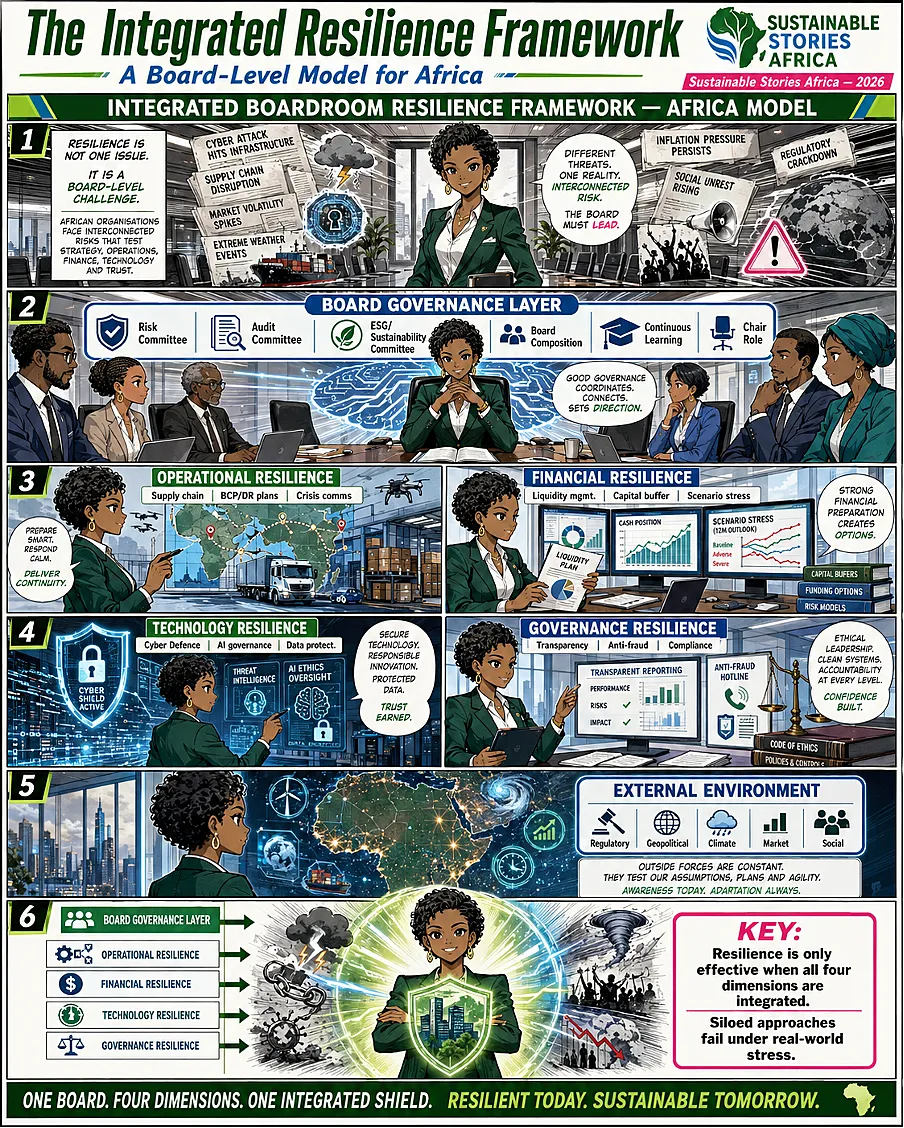
The World Economic Forum's Global Risks Report 2026 is unambiguous: traditional, siloed approaches to risk management are no longer sufficient.
Resilience must be embedded holistically across property, infrastructure, operations and governance, rather than parcelled out to departmental silos.
For African organisations, where boards frequently operate with fewer resources, less specialist expertise and thinner capital buffers, the implications are acute.
A cyber-attack, governance failure, climate event or geopolitical shock that an internationally resilient organisation absorbs can be existential for an African counterpart that has not invested in integrated resilience.
What the Data Reveals About Board Preparedness
A 2025 Deloitte survey of senior leaders paints a revealing picture of global board priorities.
- Geopolitical and economic volatility topped the list at 55%.
- Security and cybersecurity came second at 50%.
- Rapid technological change and digital disruption were cited by 42%.
- Human capital concerns ranked fourth, at 41%.
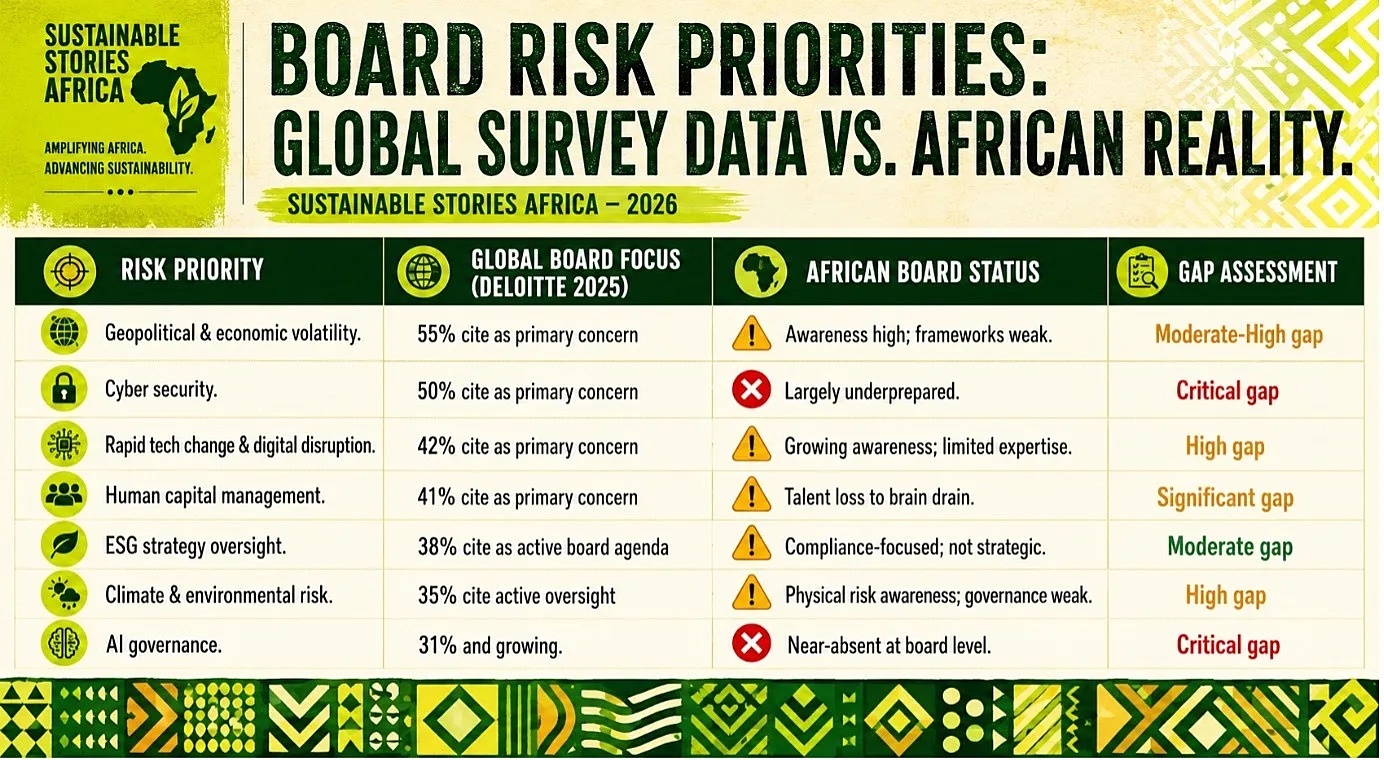
When asked whether organisations had sufficient resources to build long-term resilience, confidence was highest in financial capacity, but notably lower for technology capability and human capital.
This gap is even more pronounced across African markets, where talent pipelines for cybersecurity, AI governance and risk analytics are thin, and board composition rarely reflects the depth of technical expertise the moment demands.
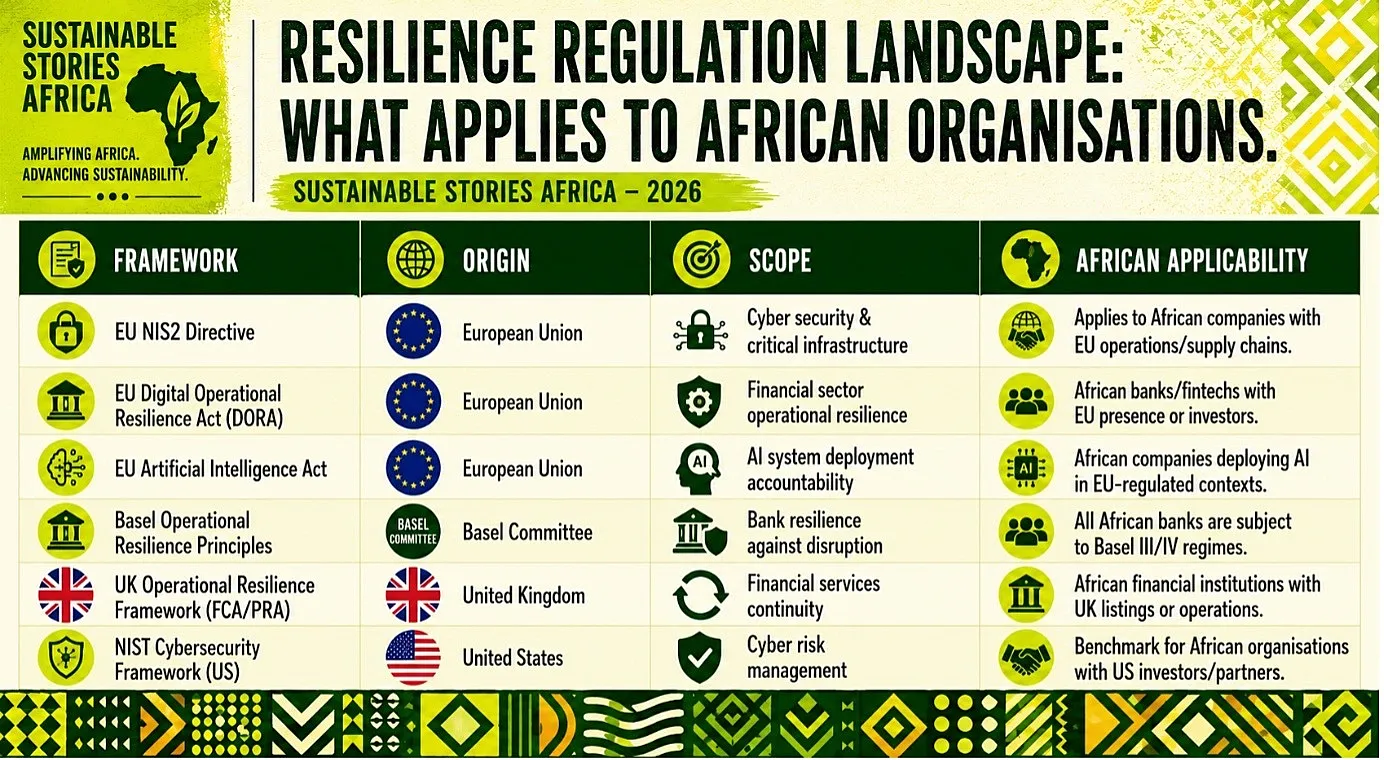
The regulatory environment is also tightening globally.
- The EU's NIS2 Directive
- The Digital Operational Resilience Act
- The EU Artificial Intelligence Act
- Basel Operational Resilience Principles
These regulations are each raising the bar for governance, cybersecurity and operational continuity.
While these are primarily European frameworks, their extraterritorial reach, through multinational supply chains, cross-listed companies and investor ESG requirements, is bringing African organisations within their scope whether they are ready or not.
Notably, 86% of Deloitte survey respondents reported increased board activity in monitoring risk and overseeing resilience strategies, with 39% describing this increase as significant.
African boards must move in the same direction, not as followers, but as proactive architects of resilience for their specific operating context.
Resilience as Competitive Advantage
The argument for boardroom resilience is not only defensive. Organisations that build genuine, integrated resilience capabilities are better positioned to attract investment, access better financing terms, retain talent, and sustain stakeholder trust through periods of volatility.
For African companies seeking international capital, institutional-grade governance and resilience frameworks are increasingly table-stakes.
ESG-aligned investors, whose mandates require evidence of robust governance, operational continuity planning and risk oversight, are systematically favouring companies that can demonstrate board-level resilience infrastructure.
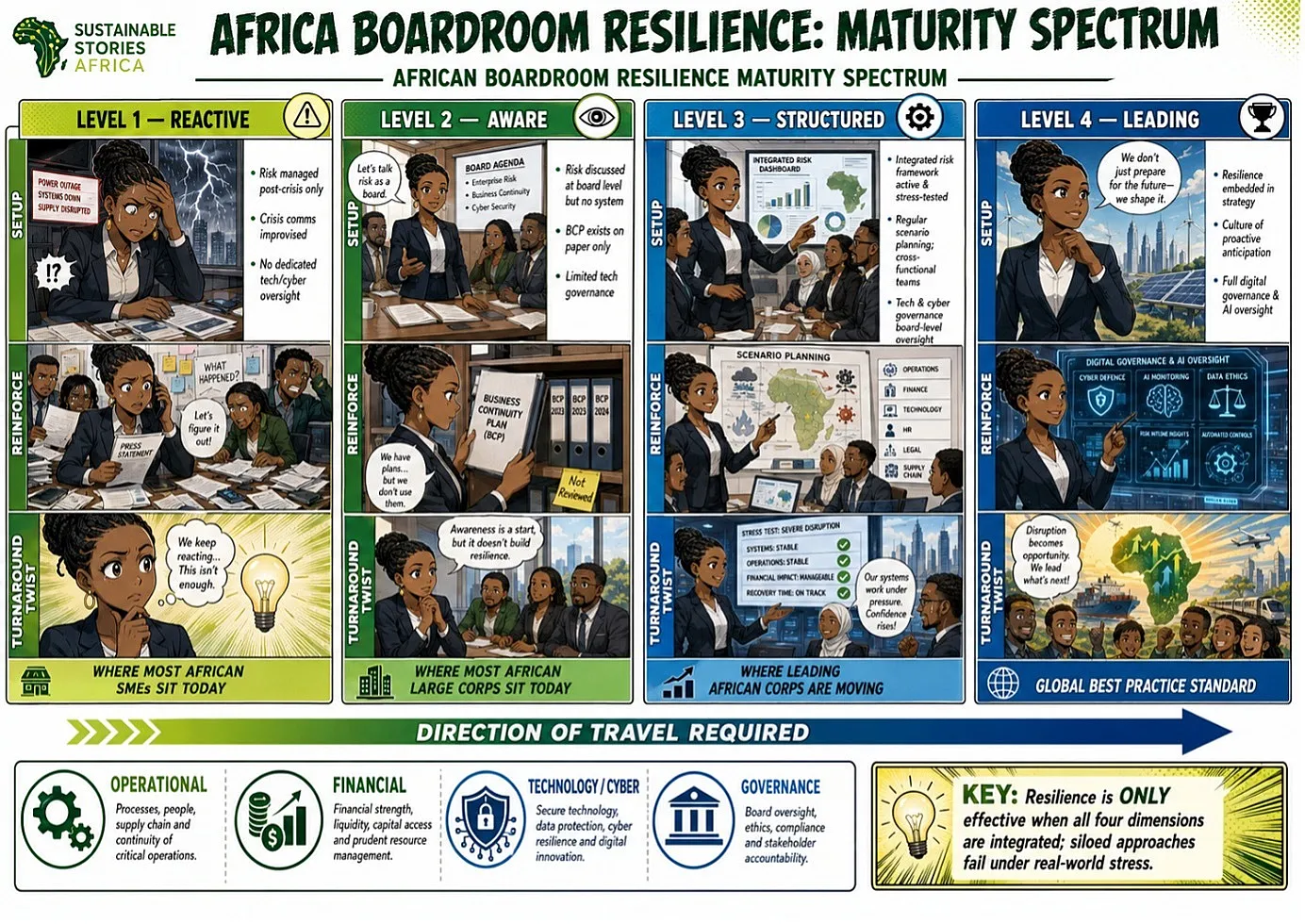
The competitive advantage is real.
African financial institutions with strong operational resilience frameworks, clear business continuity plans, cybersecurity governance, board-level risk reporting and scenario-planning capability are beginning to differentiate themselves in international capital markets.
This is particularly visible in the banking sector, where Basel III and emerging Basel IV requirements are prompting leading African banks to invest significantly in resilience infrastructure.
A resilient board also makes better decisions under pressure, which is precisely when decisions matter most.
The ability to act decisively during a crisis, maintain stakeholder communication and protect core operations depends on resilience investments made before the crisis arrives.
A Practical Agenda for African Boards
The recommendations for African boards are concrete and achievable:
- Conduct cross-disciplinary board risk reviews. Move beyond audit committee silos to enterprise-wide resilience assessments that examine cyber, climate, supply chain, regulatory and reputational risk in an integrated framework.
- Invest in board composition and continuous education. Technology, cyber risk and AI governance must be represented at the board level, not just at the executive tier. Boards that invest in continuous learning are better equipped to challenge management and interpret complex risk information.
- Build crisis communication frameworks. The ability to respond credibly and rapidly during a crisis — managing media, regulators, employees and investors simultaneously — must be rehearsed, not improvised. Scenario planning and crisis simulation are non-negotiable investments.
- Embrace board management technology. Digital platforms for board operations, information security and governance processes are now widely available. African organisations should prioritise their adoption.
- Engage ESG as a resilience tool. Environmental, social and governance integration is not separate from operational resilience — it is its foundation. Boards that understand this connection will make better long-term decisions.
PATH FORWARD – Resilience Is Africa's Governance Opportunity
Africa's boards are not defined by their current limitations. They are defined by the choices they make in this moment.
The governance frameworks, capacity investments and leadership culture required to build resilient organisations are available; the question is whether boards will act with the urgency the risk environment demands.
Resilience is not just a defensive posture. It is Africa's boardroom opportunity to lead with credibility in the decade ahead.