The global push to integrate compliance and voluntary carbon credit markets, as argued in a landmark May 2026 Brookings Institution brief, carries a quiet but urgent message for Africa.
The continent's vast natural capital and emerging economies sit on an enormous, largely untapped carbon asset.
However, without governance reform, infrastructure investment, and decisive policy alignment, that asset will continue to be extracted on other people's terms.
For African policymakers, regulators, and communities, this is not a North American debate. It is Africa's own.
Carbon Markets: Africa's Defining Moment
Carbon credit markets are no longer a niche instrument reserved for rich-country climate policy negotiations. In May 2026, researchers at the Brookings Institution published a detailed policy brief arguing that compliance and voluntary carbon markets across North America are "unnecessarily fragmented in ways that make them less efficient, less transparent, and less reliable."
Their prescription, common governance, shared infrastructure, and stronger quality standards, is a call to action that resonates far beyond Washington and Sacramento.
For Africa, a continent that holds an estimated 600 billion tonnes of carbon stored in forests, savannahs, wetlands, and soils, the stakes could not be higher.
The continent contributes less than 4% of global greenhouse gas emissions; however, it bears the most acute climate costs.
As richer nations debate how to harmonise their carbon markets, African nations risk remaining peripheral suppliers in a system designed and governed elsewhere.
This piece argues that Africa must not wait for North America or Europe to set the rules of a game in which it holds some of the most valuable pieces.
The moment to build an African carbon market architecture, credible, transparent, ESG-grounded, and community-anchored, is now.
A Continent Rich in Carbon, Poor in Market Power – Africa has the assets. What it lacks is the architecture.
Africa's position in global carbon markets represents one of the sharpest contradictions in climate finance.
The continent holds the Congo Basin, the world's second-largest tropical rainforest; however, it barely registers in formal voluntary carbon credit issuance data.
Meanwhile, at least 24 government-administered carbon crediting programmes operate globally, with North American companies alone retiring nearly 48 million credits in 2025 from U.S.-based mitigation projects, according to the International Carbon Action Partnership's 2025 status report.
The inequity runs deeper than economics. Africa is the world's climate creditor, contributing least to the crisis while absorbing its heaviest consequences; however, it earns a fraction of what its natural systems are worth in an increasingly financialised carbon economy.
Independent programmes such as Verra, Gold Standard and Plan Vivo operate on the continent but remain headquartered in Europe and North America, with methodological standards shaped by Northern regulatory contexts.
This is a governance failure as much as a market failure, and one that African nations, institutions and civil society must treat as an urgent infrastructure priority.
The Stakes Are Rising Fast – The world is moving. Africa's window is narrowing.
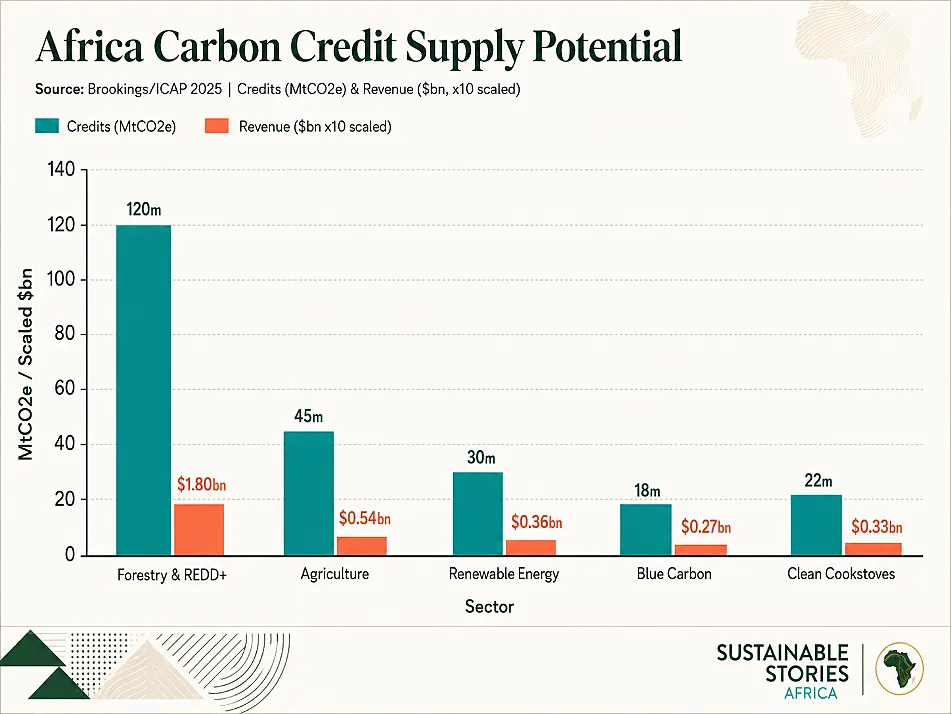
Africa's voluntary carbon market potential is substantial but structurally unrealised. The continent's forestry, agriculture, blue carbon and clean energy sectors could conservatively supply more than 235 million tonnes of CO2-equivalent credits annually, with revenue potential exceeding $3 billion per year at modest carbon prices.
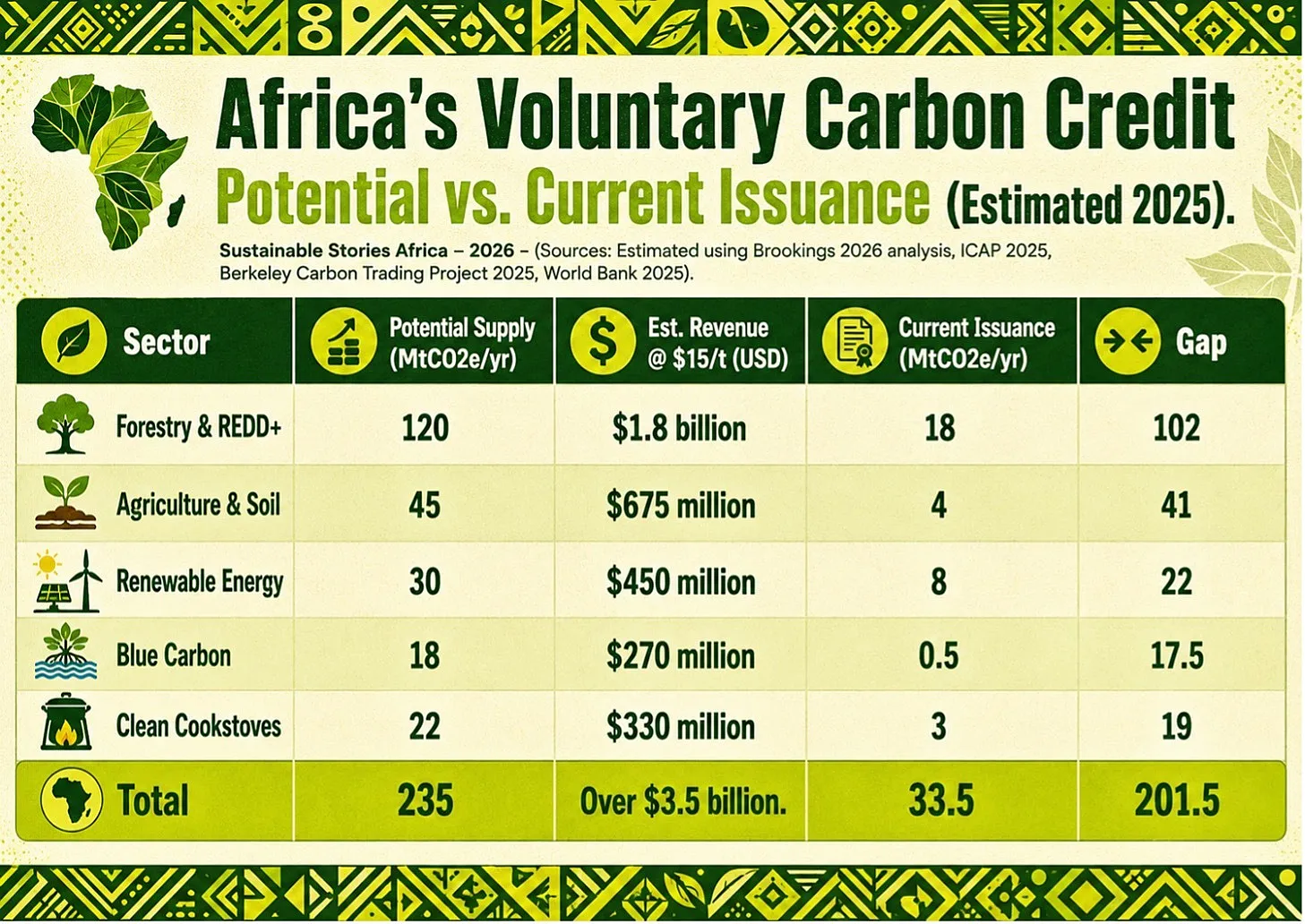
However, fragmented governance, marked by inconsistent verification standards, absence of harmonised registry systems and limited institutional capacity, prevents much of this potential from reaching the market.
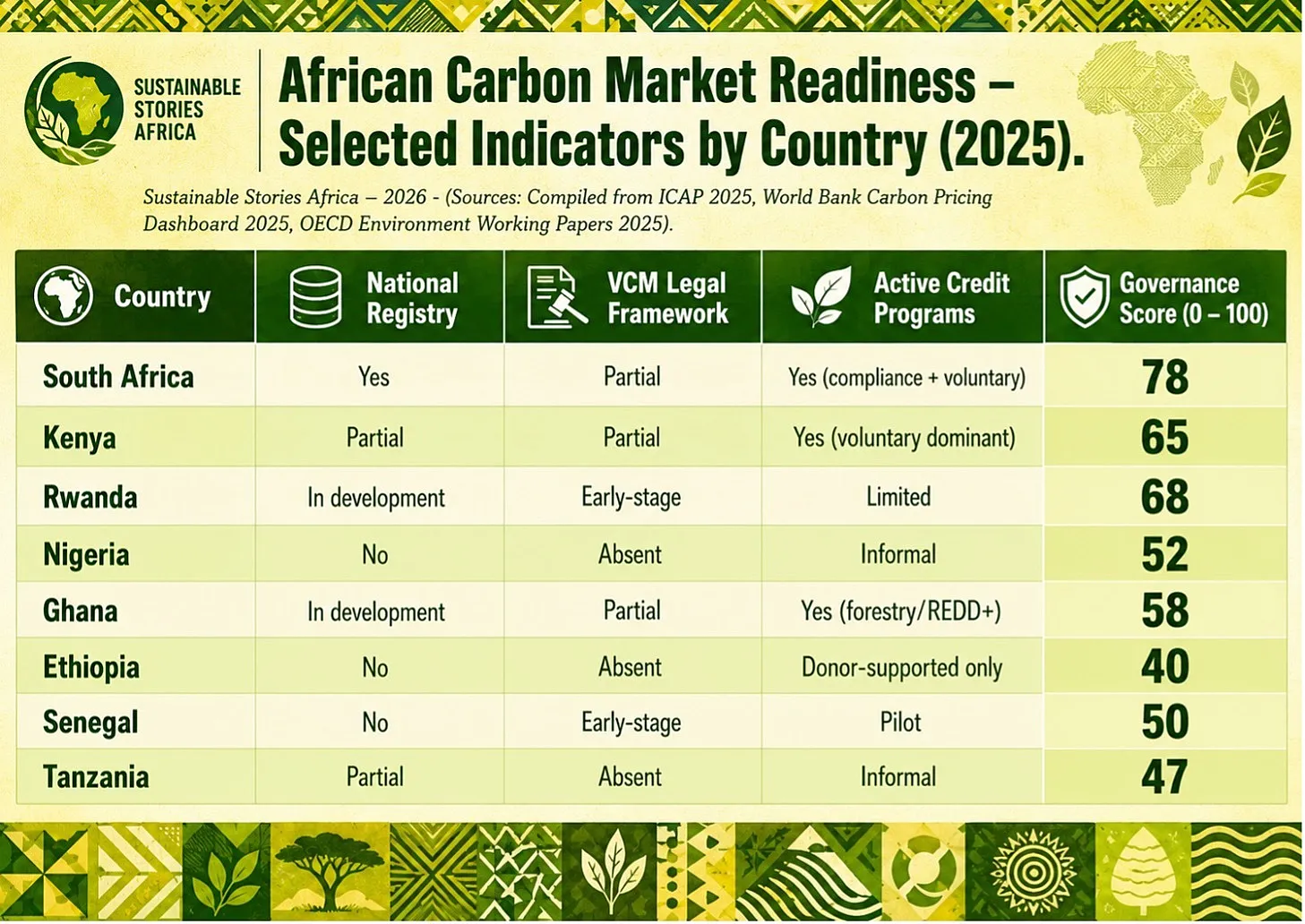
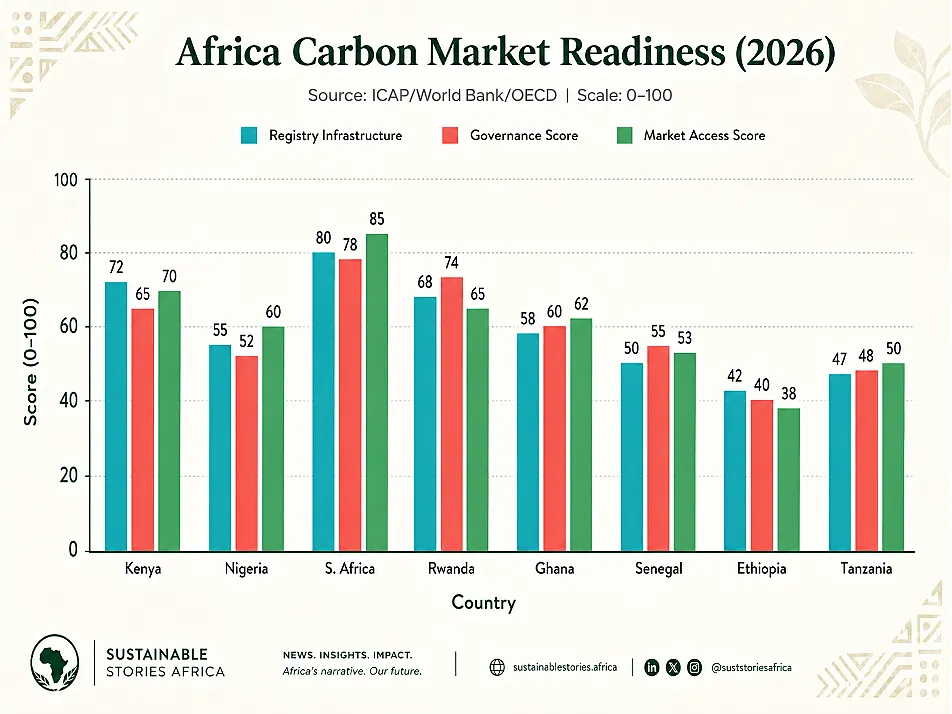
Country-level progress is uneven.
- South Africa leads on governance infrastructure and operates an emissions trading scheme, though it remains largely domestically focused.
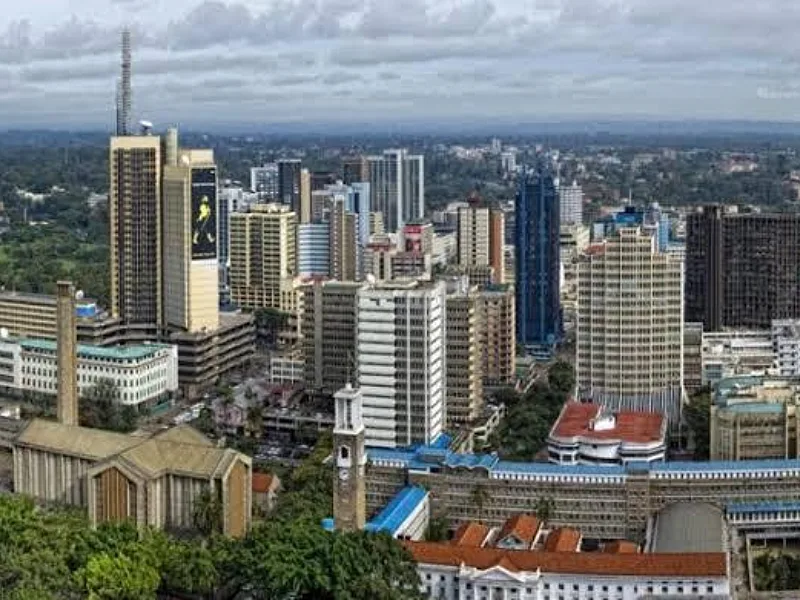
- Kenya maintains an active project pipeline in forestry and clean cookstoves; however, it struggles with registry interoperability.
- Rwanda is building institutional capacity but lacks the scale for self-sustaining operations without donor support. Nigeria is at an early-stage framework development.
The cautionary dimension is equally important. High-profile revelations of low-quality credits have periodically suppressed voluntary market demand, with research documenting widespread over-crediting and insufficient buffer reserves in forest carbon programmes.
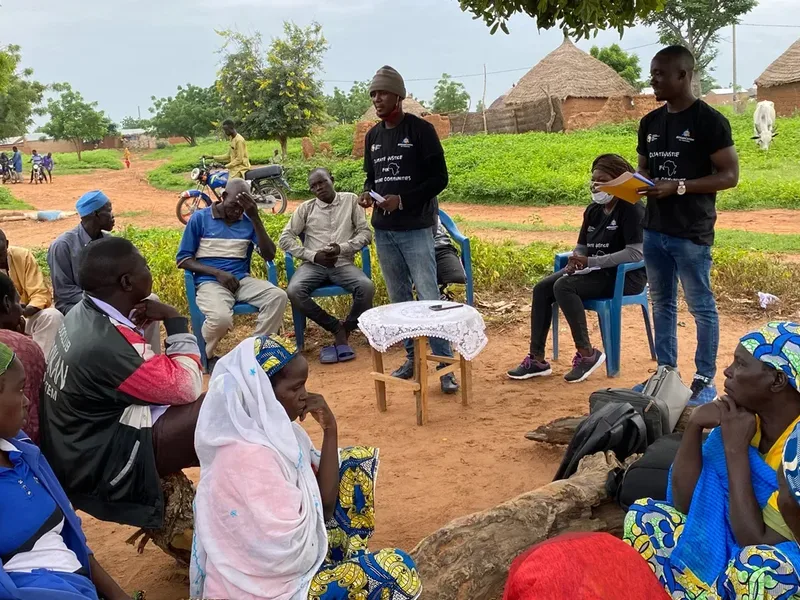
For African communities, the consequences are tangible: land displacement, eroded tenure rights and lost livelihoods.
The carbon governance failures documented in Zimbabwe and elsewhere are a warning that the continent cannot afford to repeat as market frameworks develop.
What Winning Looks Like for Africa – Imagine a continent where carbon finance is not extraction, but investment.
Africa does not need to replicate existing carbon market models; it can design something better.
Australia's Carbon Credit Unit scheme, which has certified over 2,800 projects and issued more than 177 million credits since 2011, and the EU's Carbon Removals and Carbon Farming framework, which entered into force in 2024, offer useful reference points.
However, Africa's opportunity lies in building common infrastructure from the ground up.
An African Carbon Markets Common Infrastructure, modelled on the World Bank's Carbon Action Data Trust, which aggregates registry data across nine programmes using decentralised, blockchain-based architecture, could create a single, transparent data layer that reduces transaction costs and makes African credits legible to international buyers.
- For communities, high-integrity carbon markets with ESG safeguards – covering free, prior and informed consent, benefit-sharing and environmental co-benefits, would deliver verifiable income to forest stewards, smallholder farmers and coastal fisherfolk across the continent.
- For economies, the macro-fiscal case is compelling. At just $15 per tonne – well below current European ETS prices, Africa's credit supply potential could generate over $3.5 billion annually, rivalling total bilateral climate finance inflows, without increasing sovereign debt burdens.
Six Things Africa Must Do Now – From potential to policy: the African carbon agenda.
Africa requires a continent-specific carbon market policy agenda — one that builds on global frameworks while addressing structural realities unique to the continent. Drawing on the Brookings brief's five-pillar framework for the United States, an Africa-specific agenda centres on six interconnected actions:
- Pan-African Carbon Registry Compact. The African Union, in coordination with the African Development Bank, should co-fund a shared registry layer interoperable with the World Bank's Climate Action Data Trust, the foundational infrastructure without which nothing else functions.
- Standardised governance and auditing norms. All programmes operating on continental territory, foreign-administered or domestic, should structurally separate registry operations from certification decisions, adopt neutral revenue models and ensure auditor independence.
- National voluntary carbon market disclosure laws. Modelled on California's Voluntary Carbon Market Disclosures Act, African jurisdictions should require every credit to be traceable, publicly documented and meet minimum quality thresholds.
- Community benefit mandates. Unlike Northern frameworks that treat social co-benefits as optional, African protocols should make equitable benefit-sharing a legal prerequisite for credit issuance, protecting market integrity and reducing reversal and reputational risks.
- Government-administered national programmes. Nigeria, Kenya, Ethiopia and Senegal should establish nationally administered crediting programmes, modelled on Australia's ACCU scheme, covering forestry, agriculture and clean energy, with pathways to regional and international compliance linkage.
- African Carbon Buyers' Coalition. Backed by sovereign wealth funds, development finance institutions and responsible corporates, a dedicated buyer coalition providing forward purchase commitments could unlock project financing at scale across the continent.
Path Forward – A Sovereign Stake in the Carbon Economy – Africa must own its green market terms.
Africa does not need to wait for carbon market integration to mature elsewhere before building its own architecture.
The continent's ecological wealth, youthful demographics and growing institutional sophistication position it to develop a carbon market framework that is credible, equitable and investable, on African terms.
The assets are not in question. The defining challenge of this decade is whether African leaders, regulators and communities will build the governance foundations that convert natural capital into sovereign economic power.