In 2026, national security and foreign investment have become inseparable. From Washington to Brussels, Canberra to Riyadh, governments are widening the definition of "national security" to encompass supply chain resilience, critical minerals, AI sovereignty, data protection and energy infrastructure, reshaping where, how and from whom capital is welcome.
For Africa, whose critical minerals underpin global energy transitions, whose data infrastructure is being built at pace and whose investment needs are vast, this global tightening of FDI screening is both a threat and an opportunity.
Understanding it is no longer optional for Africa's deal professionals, policymakers and development finance institutions.
Foreign Investment Is Now a Security Issue
The relationship between foreign direct investment and national security has never been more fraught, or more consequential.
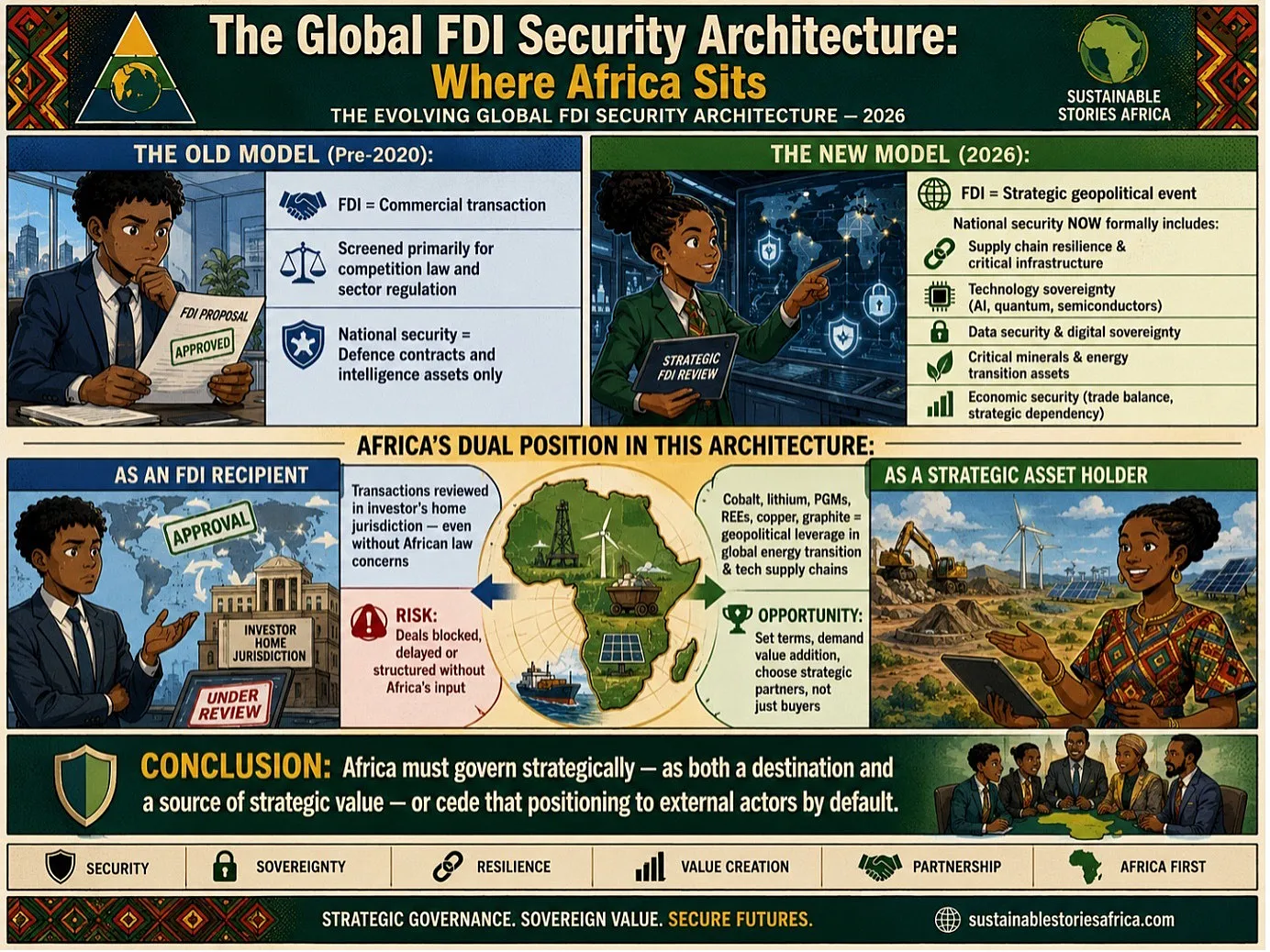
In 2026, geopolitical fragmentation, technological competition and supply chain nationalism are driving governments across the globe to treat inbound investment not merely as an economic transaction, but as a strategic event with national security implications.
For African markets, this transformation demands urgent attention on two fronts.
- First, as a recipient of foreign investment, from China, the Gulf, Europe, the United States and elsewhere, African governments must navigate an international environment in which the origin, structure and strategic implications of FDI are under unprecedented scrutiny.
- Second, as a holder of globally strategic assets, from cobalt and lithium to rare earth minerals and digital infrastructure, Africa must understand how its resources and industries are being positioned within global security calculations, and how to extract maximum value from that positioning.
The two fronts are connected.
- How Africa governs inbound investment determines what it receives.
- How it positions its strategic assets determines what it can demand.
Getting both right simultaneously, in an increasingly contested geopolitical environment, is one of the defining governance challenges of this decade.
The Definition of National Security Has Expanded
In every major economy, the concept of "national security" in the context of investment screening now extends well beyond traditional defence and intelligence concerns. Technology sovereignty, supply chain resilience, economic security, data protection and critical infrastructure are all firmly within scope. As leading international trade practitioners have observed, "In 2026, economic policy and national security are increasingly inseparable" — a doctrine now embedded in law across the EU, US, UK, Australia and beyond.
This means that an acquisition of a data centre in Lagos, a stake in a lithium mine in the DRC, or a fintech platform in Nairobi can now attract international security scrutiny — not just commercial due diligence — in the investor's home jurisdiction. African policymakers, company directors and deal professionals must understand this landscape not in general terms, but in granular operational detail. The cost of not understanding it is measured in delayed transactions, blocked deals, and missed opportunities to negotiate from strength.
What Global Screening Means for African Markets
The practical implications for Africa operate on two levels: upstream and downstream, and both demand strategic attention.
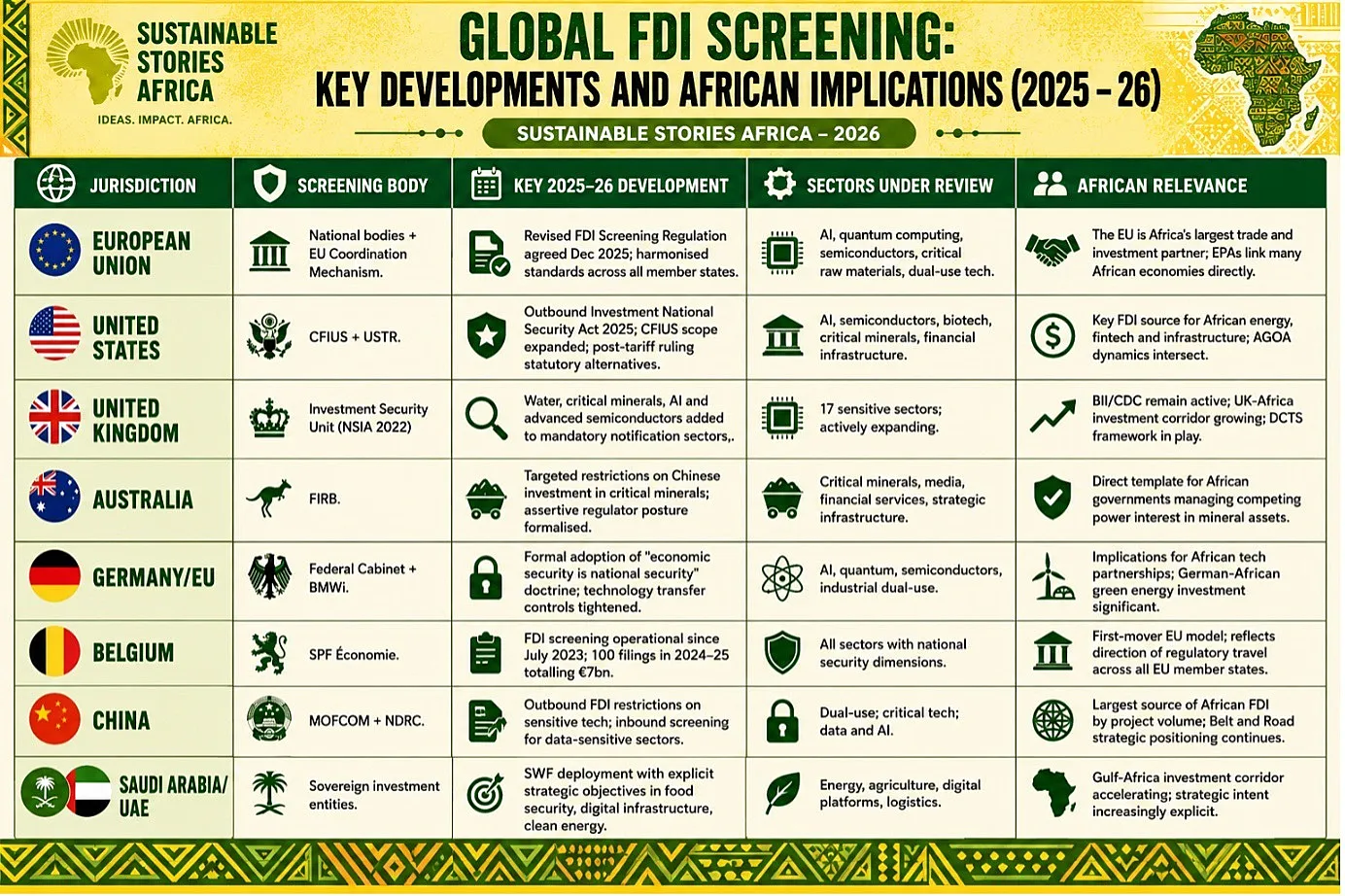
As upstream investment destinations, African critical minerals, data infrastructure, fintech platforms and energy assets are increasingly triggering foreign investment reviews in investors' home jurisdictions, even when African domestic law does not object.
- A Chinese firm acquiring a stake in a Zambian copper resource or a Gulf sovereign wealth fund entering a Nigerian fintech may now face scrutiny thousands of miles from the deal itself.
- Australia's experience is instructive; the FIRB has formalised restrictions on Chinese investment in lithium, nickel and silica to anchor supply chains with strategic partners.
- The DRC, Zimbabwe and Zambia, holding some of the world's largest cobalt, lithium and copper deposits, face analogous geopolitical logic.
Which African governments permit the ownership, extraction, and processing of these assets now shapes global supply chains, geopolitical alliances and long-term economic sovereignty.
Downstream, African pension funds and sovereign wealth funds that deploy capital into European or US markets face equivalent scrutiny.
- The EU's revised FDI Screening Regulation, provisionally agreed in December 2025, establishes harmonised screening standards covering AI, semiconductors and critical raw materials.
- For African institutional investors and countries party to EU Economic Partnership Agreements, navigating this framework is a precondition of sustained market access.
DESIRE: Turning Security Scrutiny Into Strategic Leverage
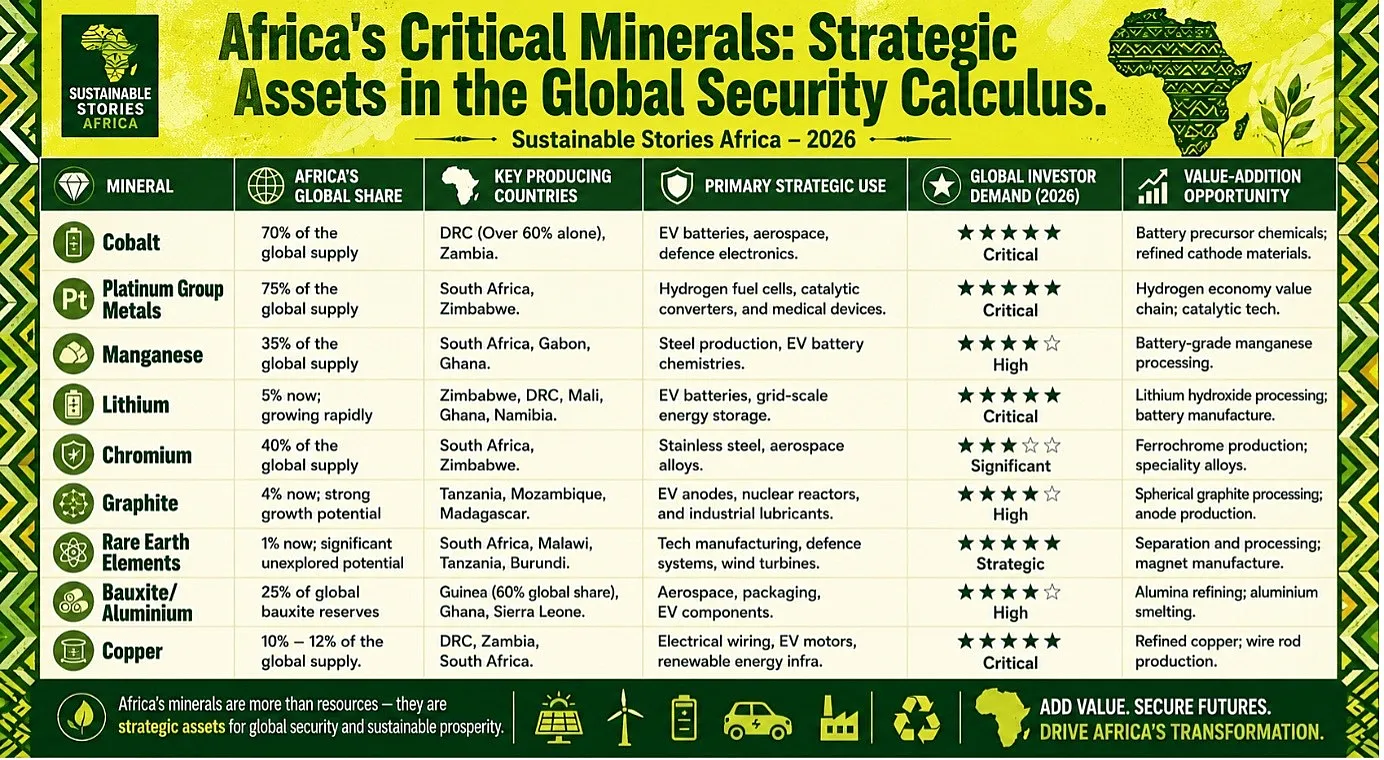
Africa's critical mineral endowment is among the most strategically significant on earth.
The continent holds approximately 30% of the world's mineral reserves, including the majority of global cobalt, significant and growing lithium deposits, the vast majority of platinum group metals, substantial manganese and graphite reserves, and rare earth elements whose strategic importance is rising with every electric vehicle produced and every data centre built.
These are not merely economic assets. In the security-first FDI architecture of 2026, they are geopolitical currencies.
In a world where Western governments are actively and urgently seeking to diversify critical mineral supply chains away from China, and where the energy transition cannot proceed without African minerals, Africa holds extraordinary structural leverage.
The African Union's Critical Minerals Strategy, the US Lobito Corridor investment in DRC-Zambia-Angola transport infrastructure, the EU's Global Gateway commitments, and the UK's British International Investment mandates all signal that the strategic importance of African mineral and digital assets is recognised internationally.
The scramble for African resources is not historical; it is present tense and accelerating.
The opportunity is not simply to respond to this demand, but to set the terms. African governments and regional bodies that develop credible, transparent, enforceable and value-adding investment frameworks for critical minerals can attract the capital they need on terms that maximise domestic benefit, including processing, employment, revenue transparency and community equity.
The alternative, passive extraction on terms set entirely by external actors, is a strategic and developmental failure that the continent cannot afford to repeat.
Beyond minerals, Africa's digital infrastructure build-out, data centres, subsea cables, cloud platforms, and fintech ecosystems sit at the intersection of economic opportunity and security sensitivity.
African governments must develop data sovereignty frameworks and digital investment policies that protect citizens and national interests while remaining open to the investment needed to close the digital divide.
Africa's Investment Governance Must Rise to the Moment
For African policymakers, deal professionals, development finance institutions and corporate boards, the actionable agenda is both clear and urgent:
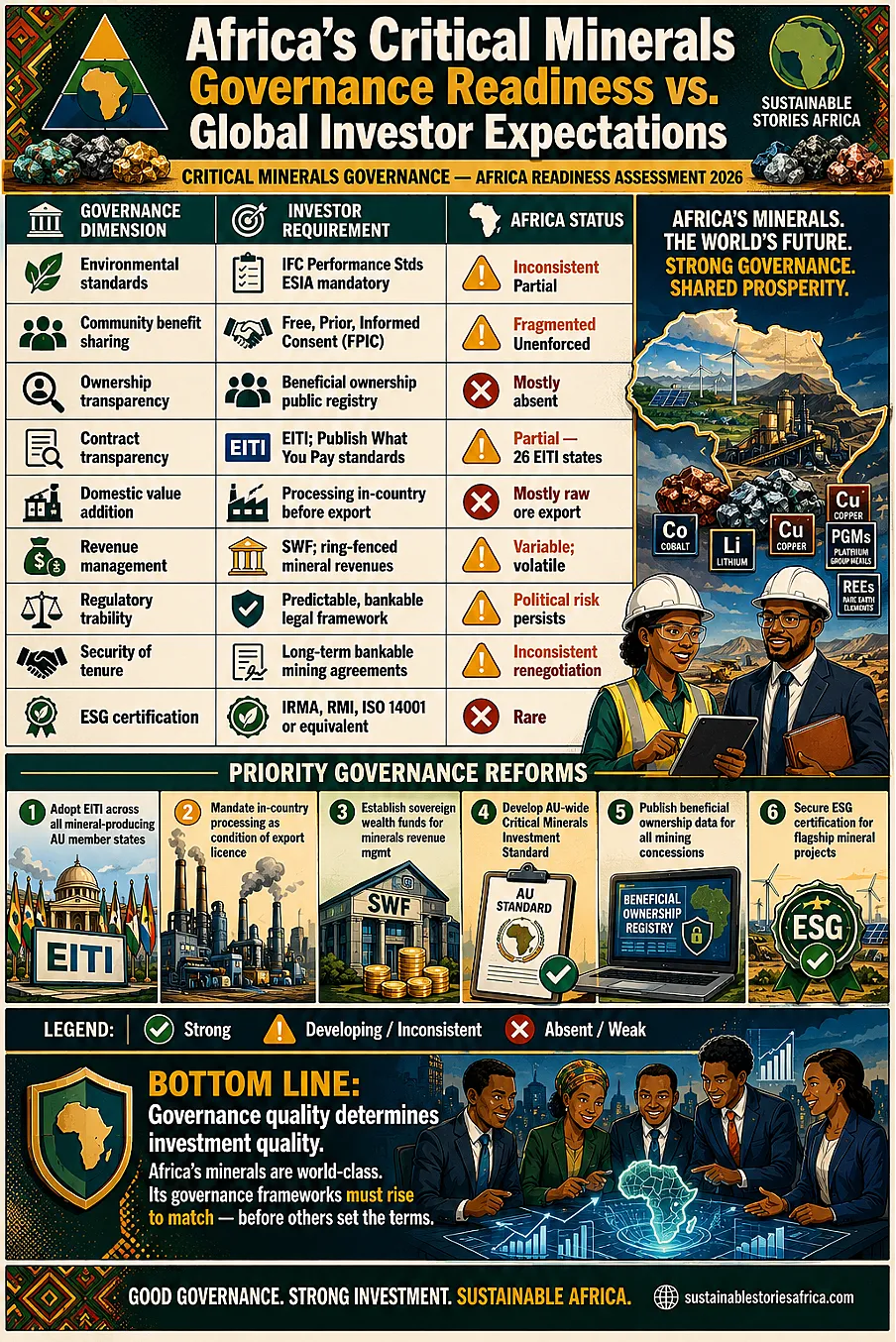
- Develop credible critical minerals frameworks – transparent, bankable and ESG-compliant, specifying ownership structures, community benefit obligations, environmental standards and revenue management rules. The DRC, Zambia and Zimbabwe each offer instructive and cautionary lessons on what attracts or deters capital.
- Build national FDI screening capacity – Nigeria, South Africa, Egypt and Rwanda are already significant outbound investors. Professionally staffed investment review functions are essential for navigating foreign screening regimes and protecting strategic interests in cross-border transactions.
- Establish data sovereignty frameworks – national and regional governance standards must define ownership, access and security for data centres, cloud platforms, subsea cable infrastructure and digital financial systems, ensuring Africa captures the value of its digital buildout.
- Coordinate through the African Union – no individual government can navigate the mineral security competition between the US, EU, China and Gulf states alone. The AU's Critical Minerals Strategy must be operationalised with urgency.
- Engage strategic partners on equal terms – initiatives like the Lobito Corridor and PGII are genuine opportunities, but only with clear terms and enforceable commitments.
- Align with ESG and sustainability standards – IFC Performance Standards compliance and EITI certification are increasingly preconditions for international capital, not optional credentials.
Path Forward – Africa's Minerals Are the Leverage: Governance Is the Key
Africa's position in the global security-investment architecture is stronger than many of its governments currently recognise.
The continent holds the physical resources that the world's energy transition and digital economy cannot proceed without, at a moment when major powers are actively competing for secure access.
That is leverage. However, leverage is only valuable when it is governed.
The reforms are achievable: transparent investment frameworks, data sovereignty policies, coordinated AU positioning and ESG-aligned governance standards.
Africa's critical minerals are the card. Governance is how it gets played.