Africa's governance gap is often framed as institutional, weak systems, poor execution, and misallocated resources. Rarely examined is the inner architecture of the leaders running those institutions.
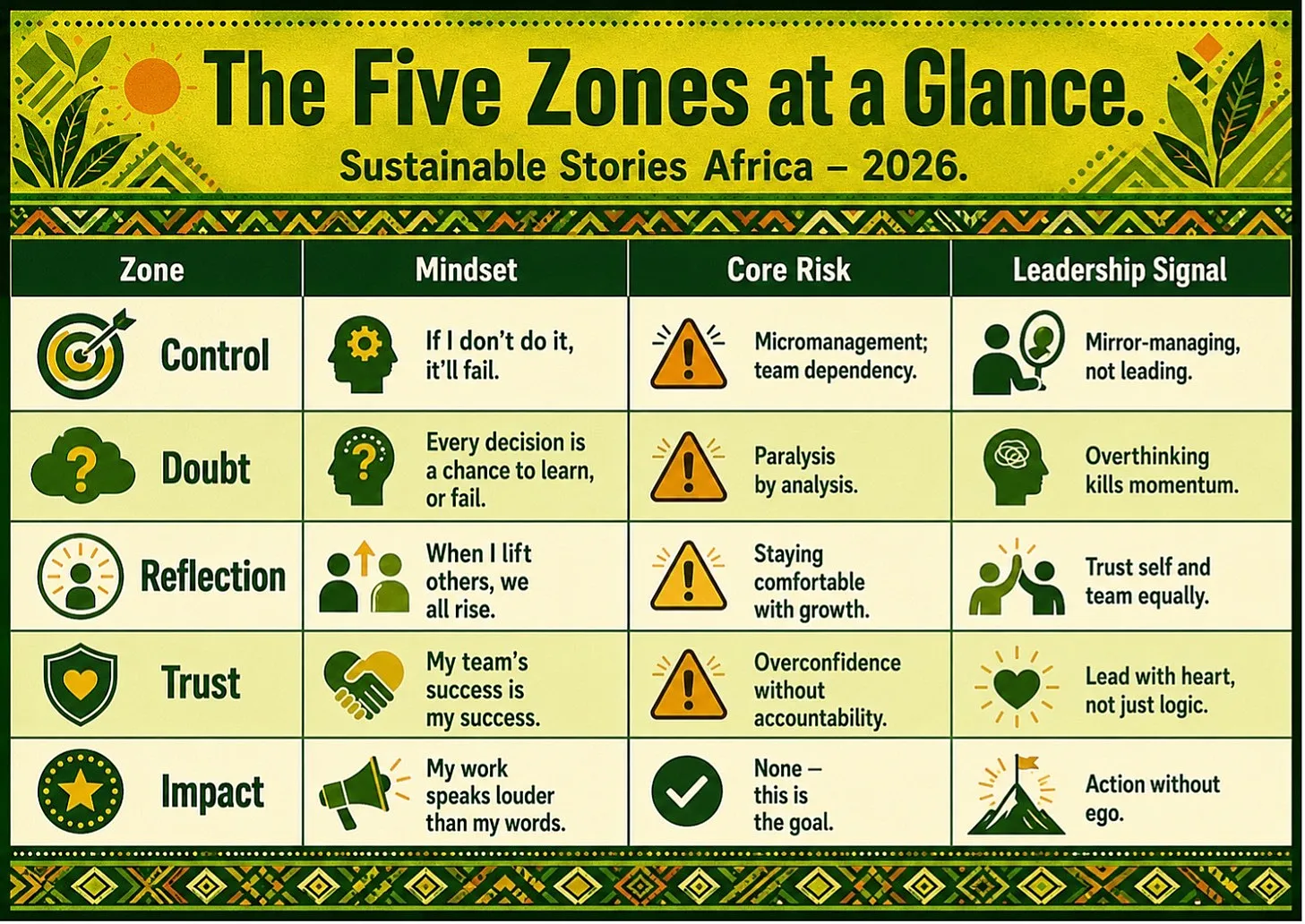
Strategist Daniel Hartweg's leadership framework identifies five zones: Control, Doubt, Reflection, Trust and Impact, offering a sharper diagnosis.
Too many African leaders in government, business and civil society operate from Control and Doubt: micromanaging, paralysed by uncertainty, mistaking busyness for impact.
The argument is direct: Africa's development deficit is, at its root, a leadership-zone problem, and shifting that culture costs nothing to begin.
Leaders Who Lead, Not Control
Leadership frameworks rarely go viral without reason. When strategist Daniel Hartweg's five-zone leadership model spread across LinkedIn and professional communities in 2025–2026, it resonated because it named something millions already felt but couldn't articulate: that the zone from which a leader operates matters more than their title, strategy or resources.
The five zones, Control, Doubt, Reflection, Trust and Impact, are not a personality test.
They are a diagnostic framework for understanding whether leadership enables or constrains the people around it.
They apply equally to the CEO of a Lagos fintech, the director-general of an African Union agency, a Nairobi school principal and a Johannesburg impact-investing fund manager.
Africa is at an inflexion point. By 2030, the continent will host 42% of the world's youth. Whether that demographic dividend becomes a development engine or a pressure point depends significantly on leadership quality.
However, the Chandler Institute of Governance's 2025 Good Government Index ranked Africa the lowest-scoring region globally, a finding inseparable from the leadership cultures that govern its institutions.
The framework offers a starting point for an honest conversation Africa can no longer defer.
The Zone You Lead From Is a Strategic Choice
Africa does not lack intelligent, credentialed leaders. It has a surplus of leaders operating in the wrong zones.
- The Control Zone – defined by the belief that "if I don't do it, it will fail" is where micromanagement lives.
A validated 2025 study introducing the Micromanagement Scale found that micromanagement consistently undermines trust, drives emotional exhaustion and accelerates turnover.
This is not a personality quirk. It is an organisational tax that compounds across institutions and generations.
- The Doubt Zone, one layer out, is where capable leaders stall. Overthinking becomes institutionalised. Decisions that should take days take months.
In Africa's development context, where implementation speed is itself a governance indicator, that hesitation carries a measurable cost.
As the Africa SDGs Report 2025 observed bluntly: "Policy without execution is not progress."
The central argument holds: Africa's institutions will not perform beyond the zone of the leaders running them. Structural reform without leadership zone reform is building on sand.
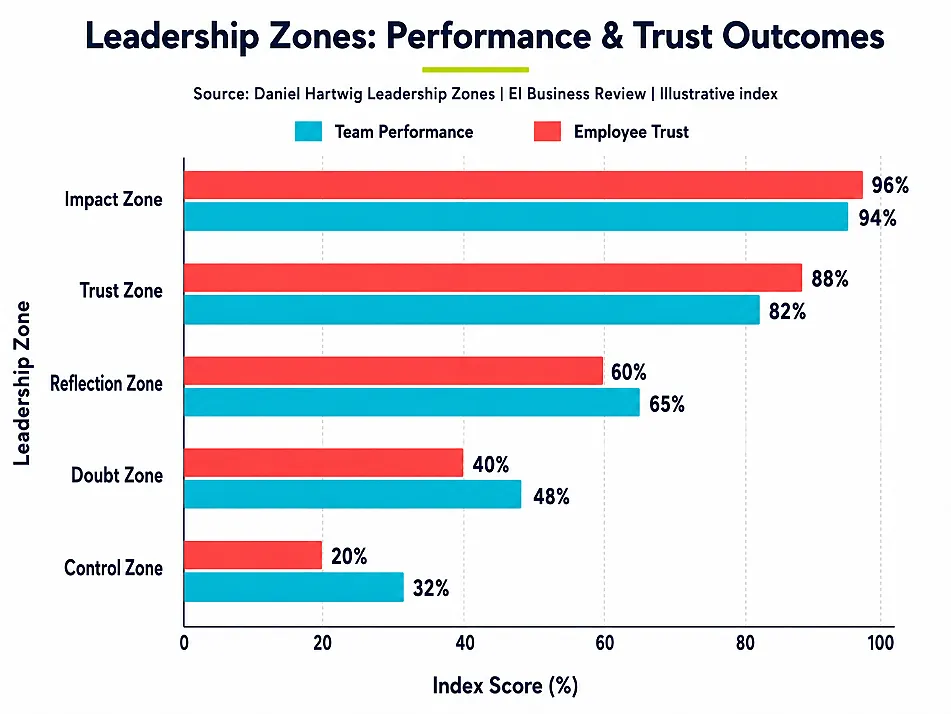
The Five Zones Mapped and What the Data Says
Understanding the five leadership zones requires moving from theory to practice, and in African organisations, each zone has a recognisable face.
The Control Zone is the most prevalent and most damaging at scale.
- It manifests as leaders who cannot delegate, centralise every decision and review every document before release.
- Ministers who bypass technocrats.
- Founders who cannot let go.
The cost is measurable: organisations with high micromanagement cultures report 28% higher turnover rates and significantly lower innovation output.
The Doubt Zone is subtler but equally costly.
- Competent leaders stall, documenting to avoid blame, seeking consensus to delay accountability.
As Hartweg's framework notes, "Doubt is data. Use it, don't drown in it." Doubt becomes pathological when it replaces decisions rather than informing them.
The Reflection Zone is where the growth curve begins.
- Leaders here lift others, trust their teams and embrace the principle that progress beats perfection.
For Africa's emerging leadership class, this is the critical transition, from reactive control to proactive enablement.
The Trust Zone transforms team dynamics entirely.
- Research confirms that trust-based leadership, characterised by high autonomy and low unnecessary control, drives stronger performance, creativity and organisational commitment.
Leaders here understand that their team's success is their success.
The Impact Zone is the destination.
- Leaders here build institutions, not just manage them, acting without ego, creating governance legacies that outlast their tenure.
In ESG terms, these are the leaders Africa's development moment demands.
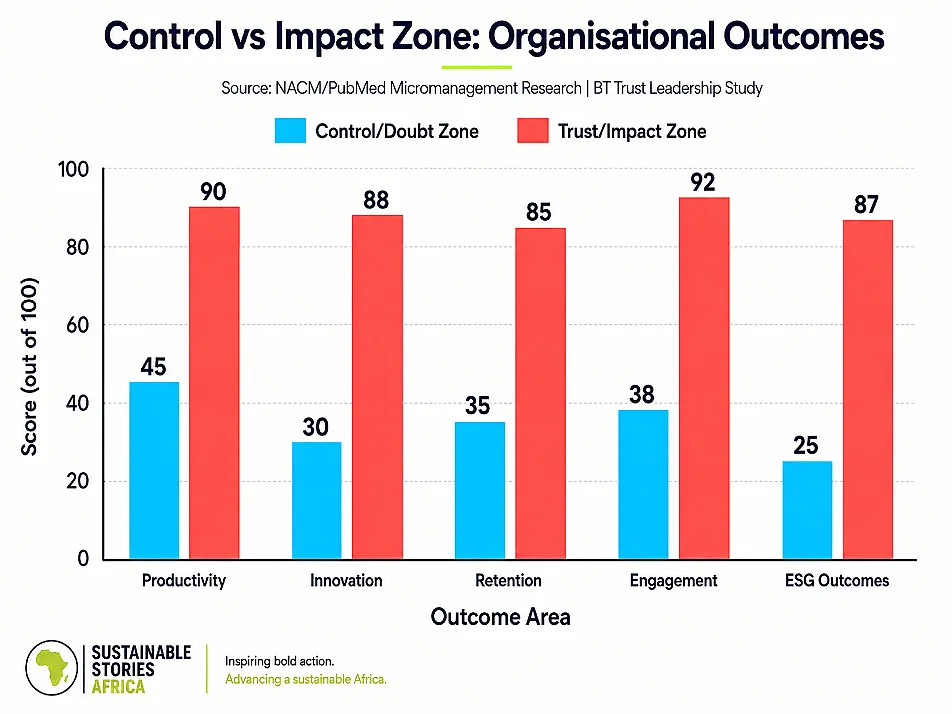
What Africa Gains When Leaders Move Up the Zones
The prize is not abstract. When leaders shift from Control to Impact, the benefits cascade across teams, organisations and markets.
For teams, the shift unlocks discretionary effort, the energy people give beyond the minimum because they feel trusted, valued and purposeful.
Research consistently links trust-based leadership to higher productivity, stronger retention, greater innovation and measurable improvements in well-being.
In Africa's talent markets, where skilled professionals have growing cross-border mobility, this is a competitive imperative, not a leadership luxury.
For institutions, Impact Zone leadership creates replication. As Hartweg's framework states, great leaders "create more leaders, not followers." The governance gap across Africa is not due to the absence of exceptional individuals.
It is caused by leadership models that concentrate agency rather than distribute it. What the continent needs is not heroic singular leaders, but leadership cultures that multiply capability at every level.
For ESG stakeholders and investors, the signal is equally direct.
Governance criteria increasingly assess not just board composition, but also institutional culture and leadership practice.
An African corporate demonstrating genuine Trust or Impact Zone leadership, evidenced by retention data, delegation practices and governance transparency, represents a materially different asset from one locked in permanent Control Zone mode.
What is lost if nothing changes is equally clear. Africa continues producing strategies without execution and summits without outcomes.
The Africa SDGs Report 2025 confirmed most countries remain off track, not because the goals are wrong, but because leadership remains misaligned.
Progress beats perfection, but only if leadership actually moves.
Moving the Zones: A Practical Agenda
Leadership zone transformation is not a training programme. It is a daily practice, a structural commitment and a governance imperative, and it requires concrete action across six fronts.
Boards and executive teams must publicly name their zone, introducing honest self-assessment at every quarterly review, not as performance management, but as cultural accountability.
Delegation must be built into governance architecture.
Control Zone behaviour is often structural, not personal; systems that require executive sign-off on operational decisions actively manufacture micromanagement and must be redesigned.
Investment must shift toward middle-layer leadership. Africa's leadership development spend is disproportionately concentrated at the top.
However, Reflection and Trust Zone transitions happen primarily among team leads, department heads and programme managers, the tier that will define organisational performance by 2030.
Leadership culture indicators, delegation depth, team autonomy scores, and psychological safety indices should be embedded in ESG disclosures alongside emissions targets and board diversity data. Trust must become an institutional standard, not a personal style.
Finally, Impact Zone leadership must be made visible. Africa needs fewer heroic narratives and more stories of quiet, systemic, ego-free impact, leaders who built institutions that outlasted them, and created other leaders in the process.
Path Forward – Lead From the Inside Out
Every Zone Shift Begins With One Decision
The shift from Control to Impact is not a career milestone. It is a daily choice.
Africa's structural reforms, ESG commitments and development targets will not be delivered by institutions, but by institutions with people operating from a zone.
The continent's youth dividend, climate resilience and governance credibility will be shaped by leaders who understand that true change needs no spotlight.
It needs consistency, trust and the courage to build something that outlasts the next term of office.