
Economic crime costs UK businesses hundreds of billions of pounds annually, with more than 70% of companies experiencing direct or indirect financial losses.
The UK's Economic Crime and Corporate Transparency Act 2023 (ECCTA) is among the most significant corporate liability reforms in decades, lowering the threshold for criminal liability and introducing strict obligations on large organisations to prevent fraud.
For Africa, where economic crime, money laundering and corporate fraud represent systemic threats to growth, investment and public trust, ECCTA is not just a UK legal story.
It is a governance benchmark and a warning about what happens when accountability is deferred too long.
Accountability Cannot Be Optional Any Longer
Economic crime is not a marginal risk. In the UK alone, it costs businesses hundreds of billions of pounds each year, with over 70% experiencing direct or indirect financial losses.
In Africa, where the informal economy, governance gaps and institutional capacity constraints create fertile conditions for fraud, money laundering and tax evasion, the costs are higher in proportion and the consequences more severe.
The UK's Economic Crime and Corporate Transparency Act 2023 (ECCTA) represents a landmark shift in how corporate liability is conceived: not merely as a legal consequence of individual wrongdoing, but as a systemic obligation on organisations to build cultures and controls that actively prevent fraud.
This is not a distant regulatory development. For African multinationals, companies with UK operations or investors, and policymakers designing the continent's next generation of corporate governance frameworks, ECCTA is directly relevant.
The Corporate Fraud Epidemic Is Real
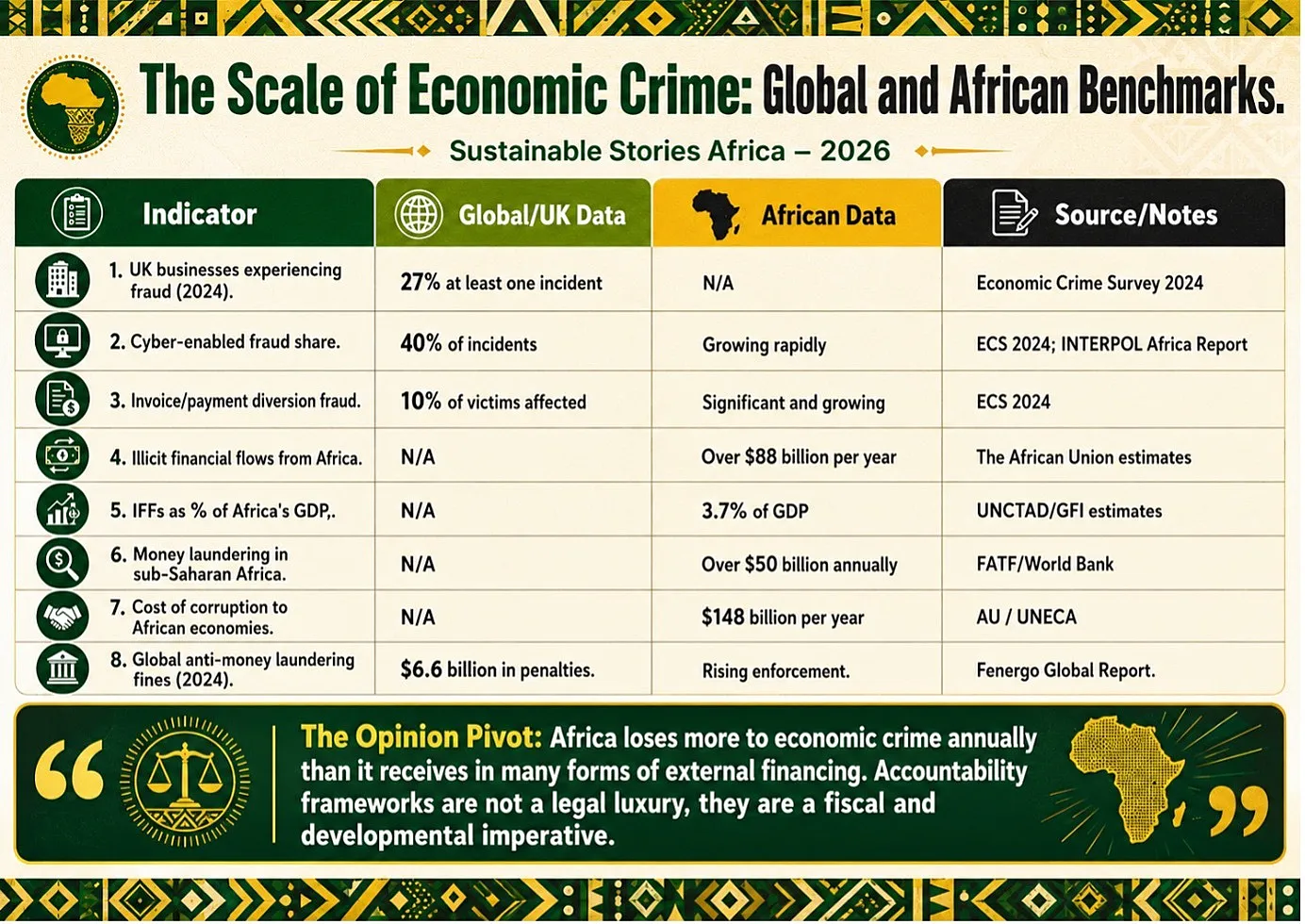
27% of UK businesses experienced at least one fraud incident in 2024, according to the Economic Crime Survey 2024. Of these, roughly 40% were cyber-enabled, primarily phishing and social engineering attacks.
Invoice and payment diversion fraud affected approximately one in 10 victims.
 |  |
Scale this to Africa.
In markets where digital financial services are expanding, regulatory oversight is uneven and corporate governance frameworks remain nascent.
The exposure is considerably higher.
The African Union estimates that illicit financial flows, including corporate fraud, tax evasion and money laundering, drain more than $88 billion from the continent annually.
That is capital that could fund hospitals, schools, roads and renewable energy.
Instead, it is lost to economic crime that too often goes unpunished.
What ECCTA Changes and What It Signals
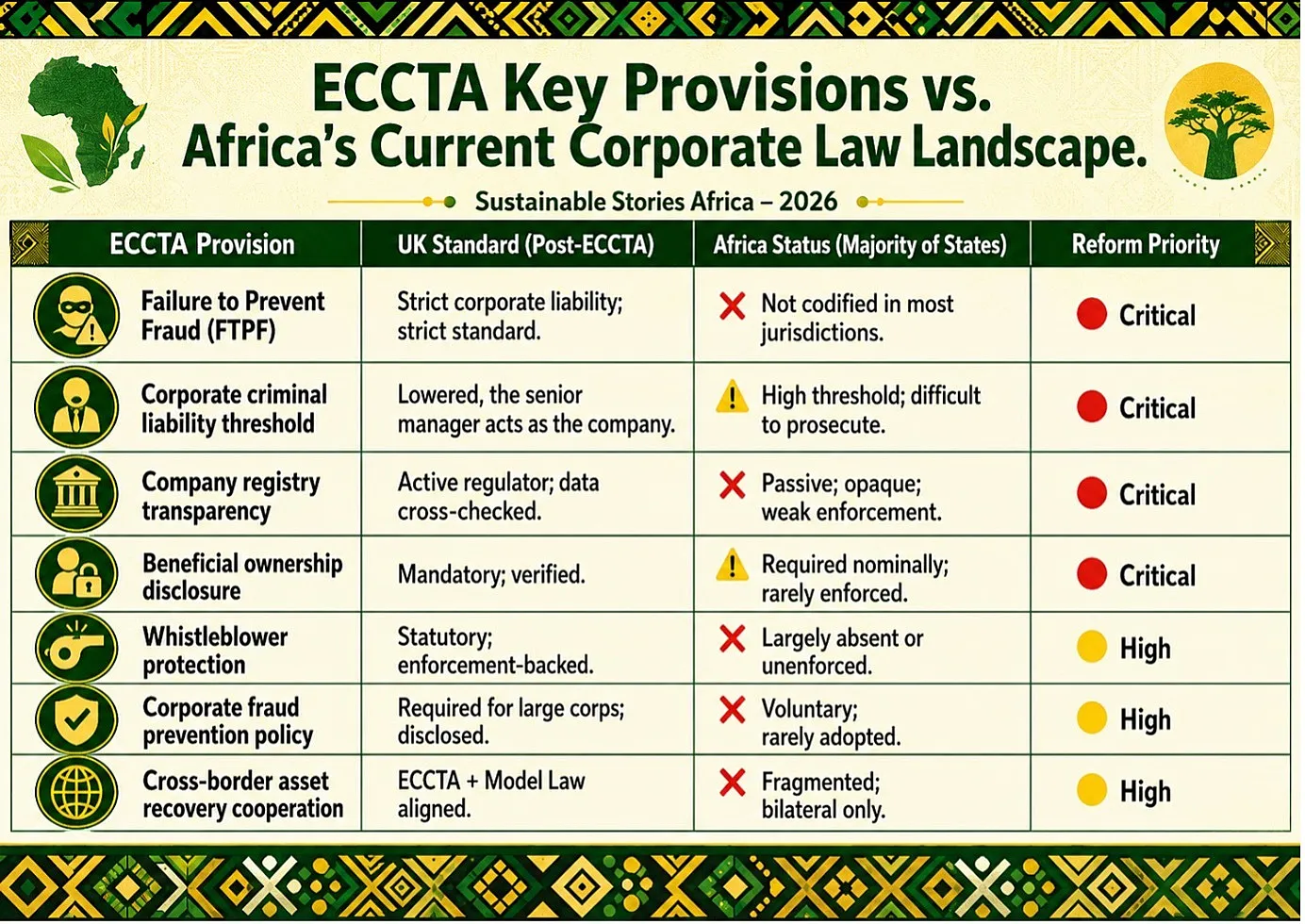
ECCTA substantially lowers the threshold for corporate criminal liability in the UK. Its most significant provision is the "failure to prevent fraud" (FTPF) offence, a strict liability standard for large corporates that automatically extends to agents and subsidiaries.
Unlike prior frameworks, FTPF does not require proof that senior management directed the fraud.
Organisations are liable unless they can demonstrate that adequate preventive procedures are in place.
The Act also reforms the "identification principle", the legal doctrine previously used to determine corporate criminal liability, making it easier for prosecutors to hold organisations criminally responsible for offences committed by senior managers acting within the scope of their authority.
Companies House has been transformed from a passive register into an active regulator with real enforcement powers.
These reforms are, as Macfarlanes partner Lorna Emson notes, "designed to be preventative and foster a cultural compliance shift."
They change not just what companies must do, but what they must be. Conglomerates with embedded cultures of transparency, accountability and proactive fraud prevention.
The parallel for African corporate law is unmistakable. Across the continent, corporate criminal liability frameworks are largely reactive, prosecutorial and resource-constrained.
Anti-money laundering regulations are frequently adopted in name but enforced weakly.
Company registries remain opaque and under-resourced. The result is a systemic accountability gap that facilitates economic crime and undermines investor confidence.
A Compliance Culture That Builds Markets
The case for ECCTA-style reform in Africa is not primarily punitive; it is economic.
Jurisdictions that establish credible corporate accountability frameworks attract better-quality investment, access lower-cost capital and build the institutional trust that sustainable markets require.
When corporate fraud goes unpunished, the costs are borne disproportionately by ordinary citizens through weakened public finances, inflated prices, reduced competition and deteriorating public services.
Conversely, when corporate accountability is real and enforcement is credible, markets function better: more competitors enter, more investment arrives, and more value is distributed.
For African businesses operating in international markets, the compliance imperative is also intensifying from external pressure. UK subsidiaries and supply chain partners of African companies are already subject to ECCTA obligations.
Global investors applying ESG screens are increasingly requiring evidence of anti-fraud policies, whistleblower mechanisms and corporate liability frameworks as conditions of investment.
Building this culture proactively, rather than reactively after a scandal, positions African organisations as serious governance actors in the global economy.
What African Regulators and Boards Must Do
The agenda is clear and urgent:

- Adopt failure-to-prevent frameworks. African legislative bodies should adapt the ECCTA model to domestic contexts, introducing corporate liability for failure to prevent fraud, bribery and corruption, with clear standards for adequate preventive procedures.
- Reform company registries. Opaque registries that enable economic crime. African governments should invest in digital, accessible and actively enforced corporate registries, moving from passive recordkeeping to active regulation.
- Resource economic crime enforcement. As Lorna Emson observes, "it is often easier for governments to reach for new legislation than to do the costly and unglamorous work of ensuring enforcement agencies can bring long, complex prosecutions." Enforcement capacity, not just legislative text, is what determines outcomes.
- Mandate corporate fraud prevention policies. Boards should be required to adopt and disclose comprehensive fraud prevention policies, supported by employee training, whistleblower protections and third-party audit.
- Coordinate across borders. Economic crime is transnational. African Union member states should accelerate the harmonisation of anti-economic crime frameworks and mutual legal assistance mechanisms to close jurisdictional gaps.
Path Forward – Accountability Is Africa's Anti-Poverty Policy
Illicit financial flows drain more from Africa's economies each year than the continent receives in foreign direct investment. Reversing this requires not just better laws, but also the political will, institutional investment and cultural change to enforce them. ECCTA offers a model; Africa must build its own.
The fight against economic crime is inseparable from the fight for development. Both demand the same tools: transparency, accountability and consequence.