Nigeria sits at a defining crossroads in its energy transition story. A landmark report by Sustainable Energy for All (SEforALL), backed by government agencies and Lagos State, has laid out a detailed roadmap for deploying electric buses (e-buses) across Nigeria's mass transit systems.
The question is no longer whether Nigeria can transition; it is whether Nigeria will.
The stakes are enormous. Nigeria's transport sector accounts for 60% of the country's total CO₂ emissions, and the road to 2060 carbon neutrality runs directly through the streets of Lagos, Abuja, Kano, and beyond.
For one of Africa's largest economy, the e-bus agenda is not just a green aspiration; it is an economic and social imperative.
Countries like Kenya, South Africa, and Rwanda are already moving. Nigeria must decide: lead, follow, or fall behind.
The Road Ahead Must Be Electric
Nigeria's transport sector is one of the most carbon-intensive in Africa, yet it remains almost entirely powered by fossil fuels.
In 2020, the International Energy Agency confirmed the transport sector as Nigeria's greatest CO₂ emitter, responsible for approximately 60% of total national emissions, a figure that makes any serious climate strategy incomplete without addressing how millions of Nigerians move daily.
In October 2024, SEforALL, in partnership with the National Automotive Design and Development Council (NADDC), the National Council on Climate Change (NCCC), the Nigerian Electricity Regulatory Commission (NERC), and Lagos State government agencies, published Transitioning to Sustainable Mass Transportation Systems: Market Assessment and Operating Models for Electric Bus Deployment in Nigeria.
The report is Nigeria's most comprehensive technical blueprint to date for replacing diesel-powered public buses with electric alternatives.
This article argues that the SEforALL report represents more than a policy document; it is a strategic opportunity Nigeria cannot afford to squander.
The country has the policy framework, the multilateral support, and the urban infrastructure foundation to move.
What it now needs is political will, coordinated private capital, and the discipline to learn from what other African nations have already done right.
60% of Emissions Cannot Wait
Nigeria's transport sector contributes approximately 15% of national greenhouse gas emissions, with road transport accounting for 96% of all transport activity.
Behind those figures are the danfo buses, BRT coaches and private vehicles choking Lagos Island and clogging the Sagamu-Ore expressway daily.
The case for electric buses is not merely environmental; it is mathematical. A single e-bus can displace between 20 and 30 private passenger cars on any given route while delivering a 75% reduction in emissions compared to its diesel equivalent.
No other single transport intervention produces that multiplier. Across Africa, e-bus transportation surged 44% year-on-year in 2024 – 2025. Nigeria, the continent's most populous nation, is not yet counted among the serious movers.
The 2023 removal of fuel subsidy made this urgent. Millions of working Nigerians absorbed higher commuting costs overnight. Electric buses, powered by electricity rather than imported fossil fuels, offer direct economic relief.
The SEforALL report is, in effect, an economic recovery plan disguised as a climate strategy.
What the Report Says and What Africa Is Already Doing
The SEforALL report moves beyond ambition with a detailed case study of Lagos's BRT system under LAMATA, commencing as the logical first corridor for e-bus deployment.
It identifies specific depots, maps power availability and proposes charging infrastructure schematics. This is actionable planning, not aspiration.
The recommended Gross Cost Contract model, in which operators earn a fixed fee per kilometre while fare revenue flows to a central transport authority, removes commercial risk from private investors while preserving government oversight of fares and service quality.
Critically, Total Cost of Ownership analysis confirms that over the full operational lifecycle, e-buses are cheaper than diesel equivalents, particularly as Nigeria's deregulated fuel prices remain volatile.
Elsewhere on the continent, the journey is already delivering results.
- Kenya has deployed 52 electric buses through BasiGo, registered over 1,350 EVs and is targeting full public transport electrification by 2027.
- Rwanda's pay-as-you-go e-bus model eliminates high upfront capital barriers, directly applicable to Nigeria's fiscally constrained transport authorities.
- South Africa leads overall EV adoption, while Egypt and Morocco are localising e-bus supply chains through strong industrial policy.
The continental lesson is consistent: start with available infrastructure, measure performance, and scale with evidence. Kenya and Rwanda did not wait for perfect conditions. Neither should Nigeria.
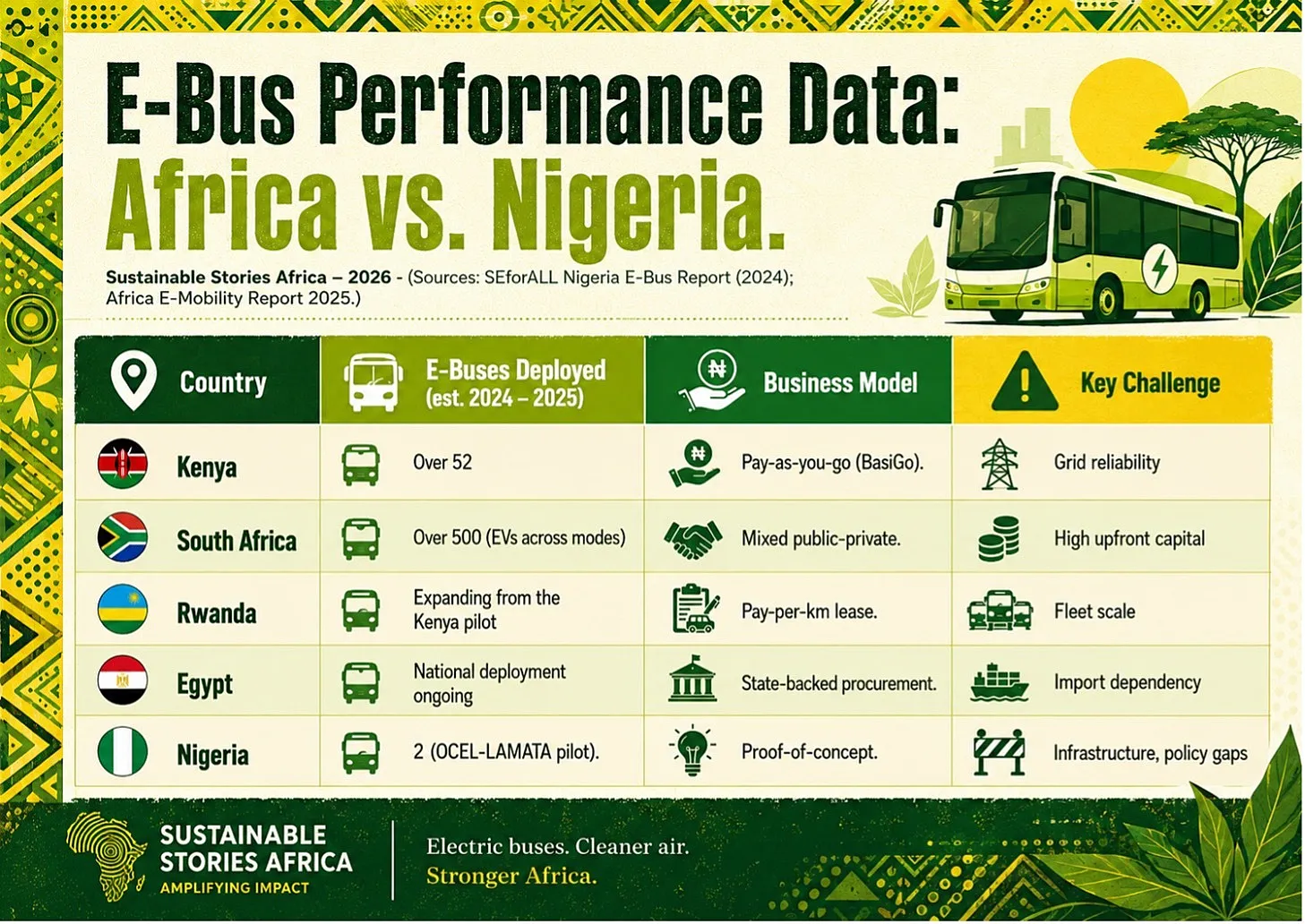
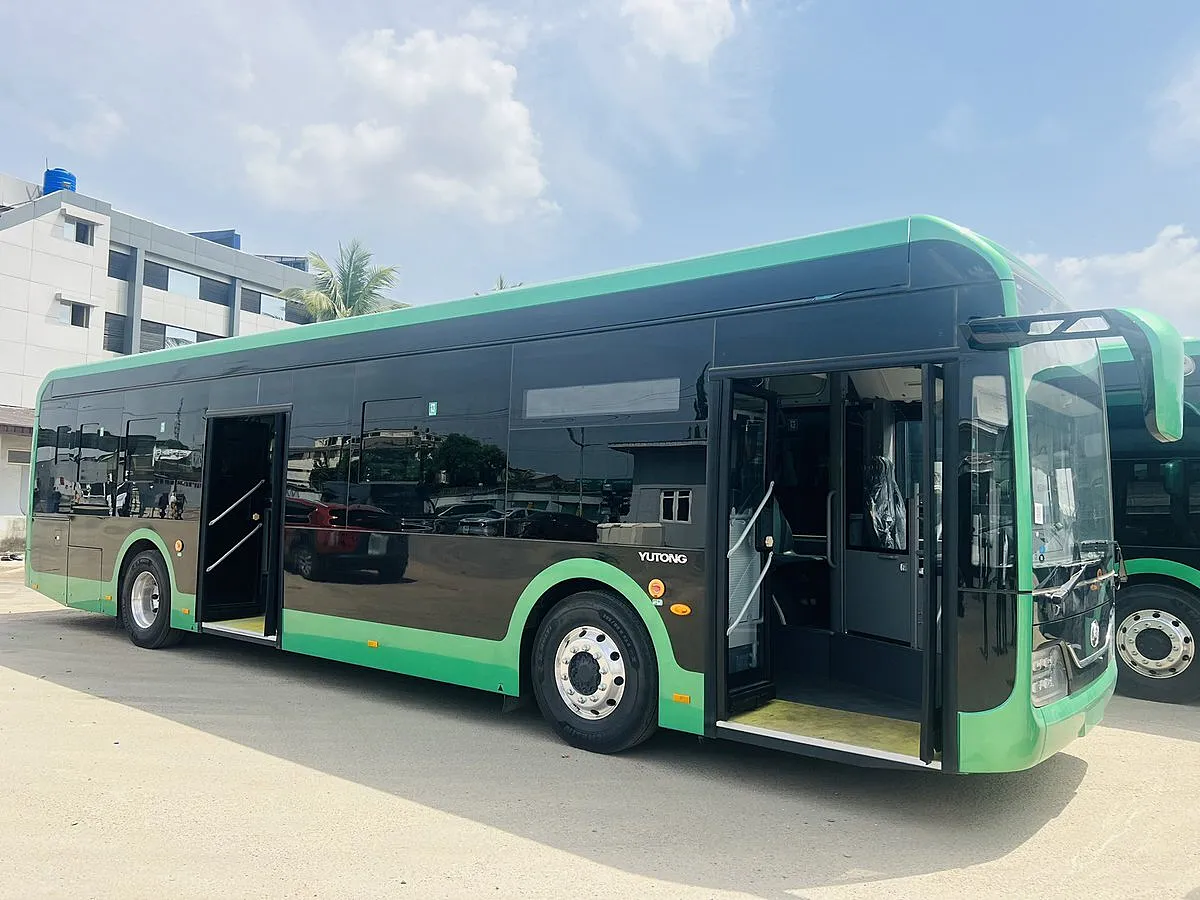
Nigeria's two-bus LAMATA-Oando Clean Energy proof-of-concept pilot in Lagos, while an important milestone, underscores just how early-stage the country's e-bus journey remains. Against the backdrop of African peers, the contrast is stark and urgent.
What Nigeria Stands to Gain and Lose
A single electric bus transition in Nigeria reduces GHG emissions by up to 1,300 tonnes of CO₂ equivalent over its lifespan.
Scale that across hundreds of buses in multiple states, and the climate contribution becomes nationally significant, rather than symbolic.
However, the benefits extend well beyond carbon accounting. For ordinary Nigerians, e-buses deliver:
- Cleaner air – zero tailpipe emissions directly improve respiratory health in Lagos, Kano and Port Harcourt, among Africa's most polluted cities
- Quieter commutes – significantly reduced noise pollution along dense urban corridors
- Stable, affordable fares – electricity-powered fleets, insulated from imported diesel price shocks, can offer more predictable pricing
- Technical jobs – local manufacturing, charging infrastructure and fleet maintenance create skilled employment, with NADDC's endorsement linking e-bus adoption to domestic automotive development
- Investment attraction – the Gross Cost Contract model de-risks the market for multilateral and private finance institutions, channelling green transport capital into Africa
The cost of inaction is equally concrete. The World Bank projects Africa's vehicle count to grow 400% by 2040, with Nigeria central to that expansion.
Countries building e-bus ecosystems now will attract green manufacturing investment this decade. Countries that delay will spend it importing both the buses and the expertise.
What Nigeria Must Do Now
The SEforALL report delivers a practical 24-month implementation roadmap across six phases, from steering committee formation and stakeholder engagement through infrastructure planning, procurement, training, pilot launch and scale-up. The planning work is done. The task now is execution.
Seven concrete actions are required without further delay:
- Activate the Gross Cost Contract framework in Lagos immediately – LAMATA operates an active BRT corridor, and Oando Clean Energy has demonstrated proof-of-concept. Lagos needs a procurement tender, not another study.
- Reform the Nigerian Automotive Industry Development Plan (NAIDP) – to explicitly include e-bus incentives and local assembly provisions. The current plan, unchanged since 2013, sends no signal to domestic or international EV investors.
- Reduce import duties on e-buses and charging components – through the Finance Bill, removing one of the most cited barriers to EV adoption across Africa.
- Mandate NERC and NADDC to co-develop a national e-bus charging infrastructure standard – assessed corridor-by-corridor before large-scale fleet deployment.
- Establish a dedicated e-mobility fund within Nigeria's Energy Transition Investment Plan – providing development finance institutions with a credible government counterpart facility.
- Scale pilots beyond Lagos – Abuja, Kano, Kaduna and Oyo State all have active or planned BRT systems ready for parallel deployment
- Learn from BasiGo's pay-per-kilometre lease model in Kenya – which has removed capital barriers for bus operators and proven commercially viable across East Africa
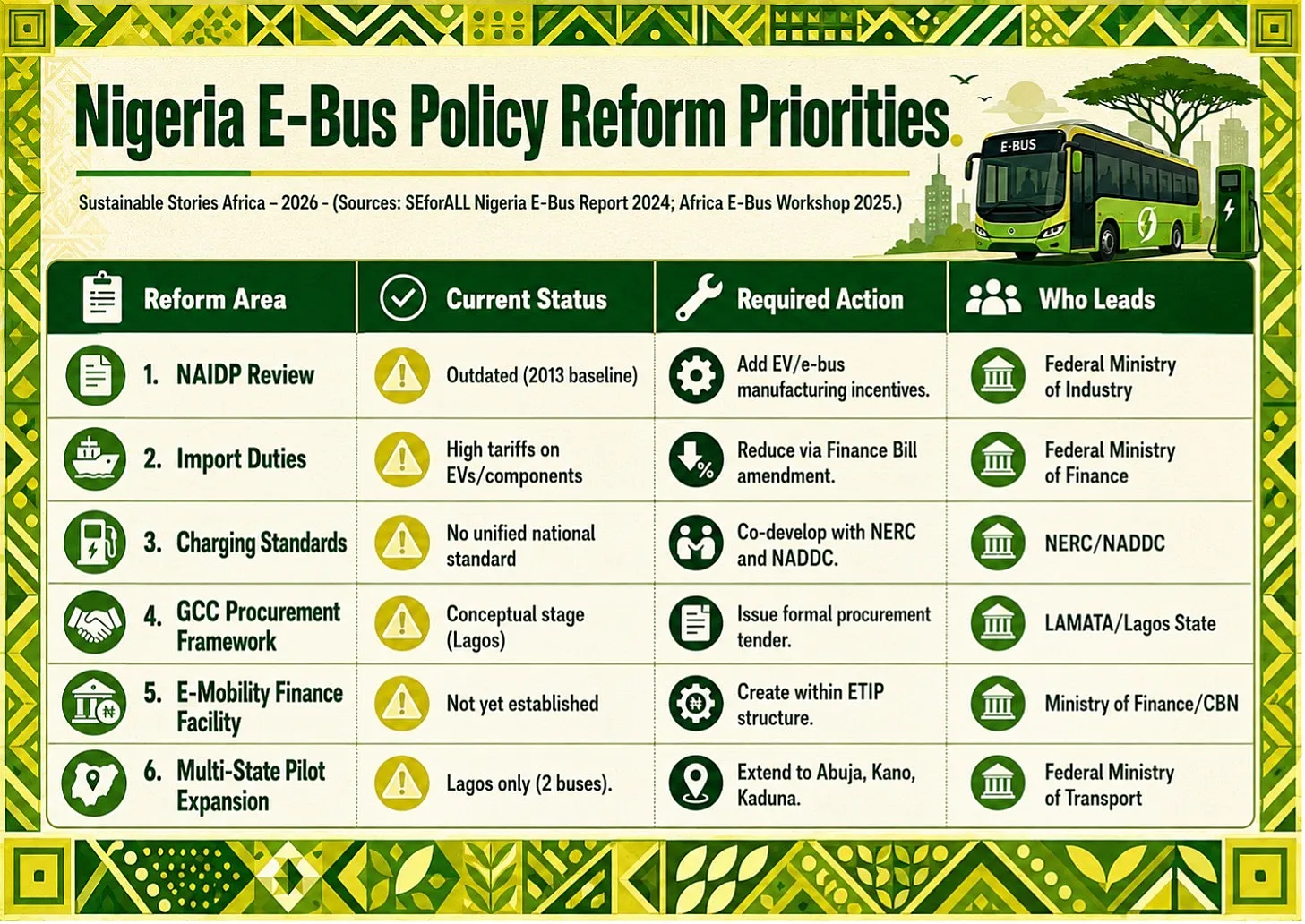
Path Forward – Nigeria Must Move Now From Blueprint to Buses on the Road
Nigeria now holds one of the most detailed and credible e-bus deployment blueprints on the continent.
The SEforALL report provides technical specifications, business models, policy recommendations, infrastructure assessments, and a 24-month phased implementation guide, all tailored to Nigerian realities. The question that remains is one of political will and fiscal prioritisation.
Kenya moved with 52 buses. Rwanda moved with a lease model and no perfect infrastructure. Nigeria, with one of Africa's largest economies and its most developed urban transport corridors, has every reason, and every tool, to move with speed, ambition, and scale.
The e-bus is not a symbol. It is a bus. Nigeria must start filling the streets with them.
This is the publication of Sustainable Stories Africa. The views expressed are analytical and opinion-driven, grounded in the SEforALL Nigeria E-Bus Report (October 2024), the Africa E-Mobility Status Report 2025, and publicly available data on African e-bus deployments as of December 2025.