
Nigeria's most consequential fiscal reform in two decades arrived quietly. Signed into law on 26 June 2025 and operative from January 2026, the Nigeria Revenue Service (Establishment) Act dissolved the Federal Inland Revenue Service, replacing it with the Nigeria Revenue Service.
It is not a cosmetic rename, but rather a structurally transformed institution with sweeping powers to assess, seize and cooperate internationally.
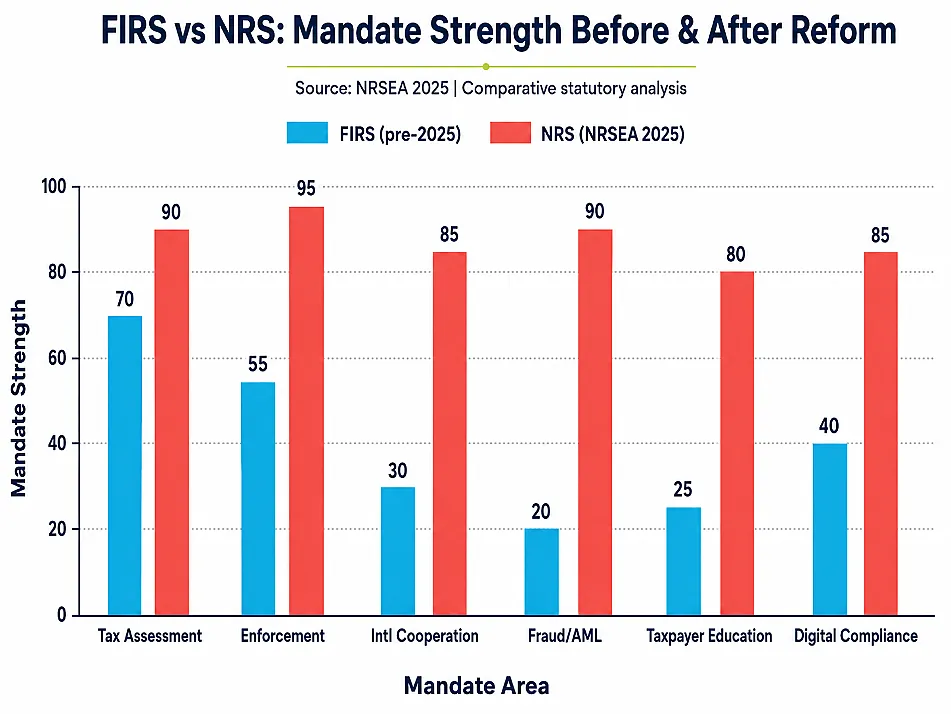
For African markets watching Nigeria's reform trajectory, NRSEA 2025 signals the arrival of a new fiscal state, one that treats tax evasion as a crime, aligns with global anti-money laundering standards and embeds BEPS compliance into its governing statute.
Nigeria's Fiscal State, Reborn
Nuggets 31 – 34 FinPolNomics' Tax & Transfer Pricing series illuminate the architecture of this transformation through 4 precise frames.
The birth of the NRS from the ashes of the FIRS (Nugget 31), its three-part core mandate to assess, collect, and account (Nugget 32), its new anti-evasion powers to freeze, confiscate, and seize proceeds of fraud (Nugget 33), and its mandate for international tax cooperation under the BEPS and CRS frameworks (Nugget 34).
Together, they paint a picture of a revenue authority no longer content to sit at the receiving end of voluntary compliance; however, one that actively hunts, traces, and recovers what is owed.
Nigeria's tax-to-GDP ratio has historically hovered around 6% – 8%, among the lowest globally for an economy of its size and ambition.
The Tinubu administration's four-law tax reform package, enacted on the same day in June 2025, was a direct response: a structured attempt to rewire the architecture of revenue collection rather than exhorting greater compliance.
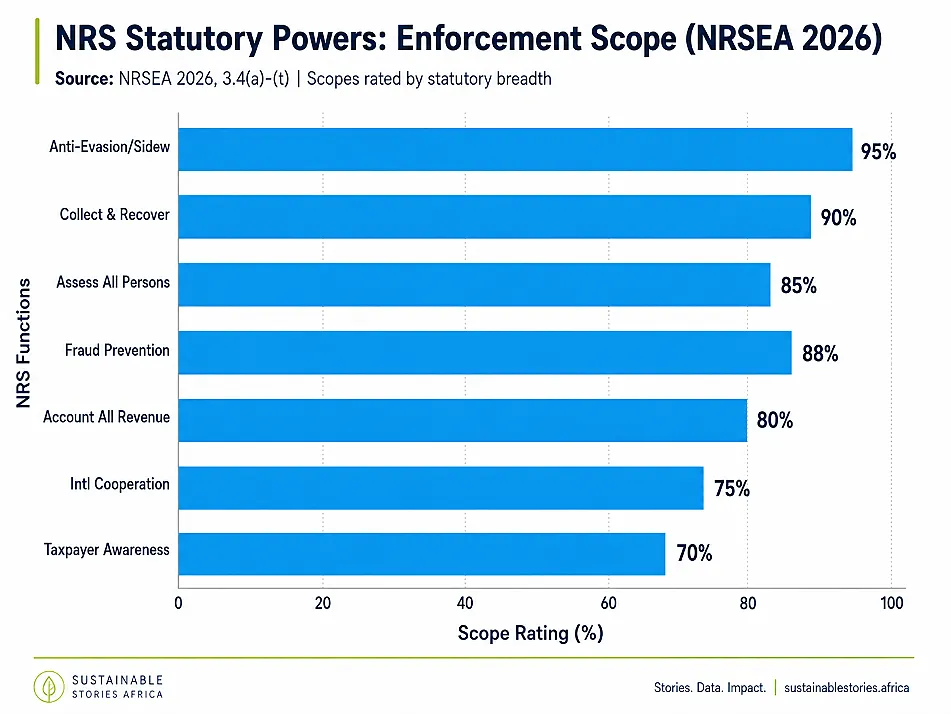
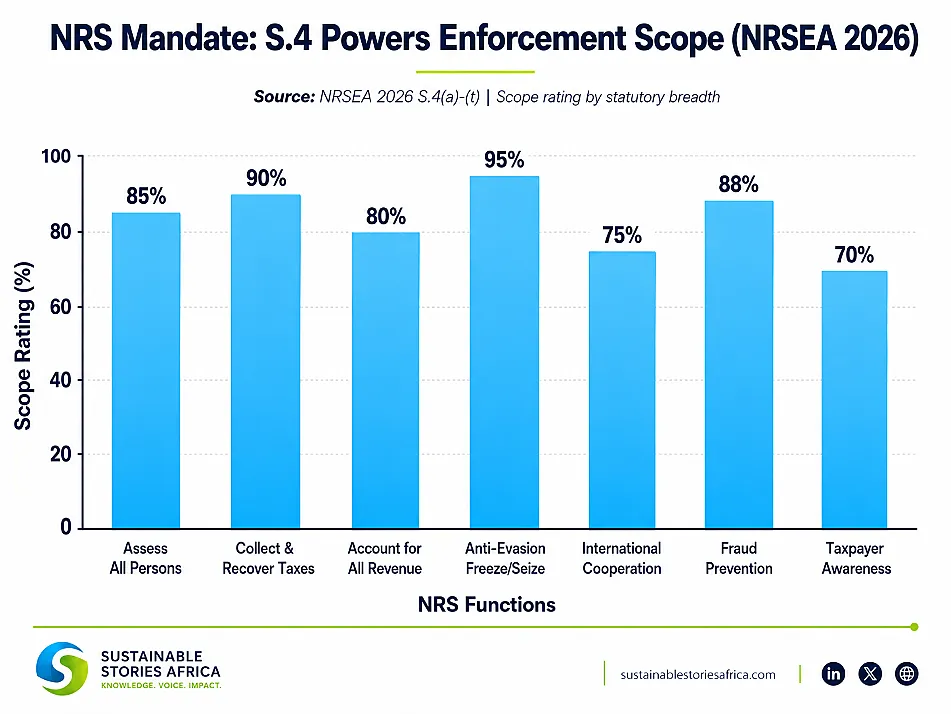
That the NRSEA 2025 went beyond renaming the authority and granted it 20 distinct statutory powers under S.4(1)(a)–(t) tells you everything about the intention.
A New Fiscal State Has Arrived
Nigeria just handed its tax authority the tools of a financial crimes unit. That is not hyperbole; it is the legal reality of NRSEA 2025.
Section 4(f) and (g) of the NRSEA 2025 explicitly empower the NRS to identify, trace, freeze, confiscate, and seize proceeds derived from tax fraud or evasion, language lifted directly from anti-money laundering statutes.
Tax evasion proceeds are now recoverable as proceeds of crime. The NRS can calculate the full financial loss to the government from evasion, issue freezing orders against accounts and assets, and confiscate those assets in the same enforcement pipeline used by financial crimes agencies.
This is an escalation without precedent in the history of Nigeria’s tax administration.
For too long, the FIRS operated with a mandate that was more administrative than prosecutorial.
The gap between what was owed and what was collected was not merely a compliance failure; it was a structural one. The NRS closes that structural gap decisively.
What NRSEA 2025 Actually Does and Why It Matters
The Nigeria Revenue Service (Establishment) Act 2025 is one of four reform laws signed simultaneously by President Bola Tinubu on 26 June 2025, together representing the most comprehensive overhaul of Nigeria's tax legal framework since 1993.
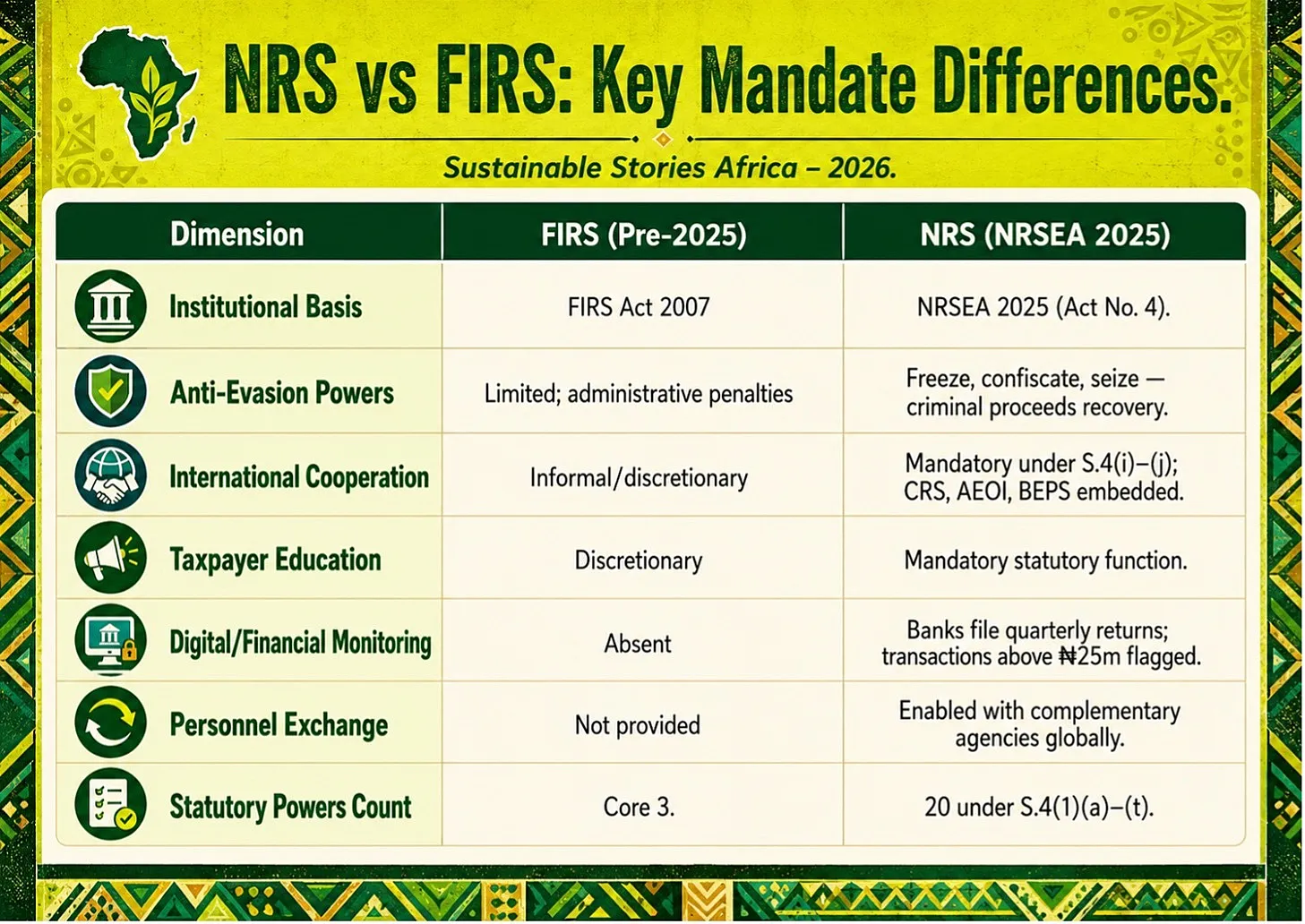
The Act repeals the FIRS (Establishment) Act 2007 entirely, reconstitutes the institution as the Nigeria Revenue Service, and came into operation on 1 January 2026.
Its mandate is precise: assess all persons chargeable to federal tax, collect and recover taxes assessed, and account for all revenue accruing to the Federal Government.
Beyond these core functions, the NRS carries 20 additional statutory powers, covering investigation, fraud prevention, taxpayer awareness and international cooperation.
Critically embedded in the NRS's governing statute are EPS and Common Reporting Standard compliance.
The institution must collaborate with national and international agencies on tax information exchange and align with FATF and OECD anti-money-laundering norms, treating proceeds from tax evasion as recoverable criminal assets.
For businesses operating across Nigeria, the compliance landscape has fundamentally shifted. The NRS inherits all FIRS rights, obligations, staff and assets, but carries an entirely new institutional ambition.
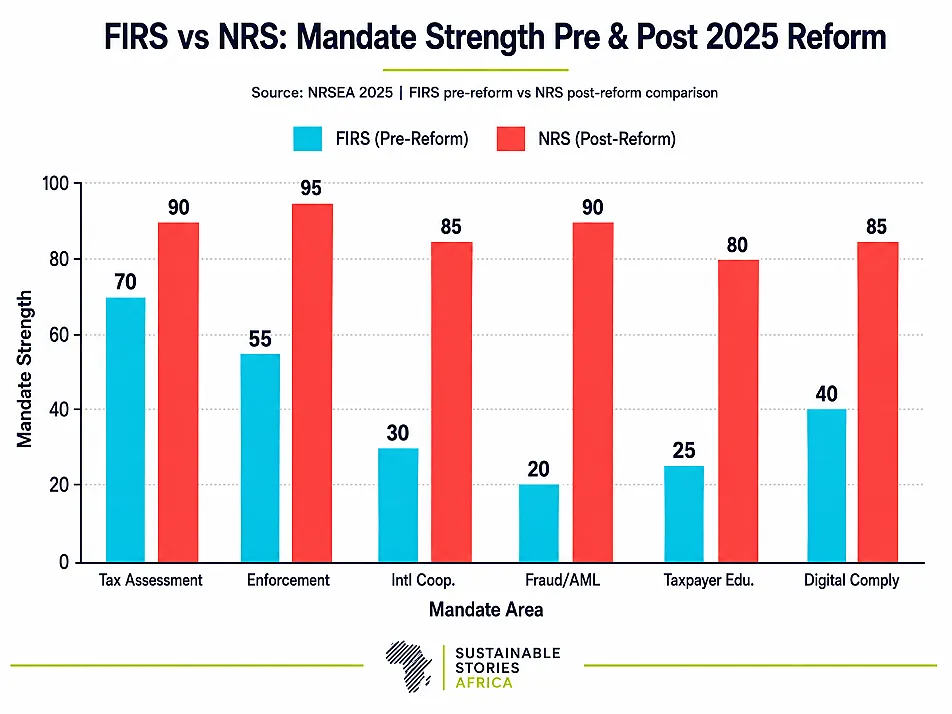
The timing matters for Africa. Nigeria joins Rwanda, Kenya, Ghana and South Africa in restructuring revenue authorities, driven by IMF benchmarks, domestic fiscal pressures and the governance credibility demands of ESG-conscious capital markets.
A Nigeria that enforces its tax laws, not just legislates them, is a materially different investment destination.
What Nigeria Gains If the NRS Mandate Holds
The upside of releasing the NRS mandate is transformative.
Nigeria's non-oil revenue mobilisation has long been constrained by weak enforcement.
If the NRS operationalises even 70% of its expanded mandate, the fiscal headroom created would be substantial, and the governance signal sent to global capital markets equally powerful.
For citizens
- A more effective revenue authority means greater public investment in healthcare, infrastructure, education and climate adaptation.
- Notably, the 2025 reform introduces a 0% tax rate for companies with annual turnover not exceeding ₦100 million, protecting the micro-enterprise sector while tightening the net around large-scale evasion.
For businesses and investors;
- NRS alignment with CRS, AEOI and BEPS frameworks creates a more predictable, internationally harmonised compliance environment.
- Transfer pricing abuses and cross-border profit shifting face a structurally stronger countervailing authority.
- For compliant businesses, this levels the playing field.
For markets and institutions.
- NRSEA 2025 provides the legal scaffolding for credible commitments under international tax transparency frameworks, directly affecting Nigeria's access to concessional capital and sovereign credit pricing.
The FIRS was built for a simpler fiscal era. The NRS is built for the world Nigeria is actually operating in.
What Must Happen Now
A powerful mandate is only as effective as its implementation.
Africa's fiscal governance history is littered with ambitious legislation that has fallen from statutory intent and institutional capacity. For the NRS, six priorities are non-negotiable:
- Operationalise the anti-evasion architecture immediately – asset tracing, freezing and confiscation machinery must be activated urgently, with trained investigators, digital forensics capability and formal cooperation protocols with the EFCC, NFIU and international law enforcement partners.
- Activate international cooperation – CRS and AEOI commitments must translate into operational tax information exchange agreements, prioritising MLATs with the UK, UAE, Switzerland and Mauritius.
- Build digital compliance infrastructure – mandatory bank reporting creates an extraordinary data pipeline, but only if the NRS invests in tax data analytics, AI-assisted audit targeting and integrated taxpayer ID systems. This is foundational, not optional.
- Protect compliant taxpayers and MSMEs – enforcement powers must target systemic evaders proportionately, not pressure small businesses navigating genuine macroeconomic hardship.
- Frame NRS progress as ESG governance – revenue transparency, anti-corruption alignment and international tax cooperation are governance indicators that belong in investor relations and sovereign credit conversations.
- Commit to annual public reporting – publishing enforcement statistics from 2026 builds the market and public confidence that sustained reform requires.
Africa's fiscal governance challenges have never lacked landmark legislation. They have lacked landmark implementation.
The NRS has been given the mandate and the architecture. A fully operational NRS, assessing fairly, collecting effectively and cooperating globally, is not merely a fiscal imperative. It is a national ESG imperative.
 |  |