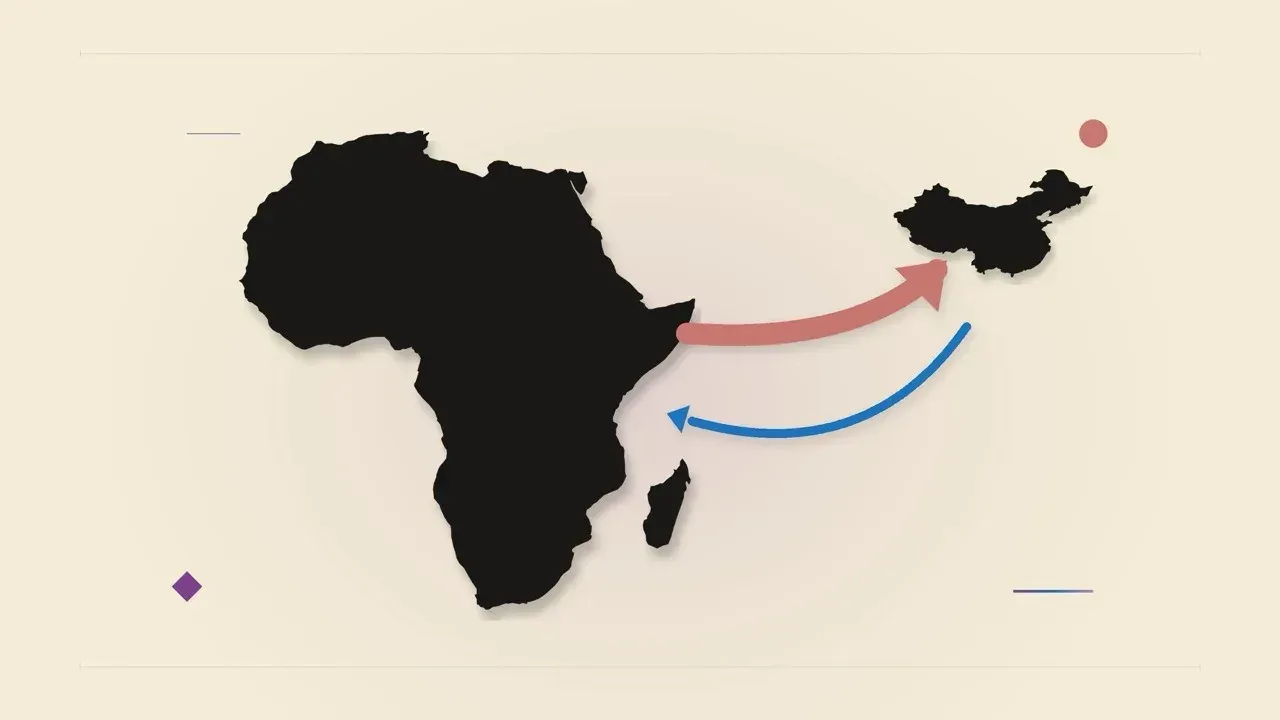
China-Africa trade reached a record $275 billion in 2024. However, the headline growth hides a more fragile shift.
African exports remain commodity-heavy, Chinese lending has fallen sharply, and debt repayments are now exceeding new disbursements.
The next test is whether African countries can turn market access, transition minerals and low-carbon technology trade into industrial upgrading, jobs and climate-resilient growth.
China-Africa Ties Enter New Test Today
China’s economic relationship with Africa is entering a more selective, more strategic and more constrained phase, according to the 2026 edition of the China-Africa Economic Bulletin by the Boston University Global Development Policy Centre and the African Economic Research Consortium.
The report shows a partnership defined by record trade, recovering foreign direct investment, growing low-carbon technology flows and a sharp retreat in lending.
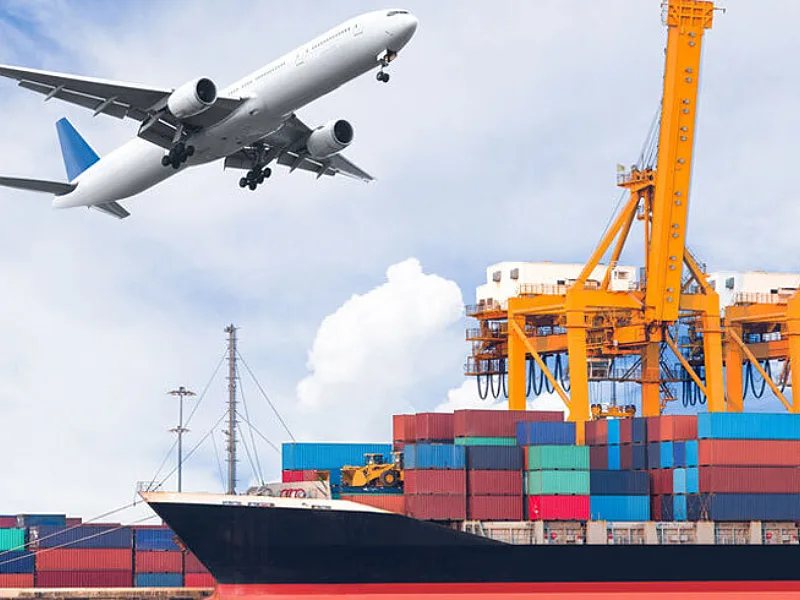
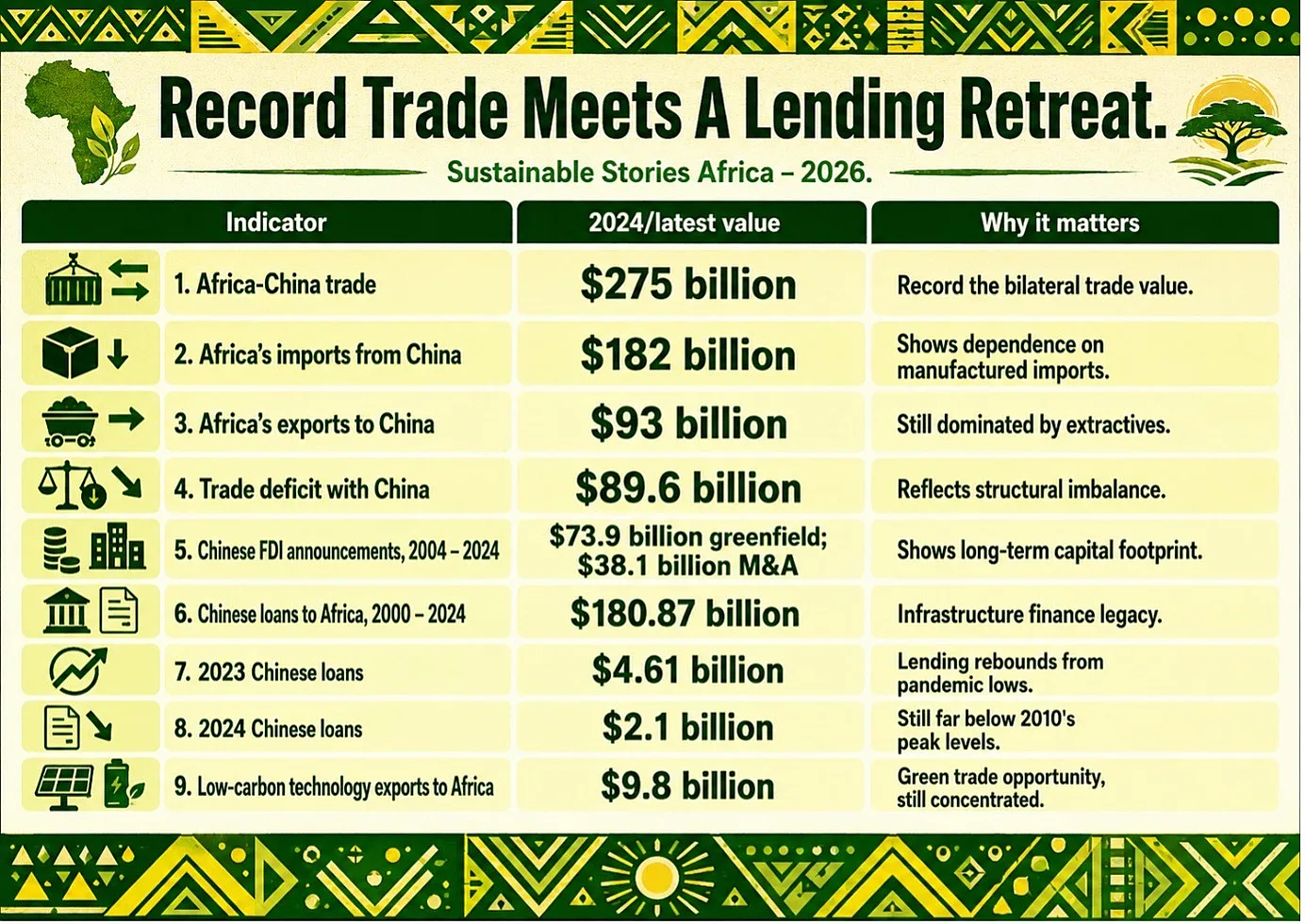
In 2024, Africa’s bilateral trade with China reached $275 billion, including $182 billion in imports and $93 billion in exports. China accounted for 16% of Africa’s exports and 28% of its imports.
For African policymakers, this is no longer just a story about trade volumes. It is about value capture.
The core question is whether Africa can move from exporting raw minerals and importing finished goods to building industries around clean energy, manufacturing, logistics, digital infrastructure and climate resilience.
Record Trade Meets A Lending Retreat
The defining tension in China-Africa economic relations is no longer about scale — it is about direction. China-Africa trade reached a record high in 2024; however, Africa's structural imbalance persists.
Imports from China totalled $182 billion against exports of $93 billion, leaving a deficit of $89.6 billion, a marginal improvement from $91.9 billion in 2023, driven largely by stronger extractive exports.
The financing picture tells a sharper story. Of the $180.87 billion in Chinese loans committed to Africa between 2000 and 2024, annual commitments have fallen below $5 billion since 2020, a dramatic retreat from the 2010s, when Chinese lending frequently exceeded World Bank disbursements.
More critically, net capital flows from Chinese lenders turned negative after 2020, meaning African countries are now repaying more in principal and interest than they receive in new disbursements.
As demand for infrastructure, power systems and climate-resilient investment remains high, the old sovereign-loan model is fading, and its replacement has not completely taken shape.
Minerals, Markets, and Capital Tell a Story
Africa's trade relationship with China remains structurally skewed.
Despite two decades of deepening engagement, agriculture and manufacturing together accounted for only 13% of Africa's export values to China between 2000 and 2024, with extractives continuing to dominate the relationship.
The minerals picture carries both strategic weight and development risk. China's top transition mineral imports from Africa include copper, bauxite, aluminium, chromium, manganese and cobalt.
Copper exports alone rose from under $5 billion in 2010 to $26 billion in 2024, with Africa supplying 18% of China's global copper imports.
Africa also supplies over 80% of China's chromium and manganese imports, primarily from South Africa, while Guinea dominates bauxite and aluminium flows.
This gives Africa meaningful leverage in the global energy transition; however, leverage translates into development when it creates additional value for the continent.
Where minerals leave as ores and concentrates, the jobs, technology and industrial learning remain elsewhere.
Regarding investment, Chinese companies announced $73.9 billion in greenfield FDI and $38.1 billion in partnerships across Africa between 2004 and 2024.
Greenfield FDI peaked at a record $13.7 billion in 2023 before moderating to $8.6 billion in 2024, driven by a small number of large projects.
North Africa is gaining prominence. Morocco and Egypt alone captured 31% of Chinese FDI from 2022 to 2024, with Morocco's export-oriented automotive and electric vehicle value chain emerging as a flagship example of Chinese investment connecting African production to European markets.
Value Addition Can Change The Bargain
The next phase of China-Africa engagement carries a clear strategic opportunity: shifting from extraction to processing, from import dependence to local production, and from isolated project deals to integrated industrial ecosystems.
Early evidence suggests this transition is possible when policy aligns with investment.
In the Democratic Republic of Congo, Chinese-established copper and cobalt smelters contributed to a measurable increase in the share of refined copper cathodes exported after 2020.
In Zimbabwe, restrictions on raw lithium exports attracted Chinese investment in lithium concentrator facilities, while a tighter 2026 policy extending those restrictions to concentrates helped trigger investment in lithium sulphate processing plants.
The lesson is consistent. African industrial policy can redirect Chinese capital toward value addition when domestic rules, infrastructure, reliable power and skills are in place.
Low-carbon technologies present a parallel opportunity. China exported $9.8 billion in clean technologies to Africa in 2024, approximately 5.4% of total exports to the continent, with a focus on power generation, energy storage and pollution control.
South Africa, Egypt and Nigeria lead as destination markets. However, geographic concentration is a caution.
Without deliberate policy, cheaper Chinese clean technologies will remain limited to larger markets rather than driving distributed power access, resilient cities and productivity gains for small businesses across the continent.
The risk otherwise is stark: Africa supplies the minerals powering the global green transition while importing its finished products.
Policy Must Turn Access Into Industry
China's extension of zero-tariff treatment to all 53 African countries with diplomatic ties in 2026, building on preferential access granted to 33 least developed countries from December 2024, opens a meaningful window for market access.
However, duty-free entry alone will not resolve the structural imbalance. African governments must diversify exports beyond primary commodities into priority sectors where Chinese demand, African resources and regional markets converge: battery minerals, agro-processing, pharmaceuticals, solar assembly, EV components and digital infrastructure.
Debt strategy requires equal discipline. Africa's public and publicly guaranteed external debt reached $760 billion in 2024, with China accounting for 10.9%, down from 14.8% in 2018.
Between 2026 and 2030, African governments are projected to allocate an average of 11.2% of total expenditure to debt repayments, rising above 25% in Djibouti and Senegal, and reaching 42% in Angola, levels that risk crowding out health, education and climate adaptation spending.
On energy, Chinese financing has shifted away from large sovereign loans toward engineering, procurement and construction contracts.
With no new fossil fuel financing recorded after 2021 and non-hydro renewable lending totalling just $1.7 billion across 2000 – 2024, the transition to clean energy finance remains incomplete.
Without embedded technology transfer and local content requirements, project delivery will not automatically build African ownership or capability.
Path Forward – Build Value, Manage Debt, Green Growth
Africa’s China strategy must now become more selective: negotiate for value addition, protect fiscal space, deepen regional markets and use low-carbon technology trade to accelerate inclusive industrialisation.
The opportunity is real, rather than automatic.
The next phase should be judged less by headline trade volumes and more by jobs, processing capacity, cleaner power, debt sustainability and African ownership of the value chain.