Africa's clean-energy transition is entering a decisive phase. With record renewable investments, stronger policy frameworks, and expanding grid and off-grid solutions, 2026 is shaping up to be a turning point for the continent's power systems.
From solar corridors in North Africa to mini-grids in rural West Africa, momentum is building across many markets long time constrains by fossil-fuel dependence and infrastructure gaps.
The question now is whether political will, finance, and local execution can finally converge.
Africa's Clean Energy Inflexion Point
Africa could be on the verge of its most significant clean-energy shift in decades. By 2026, a convergence of policy reforms, infrastructure investment, and technology deployment may finally unlock the continent's vast renewable potential, reshaping electricity access, industrial growth, and climate resilience.
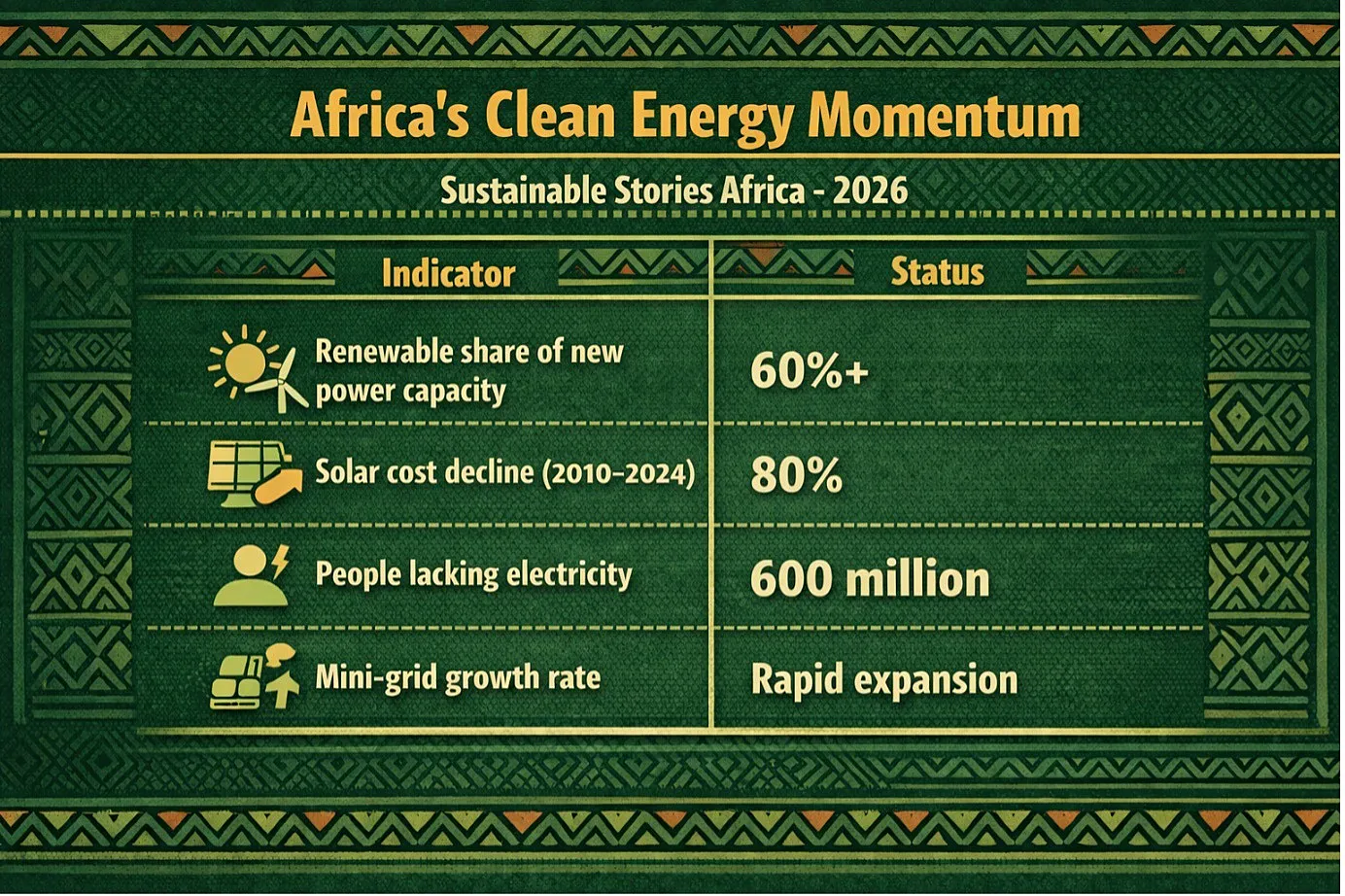
Renewables already account for over 60% of Africa's new power-generation capacity, driven largely by solar and wind projects.
Governments, multilateral lenders, and private investors are accelerating commitments to scale clean energy as energy demand surges alongside rapid urbanisation and population growth.
With power shortages still costing African economies up to 4% of GDP annually, the stakes are high.
What's Driving the Momentum?
Several structural shifts are pushing Africa's energy transition into a faster lane.
- Policy reform has reduced entry barriers for private investors. Countries such as Kenya, Morocco, Egypt, and South Africa have expanded renewable procurement frameworks, while Nigeria and Ghana are reforming electricity markets to attract clean-energy finance.
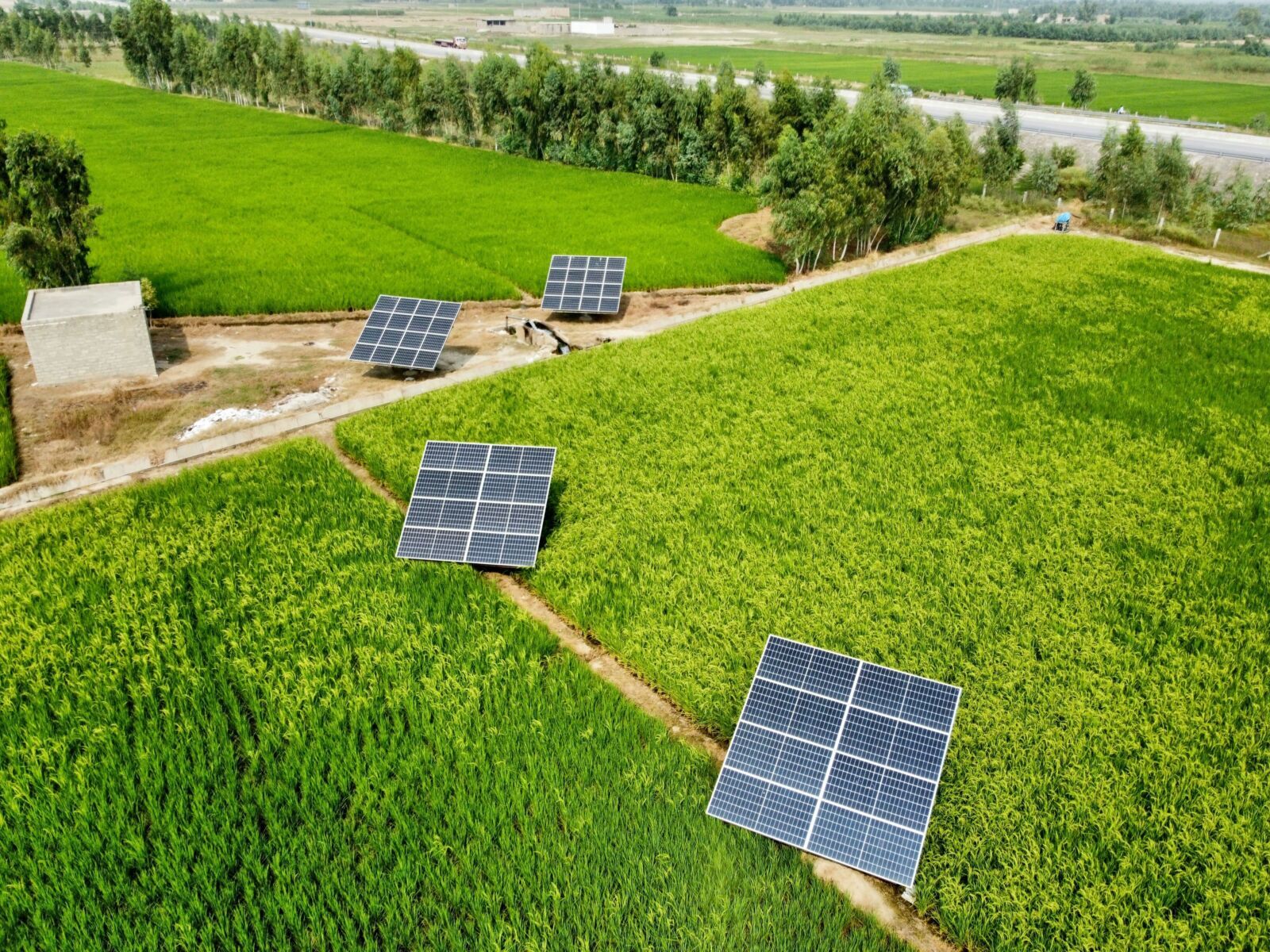
- Falling technology costs have made renewables more competitive than fossil fuels. Solar PV costs in Africa have dropped by over 80% in the past decade, enabling grid-scale projects and off-grid solutions for rural communities.
- Decentralised power is also transforming access. Mini-grids and solar home systems are reaching communities that national grids have failed to serve, particularly in West and Central Africa.
Africa's Clean Energy Momentum
| Indicator | Status |
|---|---|
| Renewable share of new power capacity | 60%+ |
| Solar cost decline (2010–2024) | 80% |
| People lacking electricity | 600 million |
| Mini-grid growth rate | Rapid expansion |
Investors are responding. Clean-energy financing to Africa surpassed $20 billion in recent years, supported by climate funds, development banks, and blended-finance instruments.
However, progress remains uneven. Grid constraints, weak utility finances, and political instability still delay project execution.
Where the Big Bets Are Happening
Three key clean-energy fronts are defining Africa's 2026 outlook.
- Utility-Scale Renewables – North Africa is emerging as a solar and wind powerhouse. Egypt's Benban Solar Park and Morocco's Noor complex show how large-scale renewables can power industrial growth and green exports.
- Off-Grid Energy Access – In countries like Nigeria, Sierra Leone, and Rwanda, mini-grids are expanding electricity access faster than traditional grid connections. These systems support small businesses, clinics, and schools, reducing dependence on diesel.
- Green Industrialisation – Africa is positioning renewables as a foundation for green manufacturing, electric mobility, and green hydrogen exports, especially in countries such as Namibia, South Africa, and Morocco.
Strategic Clean Energy Focus Areas
| Segment | Impact |
|---|---|
| Solar & wind farms | Grid stability, industrial power |
| Mini-grids | Rural access, SMEs |
| Green hydrogen | Export revenues, decarbonisation |
| Battery storage | Grid reliability |
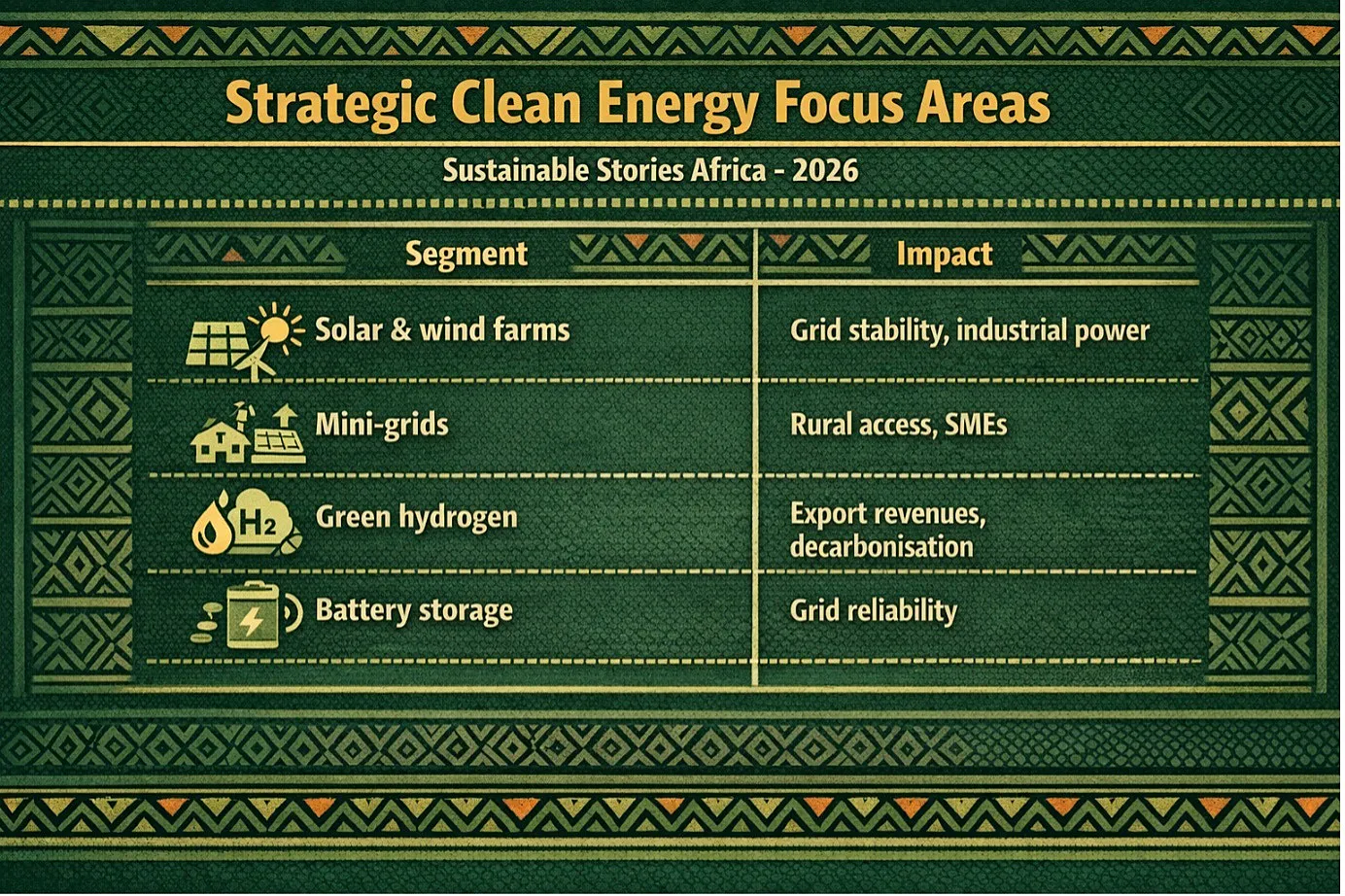
The strategic pivot is clear: clean energy is no longer just about climate goals — it is now an economic competitiveness tool.
What Still Needs Fixing
Despite growing momentum, structural barriers remain.
- Financing gaps persist, especially for early-stage projects. Many African utilities struggle with cost recovery, weakening investor confidence.
- Grid infrastructure lags behind renewable growth. Without modern transmission systems, clean power cannot reach industrial and urban centres efficiently.
- Regulatory uncertainty in some markets still slows approvals, while currency risks increase project costs.
Experts argue that the next phase of Africa's energy transition must prioritise:
- Stronger power-sector governance
- Blended-finance mechanisms
- Local manufacturing capacity
- Skills development
Failure to act could lock countries into fossil-fuel infrastructure for decades.
PATH FORWARD – Turning Momentum into Market Reality
Africa's 2026 clean-energy opportunity will depend on coordinated policy, finance, and infrastructure reform.
Governments must stabilise electricity markets, de-risk investments, and modernise grids to unlock private capital at scale.
If momentum holds, clean energy could become Africa's growth engine, powering industries, expanding access, and strengthening climate resilience across the continent.
Culled From: https://www.africanleadershipmagazine.co.uk/why-2026-could-be-africas-breakthrough-year-for-clean-energy/