
Emerging markets are entering a decisive decade for employment.
A surge in working-age populations is colliding with slower growth, automation, and fragile institutions.
Experts warn that without structural reform, the jobs gap could widen, reshaping economic stability and social cohesion.
Demographic Dividend or Disruption Risk?
Emerging markets face a stark equation: rapidly expanding youth populations and insufficient job creation.
At a recent policy dialogue examining labour market trends, economists and development experts warned that the next decade will test whether demographic expansion becomes an economic dividend or a destabilising force.
With millions entering working age annually across Africa, South Asia and parts of Latin America, employment growth must outpace population growth to sustain social stability and economic momentum.
The risk, panellists cautioned, is structural unemployment embedded within growth models that are not labour-absorbing.
Growth Without Enough Jobs
Speakers outlined three converging pressures.
- First, economic growth in many emerging markets has slowed compared to pre-pandemic levels.
- Second, automation and digitalisation are reshaping labour demand, favouring higher-skilled roles.
- Third, education systems are not always aligned with market needs.
One economist noted that "emerging markets are producing more graduates, but not necessarily more employable workers."
Youth unemployment rates in several African economies remain significantly above national averages, while informal employment continues to dominate labour markets. The structural mismatch between the supply of skills and employer demand was described as a core vulnerability.
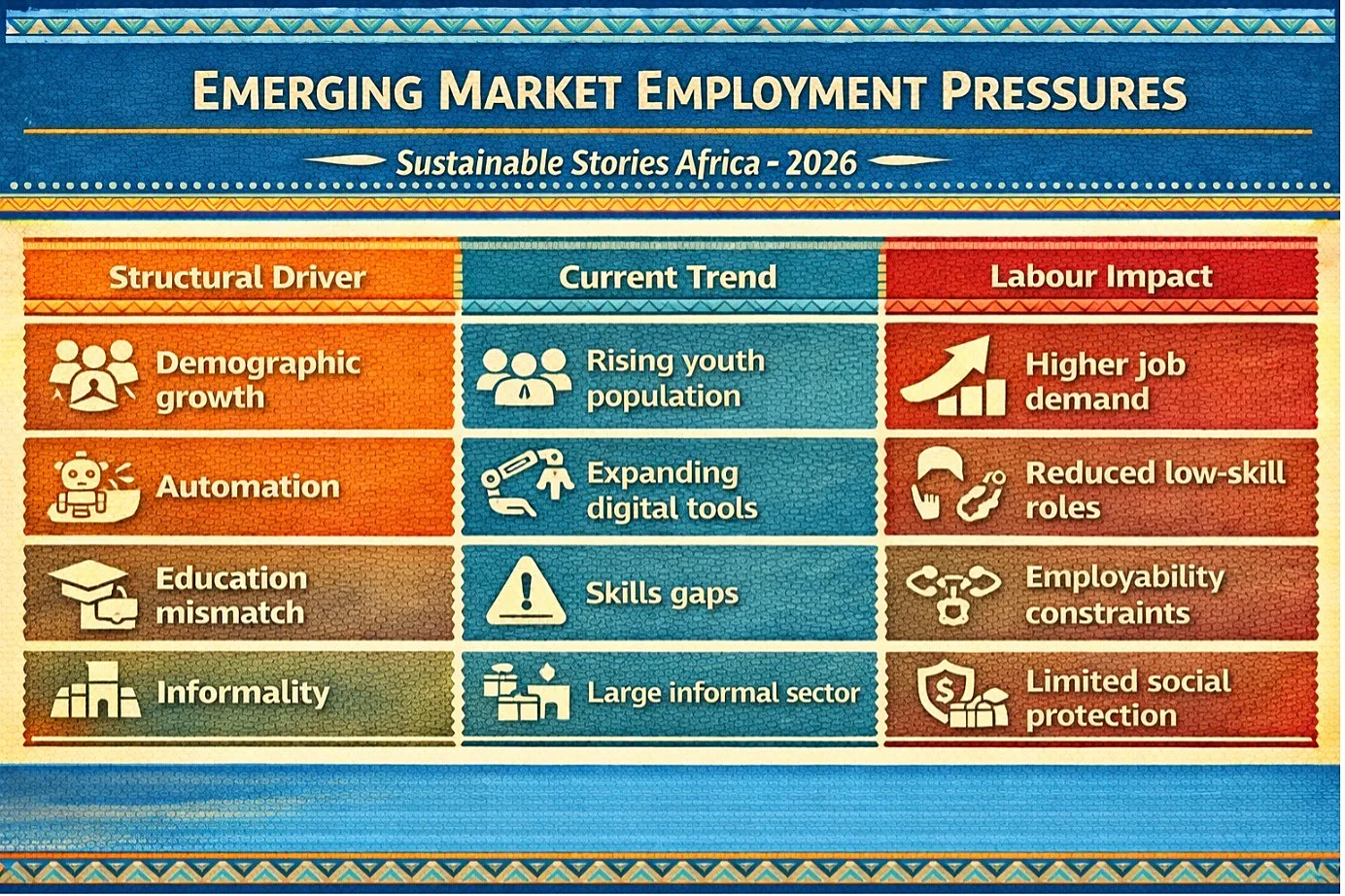
Emerging Market Employment Pressures
| Structural Driver | Current Trend | Labour Impact |
|---|---|---|
| Demographic growth | Rising youth population | Higher job demand |
| Automation | Expanding digital tools | Reduced low-skill roles |
| Education mismatch | Skills gaps | Employability constraints |
| Informality | Large informal sector | Limited social protection |
Participants emphasised that the challenge is not purely cyclical. It is structural, requiring coordinated reforms across education, industrial policy and private sector investment.
Turning Demography into Advantage
Despite the warning signals, panellists argued that emerging markets still possess a unique opportunity.
A young workforce, if properly trained and integrated, could fuel productivity gains, entrepreneurship, and regional trade expansion.
Policy priorities discussed included:
- Investment in technical and vocational training.
- Support for small and medium-sized enterprises (SMEs).
- Digital infrastructure expansion to enable remote and platform work.
- Labour-intensive green transition initiatives.
One speaker highlighted the role of climate adaptation and renewable energy deployment as potential job multipliers, particularly in infrastructure and services sectors.
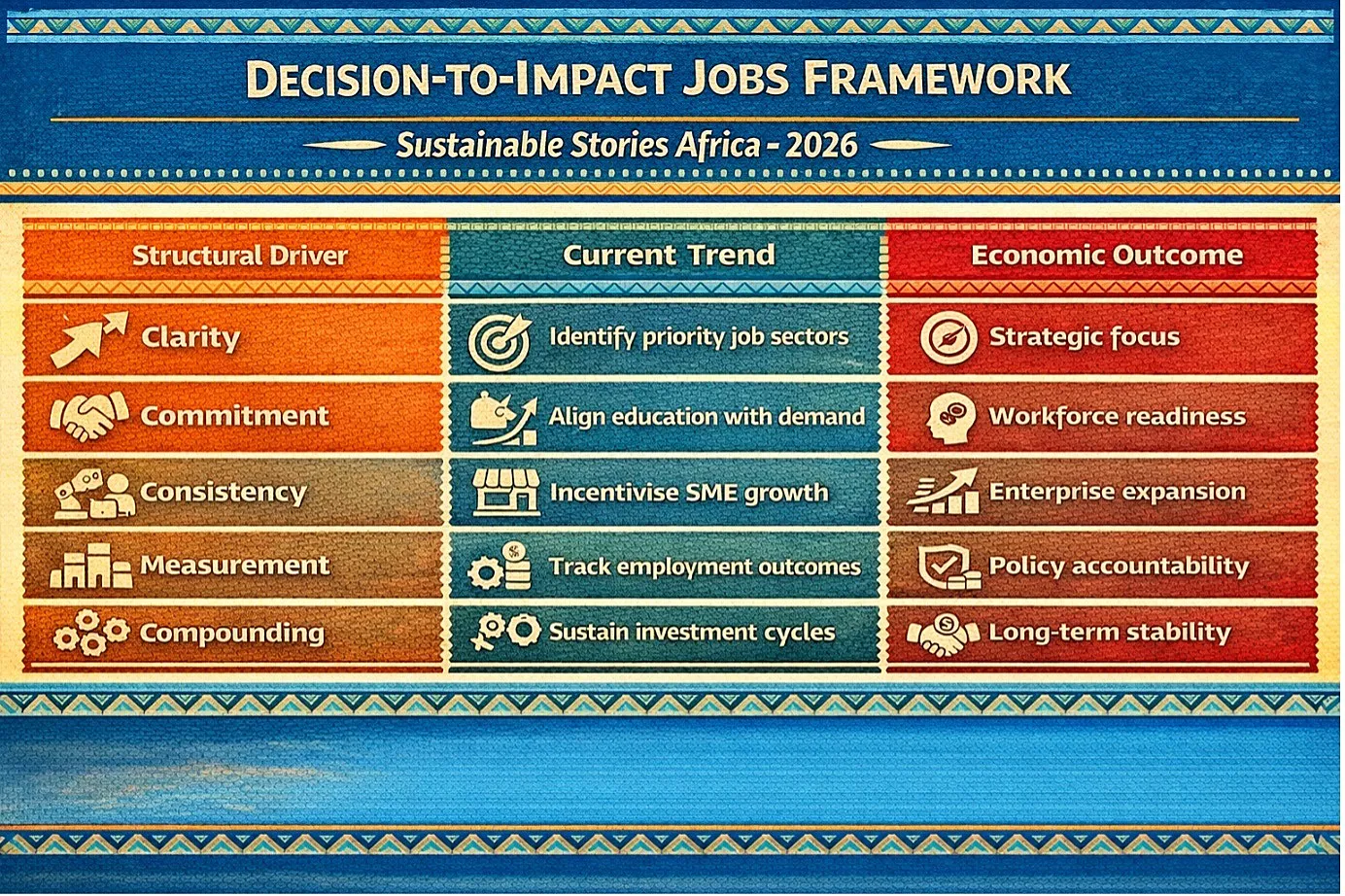
Decision-to-Impact Jobs Framework
| Stage | Leadership Action | Economic Outcome |
|---|---|---|
| Clarity | Identify priority job sectors | Strategic focus |
| Commitment | Align education with demand | Workforce readiness |
| Consistency | Incentivise SME growth | Enterprise expansion |
| Measurement | Track employment outcomes | Policy accountability |
| Compounding | Sustain investment cycles | Long-term stability |
The panel highlighted that failure to act could lead to costs going beyond economic considerations. Persistent youth unemployment risks migration pressures, political instability and weakened investor confidence.
Coordinated Reform for Employment Resilience
Speakers concluded that no single policy lever will resolve the employment gap. Instead, coordinated reform across fiscal, educational and industrial domains.
Governments were urged to prioritise labour-intensive sectors while maintaining macroeconomic stability.
Private sector leaders were encouraged to deepen apprenticeship pipelines and invest in local talent ecosystems. Multilateral institutions were called upon to support infrastructure financing and skills transfer programs.
The broader implication is clear: the employment challenge is a defining test for development in emerging markets. Managing it effectively could accelerate inclusive growth. Mishandling it could entrench inequality and volatility.
Path Forward – Align Skills, Industry, Investment
Emerging markets must synchronise education reform, SME support and sectoral investment to convert demographic growth into productive employment.
By prioritising labour-intensive industries and embedding measurable workforce strategies, governments can transform youth population expansion into sustained economic resilience rather than systemic strain.
Culled From: Event | A Coming Jobs Challenge in Emerging Markets?