Africa's leading renewable energy markets are accelerating new solar, wind and battery investments as clean electricity becomes increasingly cost-competitive.
The expansion reflects stronger policy frameworks, investor confidence and growing pressure to improve energy security.
For millions of Africans, the transition promises more reliable electricity, lower fuel dependence and stronger foundations for industrial growth.
Africa's Energy Race Enters New Phase
Africa's renewable energy transition is entering a decisive new chapter as the continent's leading clean-energy markets move from ambition to execution, rapidly expanding solar, wind and battery capacity to strengthen electricity systems and attract long-term investment.
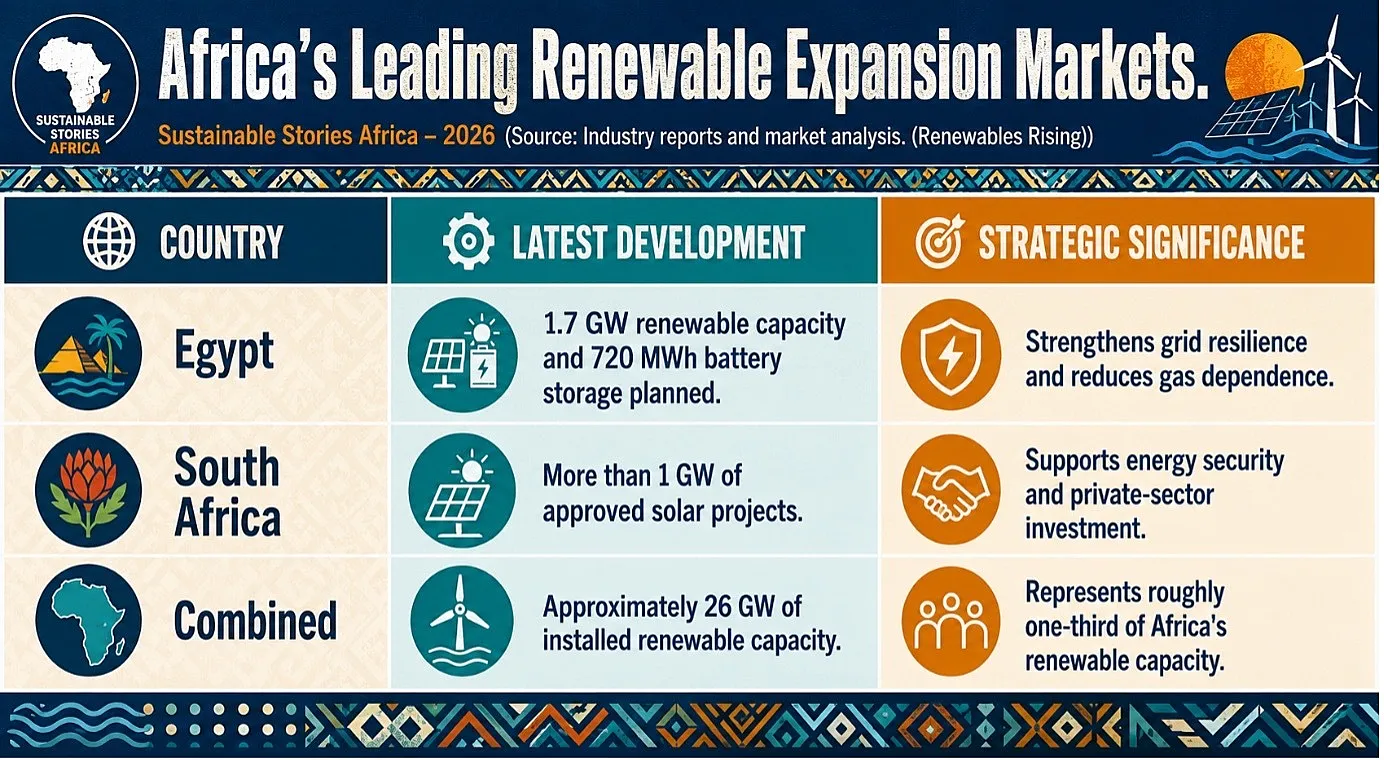
Egypt and South Africa, the continent's largest renewable energy markets, are leading the latest expansion. Egypt plans to connect approximately 1.7 GW of predominantly solar capacity alongside 720 MWh of battery storage before year-end, while South Africa has approved more than 1 GW of new solar projects.
Together, the two countries already account for roughly 26 GW of installed renewable capacity, representing nearly one-third of Africa's renewable energy base.
The acceleration comes as governments confront rising electricity demand, volatile fossil fuel prices and growing industrialisation, making reliable clean energy increasingly central to economic competitiveness.
Investment Confidence Begins Following Policy Confidence
The continent's renewable momentum is no longer being driven solely by environmental commitments. It is increasingly underpinned by economics.
Rapid declines in solar generation costs, improvements in battery technologies, and stronger regulatory frameworks have significantly improved project bankability.
Countries that have strengthened procurement systems, financing structures and permitting processes are now attracting a disproportionate share of investment.
The shift is occurring against an important global backdrop. Renewable energy generated 34% of global electricity in 2025, overtaking coal's 33% share, while renewables and nuclear together are expected to provide half of global electricity by 2030.
However, Africa still faces its greatest development challenge: approximately 600 million people remain without access to electricity.
Industry experts increasingly argue that the constraint is no longer technology.
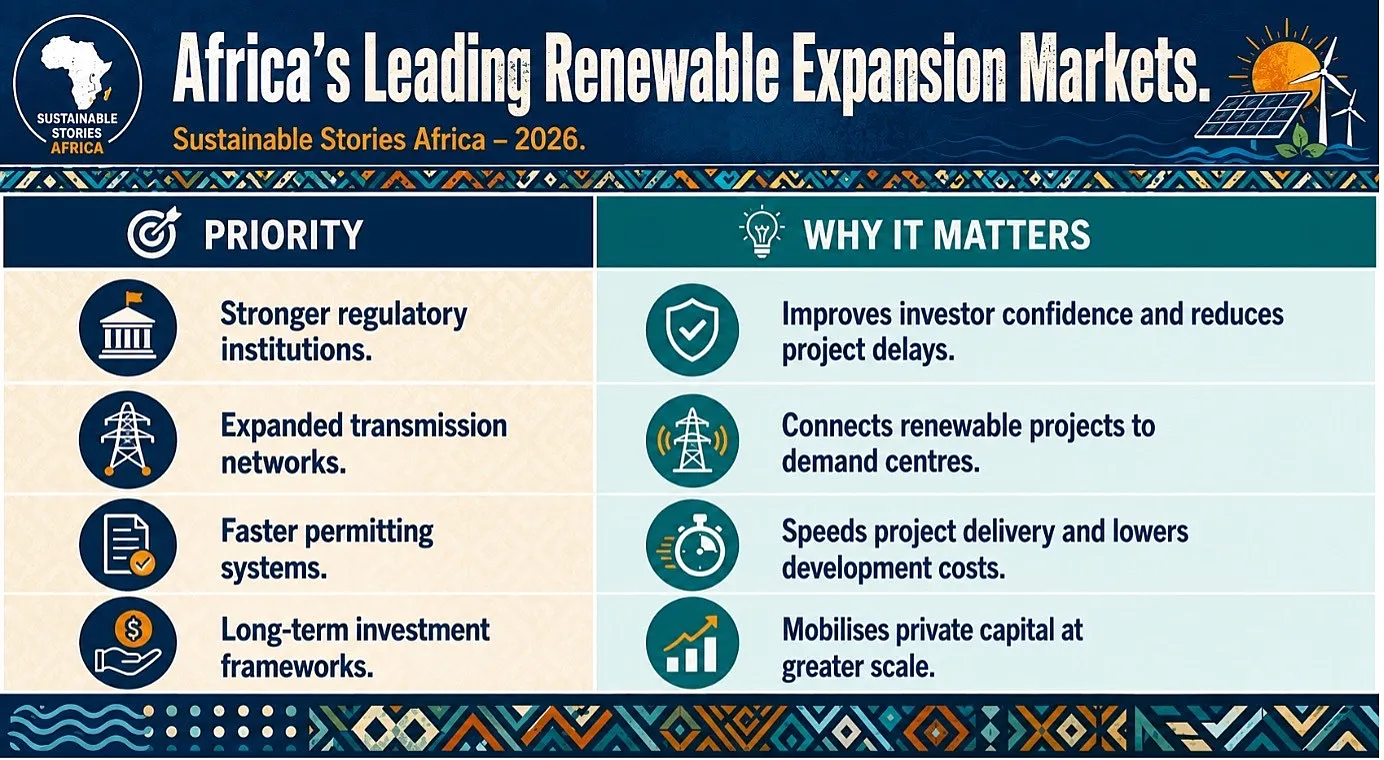
Instead, attention has shifted toward building stronger electricity markets, regulatory institutions, transmission infrastructure and investment ecosystems capable of deploying renewable projects at scale.
As Wangari Muchiri, Chief Executive of RE.Think Energy observed that the next phase is no longer about proving clean energy works; it is about removing the barriers preventing rapid deployment.
Clean Energy Is Becoming An Economic Strategy
The implications extend well beyond electricity generation.
Reliable renewable energy reduces exposure to imported fuel price shocks, strengthens manufacturing competitiveness and improves investor confidence.
Lower operating costs can help businesses expand production while enabling governments to redirect scarce fiscal resources toward healthcare, education and infrastructure.
For households, the benefits are equally tangible:
- Fewer power disruptions.
- Lower energy costs over time.
- Greater employment opportunities created by expanding renewable industries.
Conversely, failure to sustain reform risks leaving many African economies vulnerable to persistent power shortages, rising energy costs and slower industrial development, even as global investment increasingly favours cleaner technologies.
Institutions Must Now Match Renewable Ambition
The continent's next energy milestone will depend less on announcing ambitious generation targets than on building institutions capable of delivering projects efficiently.
That means accelerating transmission investment, modernising electricity markets, improving permitting processes and creating predictable regulatory environments that reduce investment risk.
Recent philanthropic and development initiatives, including new institutional support programmes announced by Bloomberg Philanthropies, reflect growing recognition that governance capacity is becoming just as important as engineering capability in determining Africa's renewable future.
Path Forward – Strong Institutions Will Unlock Sustainable Growth
Africa's renewable leaders have demonstrated that competitive policy frameworks can attract investment and accelerate deployment.
The next challenge is to extend that success across more markets through stronger institutions, smarter regulation and modern electricity infrastructure.
If governments, financiers and development partners sustain this momentum, renewable energy can become not only Africa's cleanest power source, but also one of its strongest engines for inclusive economic growth, industrial competitiveness and long-term climate resilience.
Culled From: Africa's renewables leaders speed up expansion