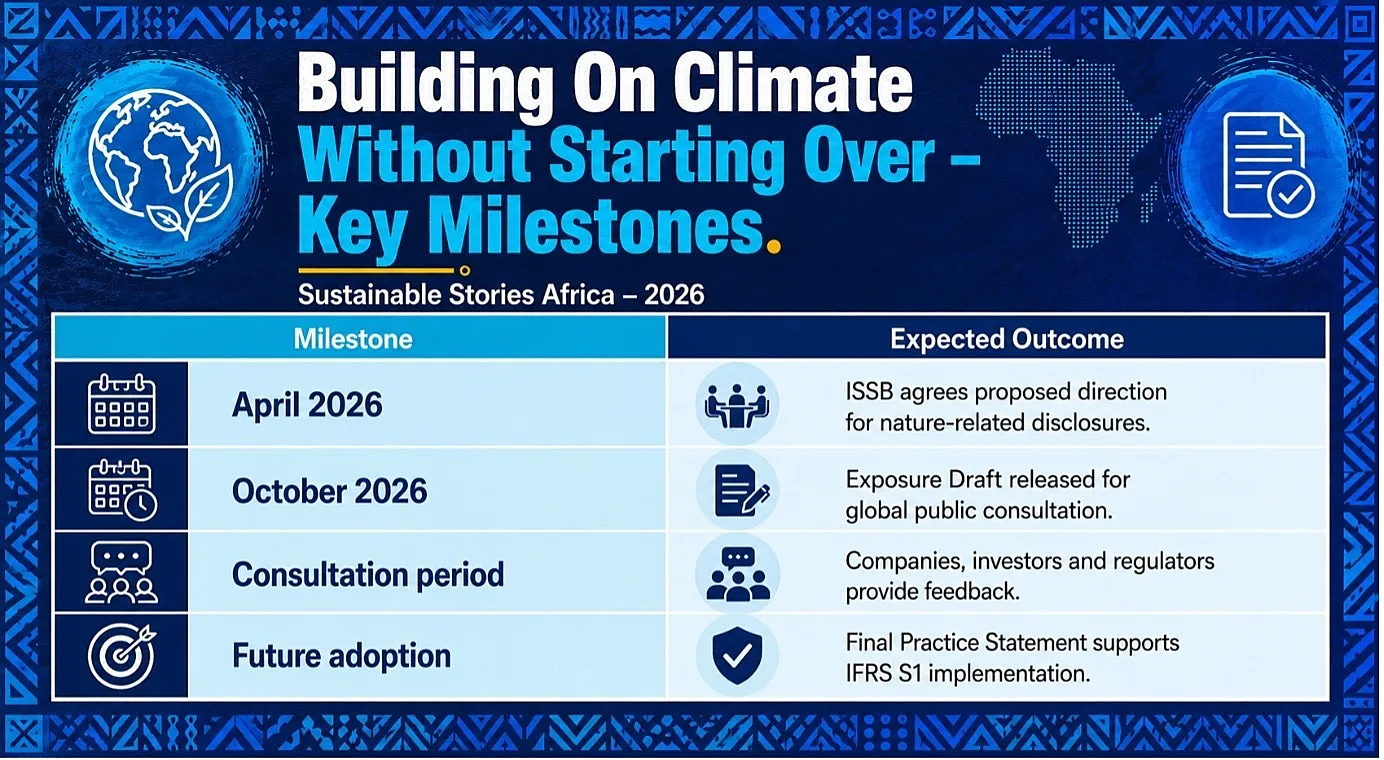
The International Sustainability Standards Board has confirmed plans to publish a nature-related disclosure exposure draft in October 2026.
The move signals the next phase of globally consistent sustainability reporting beyond climate.
For businesses, investors and African regulators, the proposal could reshape how nature-related risks influence capital allocation, resilience and long-term value creation.
ISSB Charts New Path For Nature
Nature is emerging as the next frontier of corporate reporting.
The International Sustainability Standards Board (ISSB) has confirmed plans to publish an Exposure Draft for public consultation in October 2026, advancing globally consistent nature-related financial disclosures.
Rather than creating a new mandatory IFRS standard, the ISSB will develop an IFRS Practice Statement guiding companies in applying existing IFRS S1 requirements to material nature-related risks.
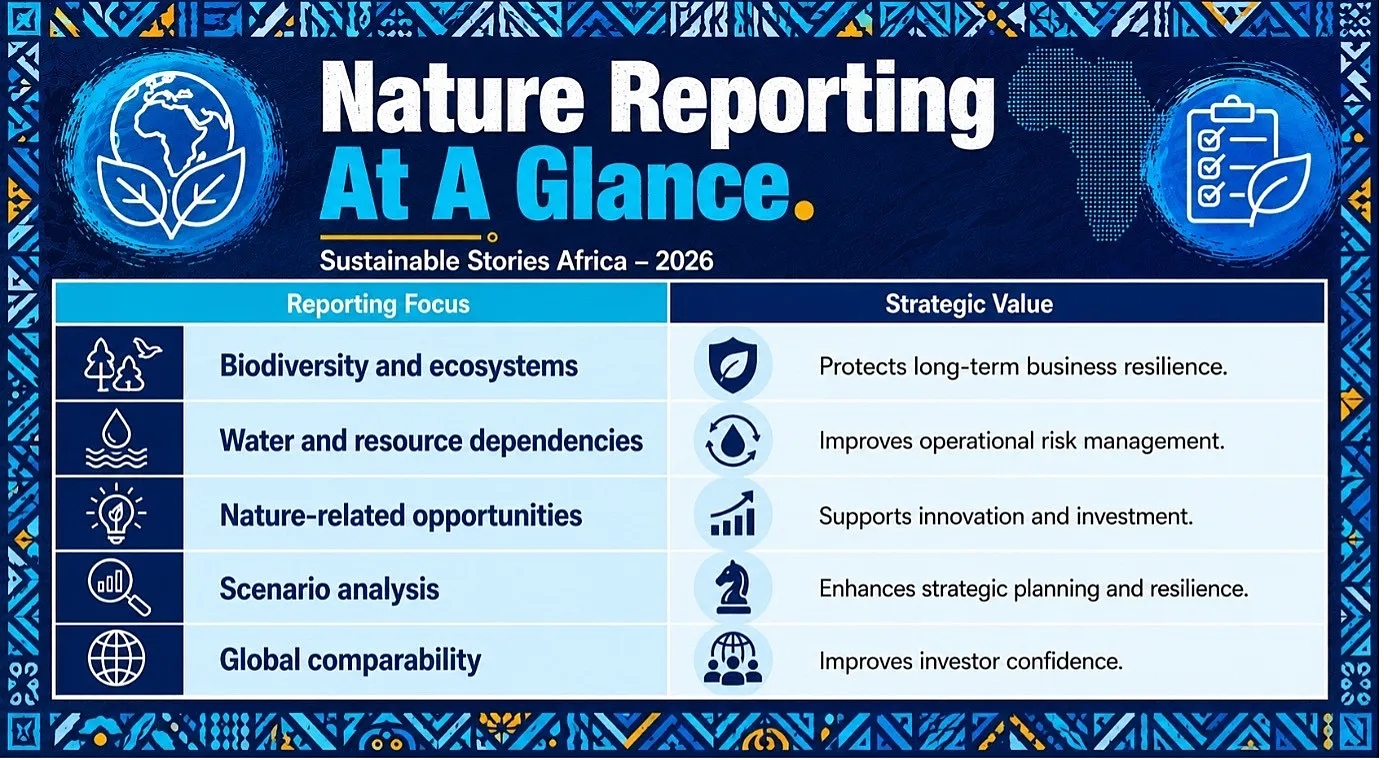
The move responds to growing investor demand for comparable data on biodiversity loss, water security, and resource dependencies across agriculture, mining, banking, and infrastructure.
For African economies, where natural capital underpins livelihoods and exports, this could reshape disclosure practices and improve access to international capital.
Nature Reporting Enters Its Next Chapter
The ISSB's latest decision answers an increasingly urgent market question: what comes after climate disclosure?
Following the successful rollout of IFRS S1 and IFRS S2, the Board agreed that nature-related disclosures should now become the next priority.
The proposed Practice Statement will provide companies with detailed guidance on reporting nature-related risks and opportunities without changing the mandatory requirements already contained in IFRS S1.
Public consultation is scheduled to begin with the publication of the Exposure Draft in October 2026.
ISSB Chair Emmanuel Faber said providing material nature-related disclosures is already required where such information affects enterprise value, adding that the Practice Statement will help companies understand how to make those disclosures consistently.
Building On Climate Without Starting Over
Unlike climate reporting, where global standards already exist, nature-related reporting remains fragmented.
To address this, the ISSB will build on the work of the Taskforce on Nature-related Financial Disclosures (TNFD), incorporating elements such as the LEAP (Locate, Evaluate, Assess and Prepare) approach while maintaining consistency with IFRS S1 and IFRS S2.
This approach aims to reduce reporting duplication and give companies that already use TNFD guidance a smoother transition toward globally recognised reporting practices.
The Board has also reached tentative technical decisions that would require more transparent disclosure of how companies use nature-related scenario analysis to assess resilience and identify opportunities, while applying proportionality mechanisms similar to those used in climate reporting.
For African businesses, these developments arrive as several jurisdictions, including Nigeria through the Financial Reporting Council's sustainability roadmap, prepare to implement ISSB-aligned reporting frameworks.
Better Nature Data Can Unlock Better Capital
Reliable nature-related disclosures have implications far beyond compliance.
Investors increasingly recognise that biodiversity loss, water scarcity, pollution and ecosystem degradation can directly affect business performance, supply chains and financial resilience.
Standardised reporting enables lenders, insurers and asset managers to price these risks more accurately while rewarding businesses that actively manage them.
For Africa, where agriculture, mining, tourism, forestry and fisheries depend heavily on natural ecosystems, improved disclosures could strengthen investment confidence and support sustainable infrastructure, climate adaptation and biodiversity conservation.
The ISSB's decision to build upon the TNFD framework also reduces implementation costs for companies already investing in nature-risk assessments, helping create greater interoperability across global sustainability reporting systems.
Prepare Before The Consultation Opens
The October Exposure Draft offers more than a regulatory milestone—it presents an opportunity for companies to shape the future of global sustainability reporting.
- Businesses should begin identifying material nature-related dependencies and impacts, strengthen governance over environmental risks and familiarise themselves with the TNFD framework before consultation begins.
- Regulators, professional bodies and stock exchanges can also use the consultation period to build capacity and prepare national implementation strategies.
For African policymakers, early engagement will help ensure regional priorities, including biodiversity conservation, food security, water resilience and sustainable development, are reflected in the emerging global reporting landscape.
Path Forward – Align Nature Reporting With Sustainable Growth
The ISSB's consultation will move nature reporting closer to becoming a globally consistent component of sustainability disclosures.
Success will depend on broad participation from companies, investors, regulators and civil society.
For African markets, aligning with these evolving frameworks can strengthen ESG credibility, improve access to international capital and ensure that natural capital is recognised not only as an environmental asset but also as a core driver of long-term economic resilience.
Culled From: ISSB Targets October 2026 for Nature-Related Disclosure Exposure Draft