
Nigeria's largest corporates and financial institutions are no longer treating ESG as a compliance obligation but as a strategic lever for long-term competitiveness. Business leaders from manufacturing, banking, and consumer goods now see sustainability as central to capital access, resilience, and growth.
The shift signals a broader recalibration of how Nigerian enterprises define value, risk, and corporate leadership.
Nigeria's Corporate Leaders Reframe ESG as Competitive Strategy
Nigeria's leading corporates and business institutions, including Dangote Group, Access Bank, British American Tobacco (BAT), and the Lagos Chamber of Commerce and Industry (LCCI), are increasingly embedding environmental, social, and governance (ESG) principles into core business strategy, marking a decisive shift from compliance-driven sustainability to long-term value creation.
Speaking at recent business and sustainability forums reported by THISDAY, corporate executives argued that ESG has become integral to competitiveness, investor confidence, and operational resilience, particularly as global capital markets, regulators, and consumers raise expectations around climate action, governance, and social impact.
ESG Moves From Reporting to Strategy
What distinguishes this new phase is not rhetoric, but strategic intent. Nigeria's largest enterprises are repositioning ESG as a driver of efficiency, risk management, and market access rather than a cost centre.
For conglomerates such as Dangote Group, ESG alignment increasingly intersects with energy efficiency, industrial emissions management, and supply-chain resilience. For financial institutions like Access Bank, it is shaping credit decisions, portfolio risk screening, and access to international sustainable finance pools.
Why Nigeria's Big Corporates Are Leaning Into ESG
Several structural forces are accelerating this shift.
Key Drivers of Corporate ESG Adoption in Nigeria
| Driver | Why It Matters |
|---|---|
| Investor expectations | ESG affects the cost and availability of capital |
| Regulatory pressure | Disclosure and governance standards are tightening |
| Energy transition risks | Exposure to carbon and fuel volatility |
| Market positioning | ESG credibility influences brand trust |
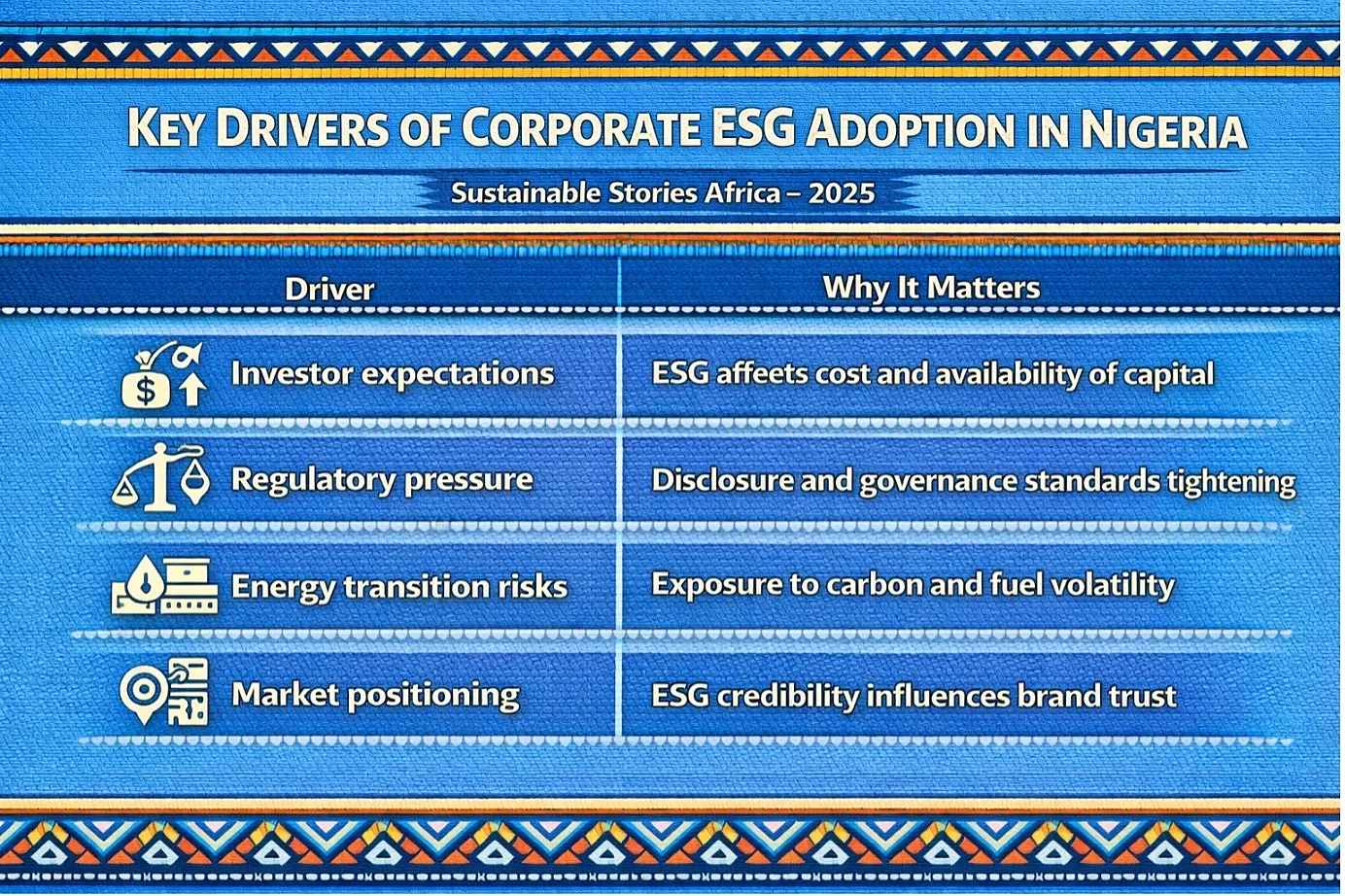
Executives increasingly acknowledge that weak ESG performance now translates into tangible financial penalties, from higher borrowing costs to lost partnership opportunities.
ESG as a Capital and Risk Filter
For banks and institutional investors, ESG is rapidly becoming a credit and risk filter.
Nigerian lenders are embedding environmental and social criteria into lending frameworks, while multinational corporates face pressure from global parent companies and supply-chain partners to meet international standards.
How ESG Influences Capital Decisions
| ESG Dimension | Business Impact |
|---|---|
| Environmental | Energy costs, carbon exposure |
| Social | Workforce stability, community risk |
| Governance | Board credibility, investor trust |
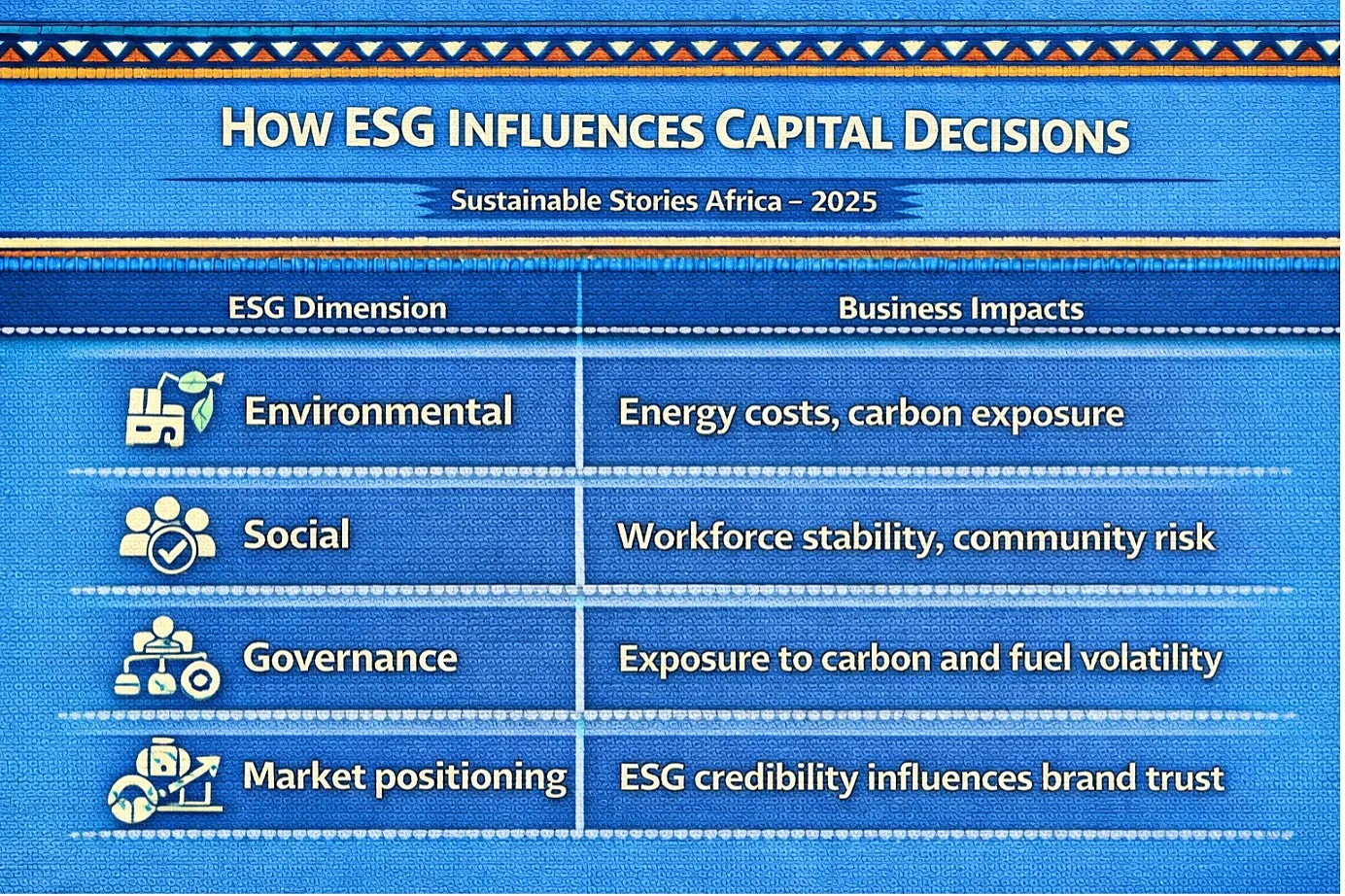
This evolution aligns Nigeria's corporate sector more closely with global frameworks such as ISSB and TCFD, even as local capacity and data challenges persist.
The Execution Gap Remains the Test
Despite growing consensus, execution remains uneven. While large corporates are advancing ESG integration, many mid-sized firms still struggle with data systems, internal expertise, and financing for transition investments.
Business leaders caution that without stronger policy coordination, skills development, and credible measurement frameworks, ESG risks becoming unevenly adopted, potentially widening competitiveness gaps across sectors.
PATH FORWARD – ESG As Nigeria's Competitive Currency
Sustainable Stories Africa analysis suggests that Turning ESG Commitments Into Market Advantage, Nigeria's ESG trajectory must remain in a more disciplined phase, where delivery, transparency, and governance depth will determine winners.
Corporations that link ESG to operational performance and capital strategy are likely to secure durable advantages in financing, partnerships, and market access.
Those that fail to move beyond statements risk being priced out as ESG becomes a baseline expectation rather than a differentiator.