
Global ESG rules are expanding rapidly; however, many African companies remain caught between international reporting expectations and domestic economic realities.
In a CNBC Africa interview, Pearl Uzokwe, Director at Africa Forward, Catalyst Now, argued that the continent’s corporate integrity debate must move beyond “tick-box compliance” toward systems that strengthen transparency, governance, and investor confidence.
Her remarks highlight a growing concern across African markets: global sustainability standards are accelerating faster than local regulatory capacity.
Global ESG Rules Meet Local Realities
African companies are increasingly navigating a complex intersection between global sustainability expectations and domestic institutional realities.
Speaking during a CNBC Africa discussion, Pearl Uzokwe, Director at Africa Forward at Catalyst Now, emphasised that environmental, social, and governance (ESG) frameworks are reshaping how corporations operate globally.
However, she warned that simply importing global rules without adapting them to African markets risks weakening rather than strengthening corporate integrity.
Uzokwe noted that while ESG compliance is becoming central to international investment decisions, African companies often face structural barriers, including regulatory fragmentation, limited reporting infrastructure, and capacity constraints.
“ESG should not be treated as a compliance exercise,” she said. “It must become a strategic framework for building trust, strengthening governance, and attracting long-term capital.”
The debate comes as global financial institutions increasingly integrate ESG metrics into capital allocation decisions, placing African corporates under growing pressure to demonstrate transparency and accountability.
Investors Demand Stronger Governance Signals
Uzokwe explained that the global investment landscape has shifted significantly in recent years, with institutional investors paying closer attention to governance structures, climate exposure, and social impact indicators.
For African companies seeking global capital, ESG alignment is becoming a market entry requirement rather than a reputational advantage.
However, she stressed that African markets require tailored approaches that recognise their development context.
“Africa cannot simply copy frameworks designed for mature markets,” Uzokwe said. “What matters is building credible systems that reflect local realities while still meeting global expectations.”
In practice, this means strengthening regulatory institutions, improving corporate disclosure practices, and expanding professional expertise in sustainability reporting.
Key ESG Challenges Facing African Markets
Challenge | Description |
|---|---|
Regulatory Fragmentation | ESG frameworks differ across jurisdictions, creating reporting inconsistencies |
Capacity Constraints | Limited technical expertise in sustainability reporting and assurance |
Infrastructure Gaps | Data collection systems for environmental and social metrics remain weak |
Capital Access Pressure | Global investors increasingly require ESG disclosures before funding |
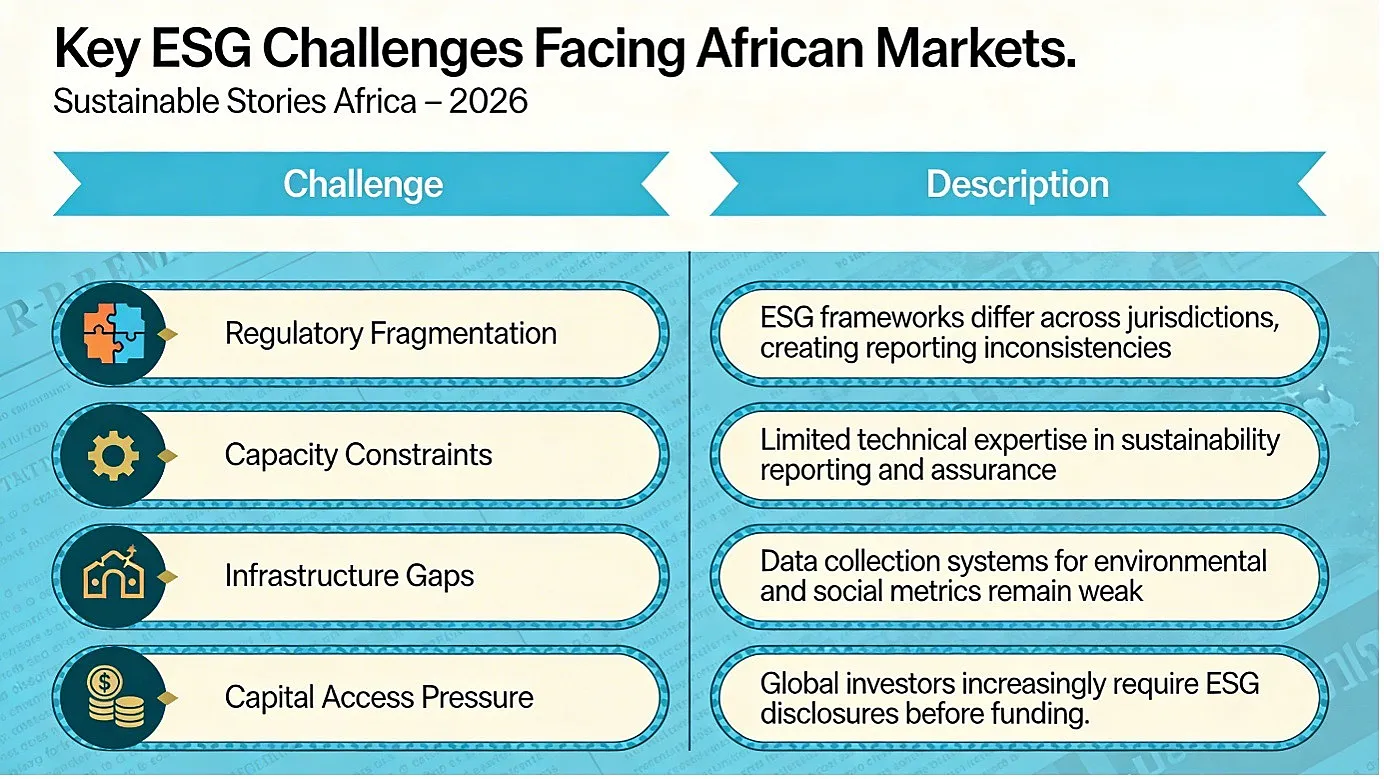
Uzokwe noted that these challenges are not unique to Africa but are particularly pronounced in emerging markets where regulatory ecosystems are still evolving.
Why ESG Integrity Matters Now
Beyond compliance, ESG frameworks are becoming central to risk management and long-term economic resilience.
Globally, regulators are tightening disclosure rules, with new sustainability reporting standards shaping how corporations report climate risks, governance structures, and social impact.
African companies that adapt early may gain a competitive advantage in accessing international capital markets.
Uzokwe pointed out that transparency and governance reforms can strengthen investor confidence and improve corporate performance.
“Companies that embed ESG into their strategy often become more resilient businesses,” she said.
ESG Opportunity Signals For African Corporations
Opportunity | Strategic Impact |
|---|---|
Improved Transparency | Builds investor trust and reduces governance risk |
Stronger Governance Systems | Enhances corporate resilience and operational accountability |
Climate Disclosure | Positions firms for global sustainability finance |
Impact-Driven Strategy | Aligns business growth with social and environmental outcomes |
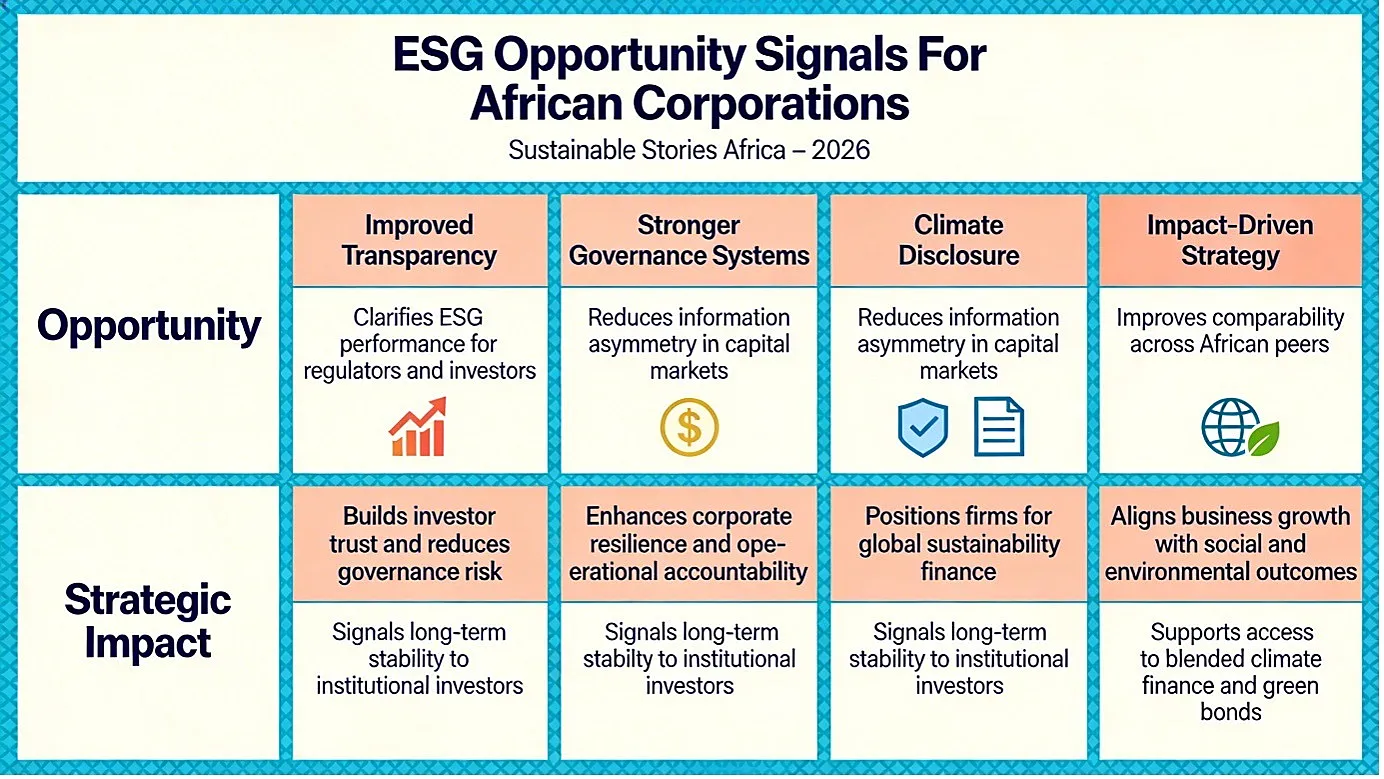
These shifts are particularly relevant as African economies seek greater participation in global capital markets and sustainable finance flows.
Building Practical ESG Frameworks
Uzokwe argued that strengthening ESG adoption across Africa requires collaboration between regulators, corporates, investors, and civil society.
Rather than focusing exclusively on compliance, stakeholders must prioritise capacity building, institutional strengthening, and practical implementation frameworks.
She emphasised that African regulators should focus on building coherent policy frameworks that support sustainable investment while ensuring that reporting requirements remain realistic for companies operating in emerging economies.
“Integrity systems are not built overnight,” she said. “They require sustained collaboration between the public and private sectors.”
For companies, the next step is embedding ESG principles into governance structures, risk management processes, and long-term strategy.
Path Forward – Building Credible ESG Systems
African markets must prioritise practical ESG frameworks that strengthen governance, transparency, and accountability while recognising the continent’s unique economic context.
Regulators and corporations alike will need to invest in reporting capacity, professional expertise, and institutional coordination.
Uzokwe’s message is clear: ESG adoption in Africa must move beyond symbolic compliance toward credible systems that attract investment, strengthen corporate integrity, and support sustainable economic growth.