The Rockefeller Foundation has committed $10 million to expand electricity access across Africa, supporting innovative energy solutions and clean power infrastructure.
The investment aims to accelerate progress toward universal energy access while strengthening climate-aligned development.
For millions of households, small businesses and health facilities across the continent, the initiative could mean reliable electricity, economic opportunity and improved resilience in a rapidly warming world.
$10 Million Push to Power Africa’s Future
The Rockefeller Foundation has announced a $10 million commitment to expand electricity access across Africa, reinforcing global efforts to close one of the continent’s most persistent development gaps.
The funding will support programmes designed to accelerate deployment of clean energy systems, distributed electricity infrastructure and innovative power solutions for underserved communities.
Despite significant progress in recent years, around 600 million Africans still lack reliable electricity, according to international energy agencies. The absence of dependable power continues to constrain economic growth, healthcare delivery, education and digital connectivity across large parts of the continent.
The Rockefeller Foundation says the new investment will focus on scaling practical solutions that expand access while supporting climate-aligned energy transitions, particularly in regions where national grids remain limited.
By targeting distributed energy technologies such as mini-grids, solar home systems and battery storage, the initiative aims to reach communities that conventional power infrastructure has struggled to serve.
Africa’s Electricity Access Challenge
Energy access remains one of the defining development challenges of the 21st century.
While global electrification rates have improved significantly over the past two decades, Africa still accounts for more than three-quarters of the world’s population without electricity.
For rural communities, the lack of power affects nearly every aspect of daily life, from refrigerating medicines to irrigating agricultural produce to students' ability to study after sunset.
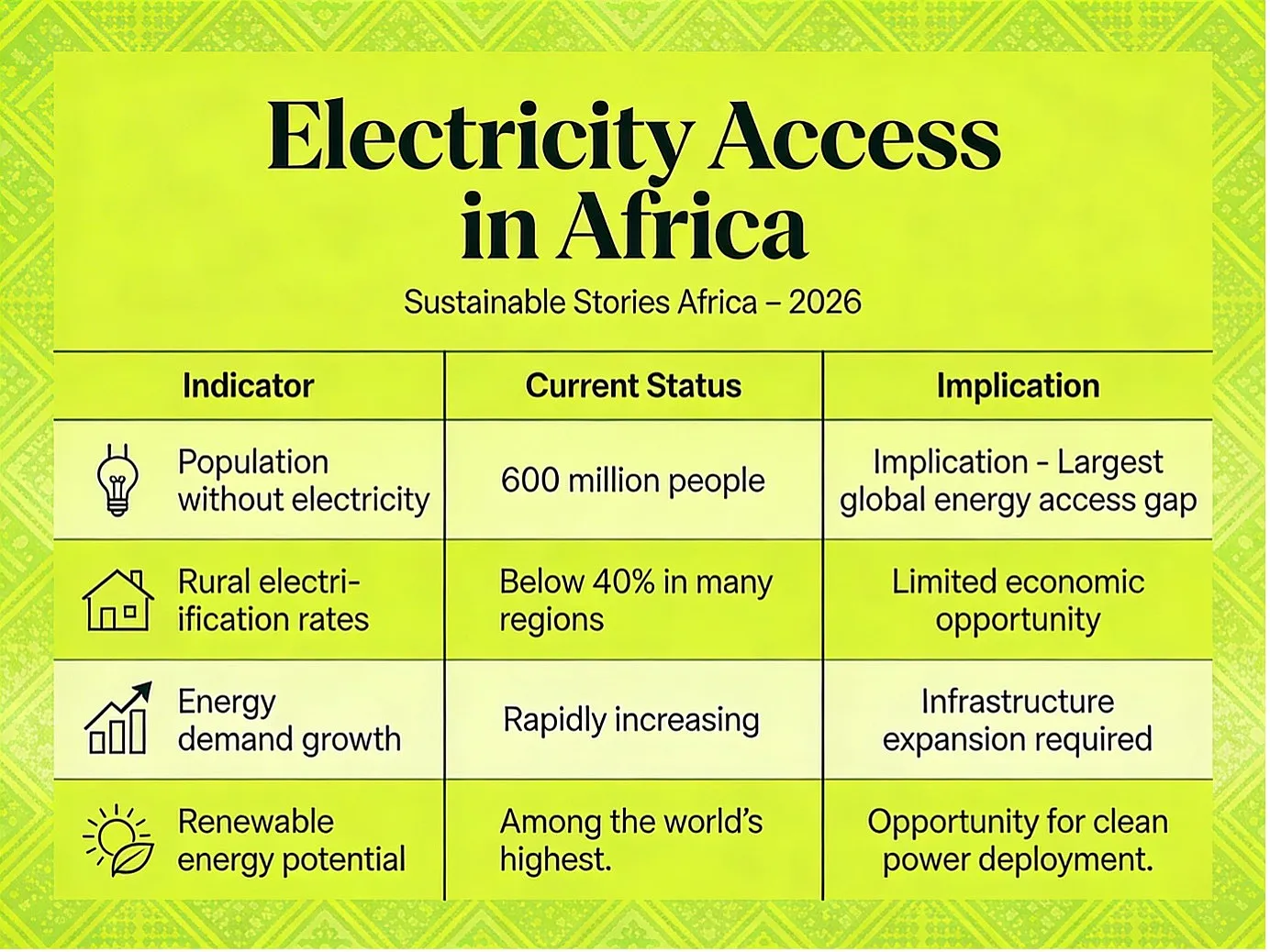
Electricity Access in Africa
Indicator | Current Status | Implication |
|---|---|---|
Population without electricity | 600 million people | Largest global energy access gap |
Rural electrification rates | Below 40% in many regions | Limited economic opportunity |
Energy demand growth | Rapidly increasing | Infrastructure expansion required |
Renewable energy potential | Among the world’s highest | Opportunity for clean power deployment |
Distributed renewable energy solutions have emerged as one of the most promising pathways to close this gap.
Mini-grids and solar systems can deliver electricity to remote communities faster and more affordably than extending national grids across vast rural landscapes.
Rockefeller Foundation programmes have previously supported initiatives such as mini-grid development, energy innovation ecosystems and financing models that attract private investment into rural electrification projects.
Experts say such catalytic funding is essential to unlock larger flows of capital from development banks, governments and private investors.
Powering Development and Climate Resilience
Expanding electricity access does far more than illuminate homes; it transforms entire economies.
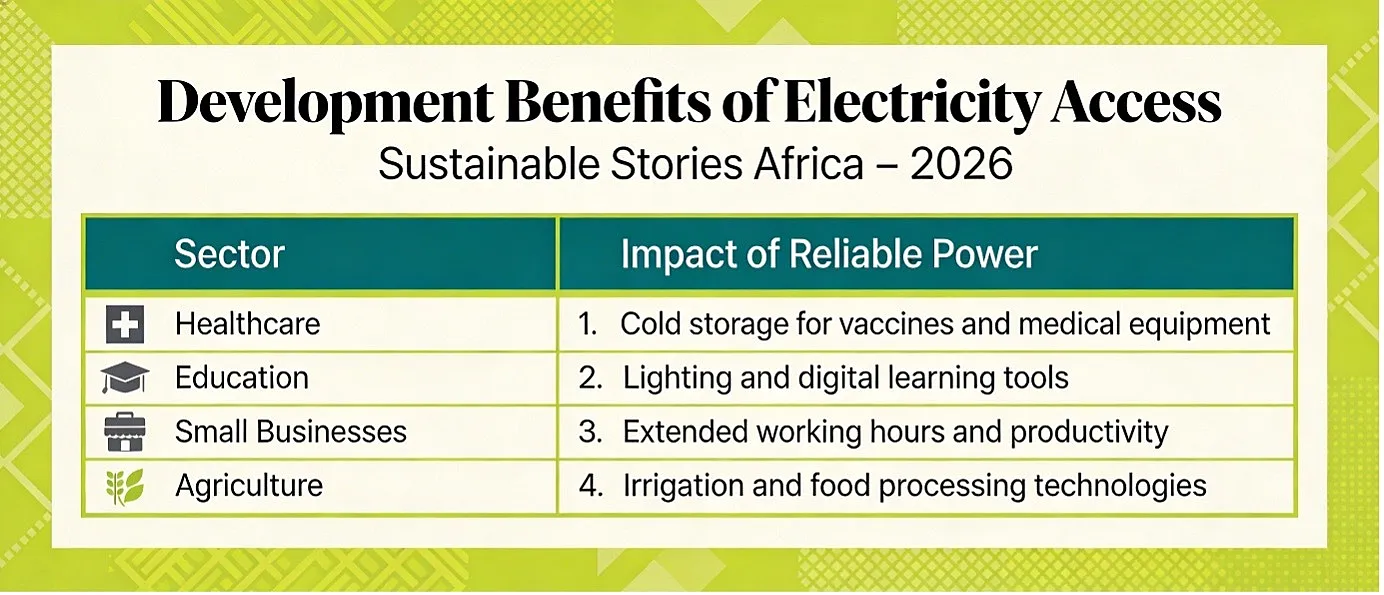
Reliable energy enables small businesses to operate longer hours, farmers to process crops locally, clinics to store vaccines safely, and schools to connect students to digital learning platforms.
Development Benefits of Electricity Access
Sector | Impact of Reliable Power |
|---|---|
Healthcare | Cold storage for vaccines and medical equipment |
Education | Lighting and digital learning tools |
Small Businesses | Extended working hours and productivity |
Agriculture | Irrigation and food processing technologies |
Electricity access is also central to Africa’s climate transition.
As renewable energy technologies become cheaper and more efficient, the continent has an opportunity to expand energy access while avoiding carbon-intensive development pathways.
Africa possesses some of the world’s most abundant solar, wind and geothermal resources, positioning the region as a potential global leader in clean energy.
Investments like the Rockefeller Foundation’s $10 million initiative can therefore serve as catalytic funding, supporting innovative models that scale renewable energy deployment across underserved communities.
Mobilising Investment for Energy Access
The Rockefeller Foundation’s commitment highlights the importance of blended finance and philanthropic capital in addressing Africa’s electricity access gap.
While the $10 million investment represents a modest share of the total funding required, it is strategic to unlock larger pools of capital and support scalable energy solutions.
Experts estimate that achieving universal electricity access in Africa by 2030 could require more than $100 billion in investment.
To reach this goal, policymakers, investors and development institutions must work together to:
- Expand financing for renewable mini-grids and distributed energy systems
- Strengthen regulatory frameworks for energy markets
- Support local energy entrepreneurs and innovation ecosystems
- Mobilise international climate finance for infrastructure development
For millions of Africans still living without reliable electricity, the urgency is clear.
Access to power is not only an energy issue; it is a foundation for economic growth, health outcomes, climate resilience and social inclusion.
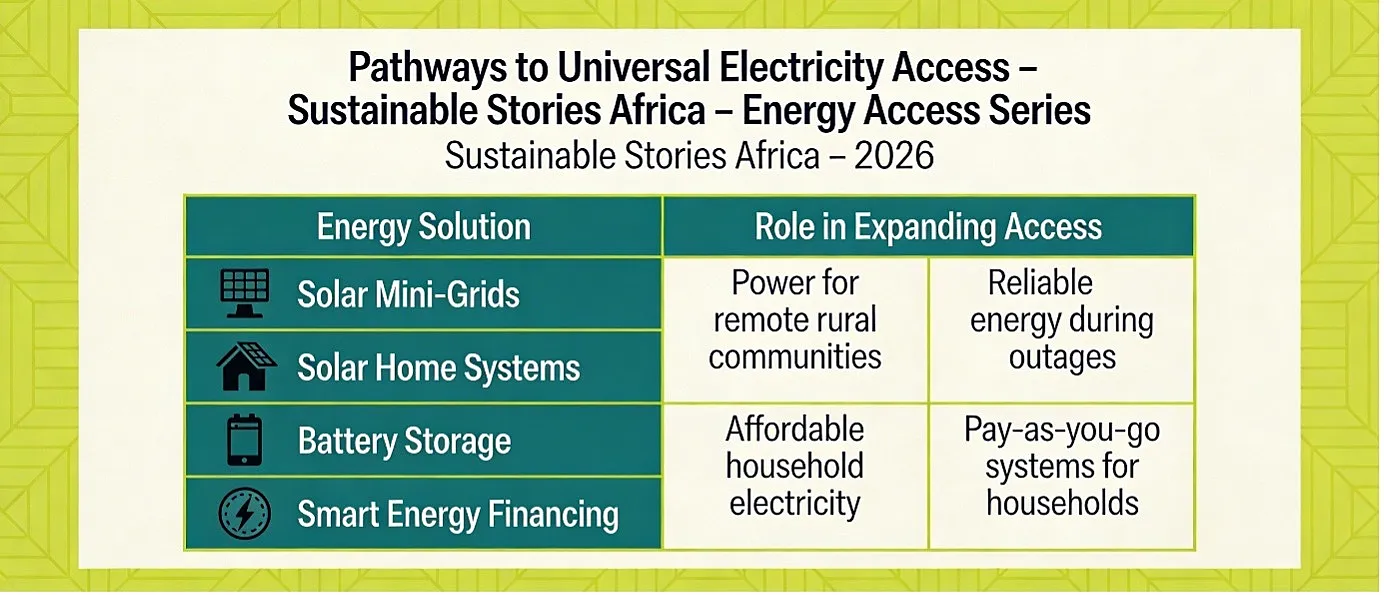
Pathways to Universal Electricity Access – Sustainable Stories Africa – Energy Access Series
Energy Solution | Role in Expanding Access |
|---|---|
Solar Mini-Grids | Power for remote rural communities |
Solar Home Systems | Affordable household electricity |
Battery Storage | Reliable energy during outages |
Smart Energy Financing | Pay-as-you-go systems for households |
Path Forward – Scaling Clean Energy for Inclusive Growth
The Rockefeller Foundation’s $10 million commitment reinforces the growing recognition that electricity access is central to Africa’s development future.
Moving forward, partnerships between philanthropies, governments, development banks and private investors will be essential to scale renewable energy solutions.
By combining climate finance with innovation and policy reform, Africa can expand electricity access while building a resilient, low-carbon energy system that powers inclusive economic growth.
Culled From: Rockefeller Foundation commits $10 million to boost electricity access in Africa - Energy in Africa