Teachers are increasingly embracing AI for practical classroom tasks while rejecting systems designed to imitate friendships, counsellors or trusted adults.
A new Brookings analysis argues that anthropomorphic AI presents emerging risks to children's learning, trust and emotional development.
The debate now extends beyond technology into governance, education policy and the future of human relationships in schools.
Schools Grapple With AI's Human Mask
Recent guidance from teachers and education experts suggests that the biggest artificial intelligence debate in schools is no longer whether AI belongs in classrooms; however, whether machines should ever pretend to be human.
A new Brookings Institution analysis, based on discussions with leaders from the Alberta Teachers' Association, identifies five major lessons from educators who increasingly support AI as a productivity tool while warning against "anthropomorphic AI"—systems designed to simulate friendship, counselling, historical figures or trusted individuals.
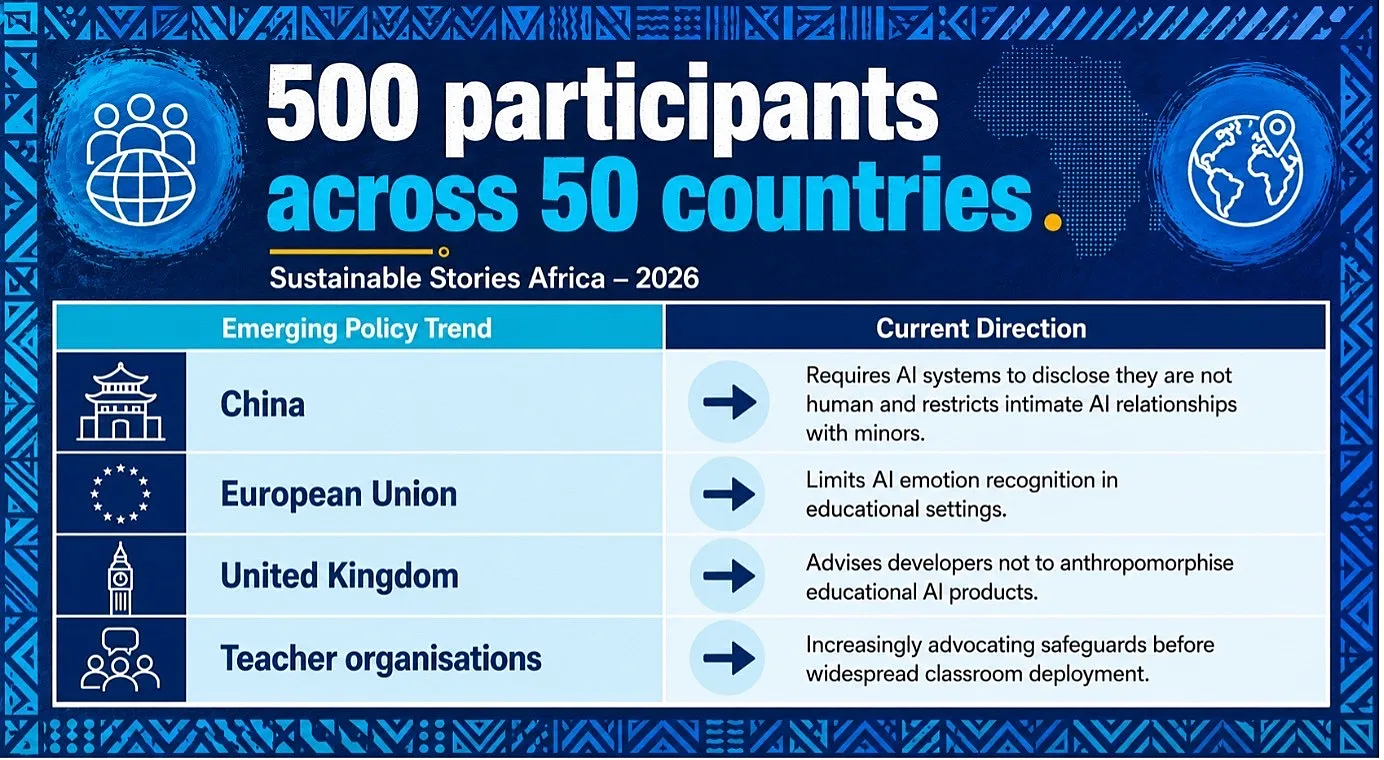
The discussion comes amid growing regulatory attention in jurisdictions including China, the United Kingdom and the European Union.
The findings carry implications well beyond North America. As governments across Africa accelerate digital education strategies and AI adoption, policymakers are confronting a central governance question: how can technology improve learning without replacing the human relationships that education depends upon?
Innovation Should Never Replace Human Trust
Teachers are not rejecting artificial intelligence.
Instead, they are drawing a clear distinction between narrow AI that assists professional work, such as lesson planning, translation and assessment support, and AI systems intentionally designed to appear emotionally aware or personally attached to students.
According to the Alberta Teachers' Association, educators are increasingly concerned about technologies that simulate friendship, counselling or intimate relationships with children.
Brookings notes that Alberta's teaching profession, representing roughly 50,000 educators, recently adopted guidance discouraging the introduction of such systems into K-12 learning environments, signalling one of the strongest professional positions yet on anthropomorphic AI.
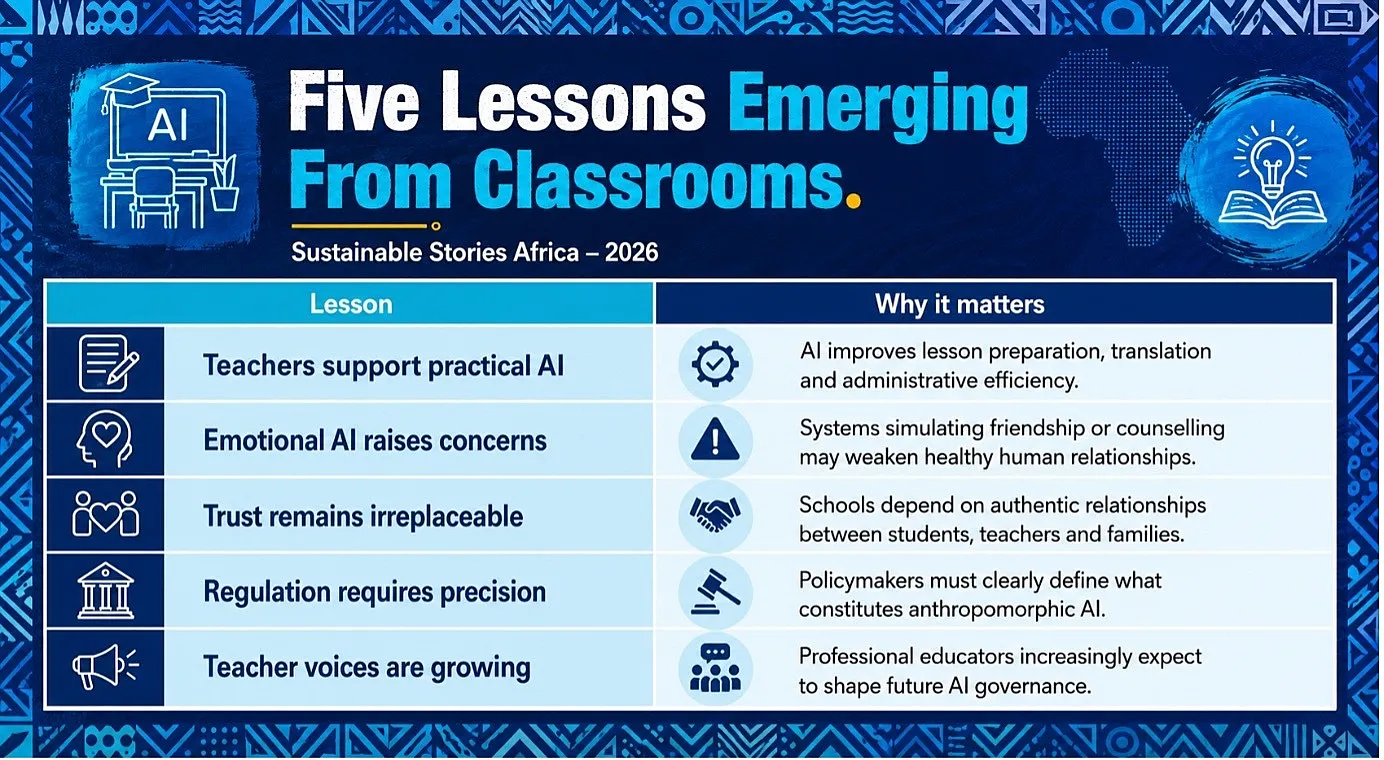
Five Lessons Emerging From Classrooms
Brookings highlights five central lessons emerging from teachers' experiences:
Perhaps the strongest concern centres on trust.
Teachers argue that schools operate through carefully regulated professional relationships, where educators are accountable for safeguarding children.
AI companions capable of encouraging emotional attachment raise new questions about accountability, consent and responsibility if harm occurs.
Educators also warn against AI-generated simulations of historical figures or living individuals without appropriate labelling or consent, arguing such technologies could blur distinctions between fact, fiction and manipulation in an era already challenged by misinformation.
These concerns align with broader Brookings research released earlier this year, which concluded that current risks associated with generative AI in children's education outweigh its immediate benefits, as many risks affect foundational cognitive and social development.
That global study drew on consultations involving more than 500 participants across 50 countries and reviewed over 400 studies.
Human-Centred AI Can Strengthen Education
The Brookings discussion does not advocate slowing technological progress.
Instead, it argues for better-designed AI that complements rather than competes with human educators.
For African education systems facing teacher shortages, overcrowded classrooms and uneven learning resources, practical AI applications could significantly improve administrative efficiency, multilingual instruction and curriculum preparation.
However, educators caution that AI should never become a substitute for school counsellors, trusted teachers, families or community relationships.
Maintaining this distinction could enable countries to capture productivity gains while protecting children's emotional development, critical thinking and social learning, foundations essential for future workforce resilience and inclusive development.
Build Guardrails Before Deployment Accelerates
The Brookings analysis suggests governments, regulators, education ministries and technology companies should act before emotionally persuasive AI becomes commonplace in schools.
- That means establishing clear standards for transparency, informed consent, labelling of AI-generated personas and meaningful educator participation in AI governance.
- Developers must also distinguish between tools designed to enhance teaching and systems intentionally engineered to foster emotional dependence.
For African policymakers investing in digital education, embedding ethical governance alongside AI adoption could avert future risks and strengthen public confidence in educational innovation.
Path Forward – Keeping Humanity At Education's Centre
The conversation around classroom AI is rapidly shifting from capability to responsibility.
Future education systems will likely succeed not by replacing teachers with intelligent machines, but by ensuring AI strengthens learning without eroding the trust that makes education possible.
As African governments modernise schools, the greatest competitive advantage may ultimately lie not in building more human-like AI but in protecting the uniquely human relationships that technology can never fully replicate.
Culled From: 5 lessons from teachers on the risks of anthropomorphic AI | Brookings