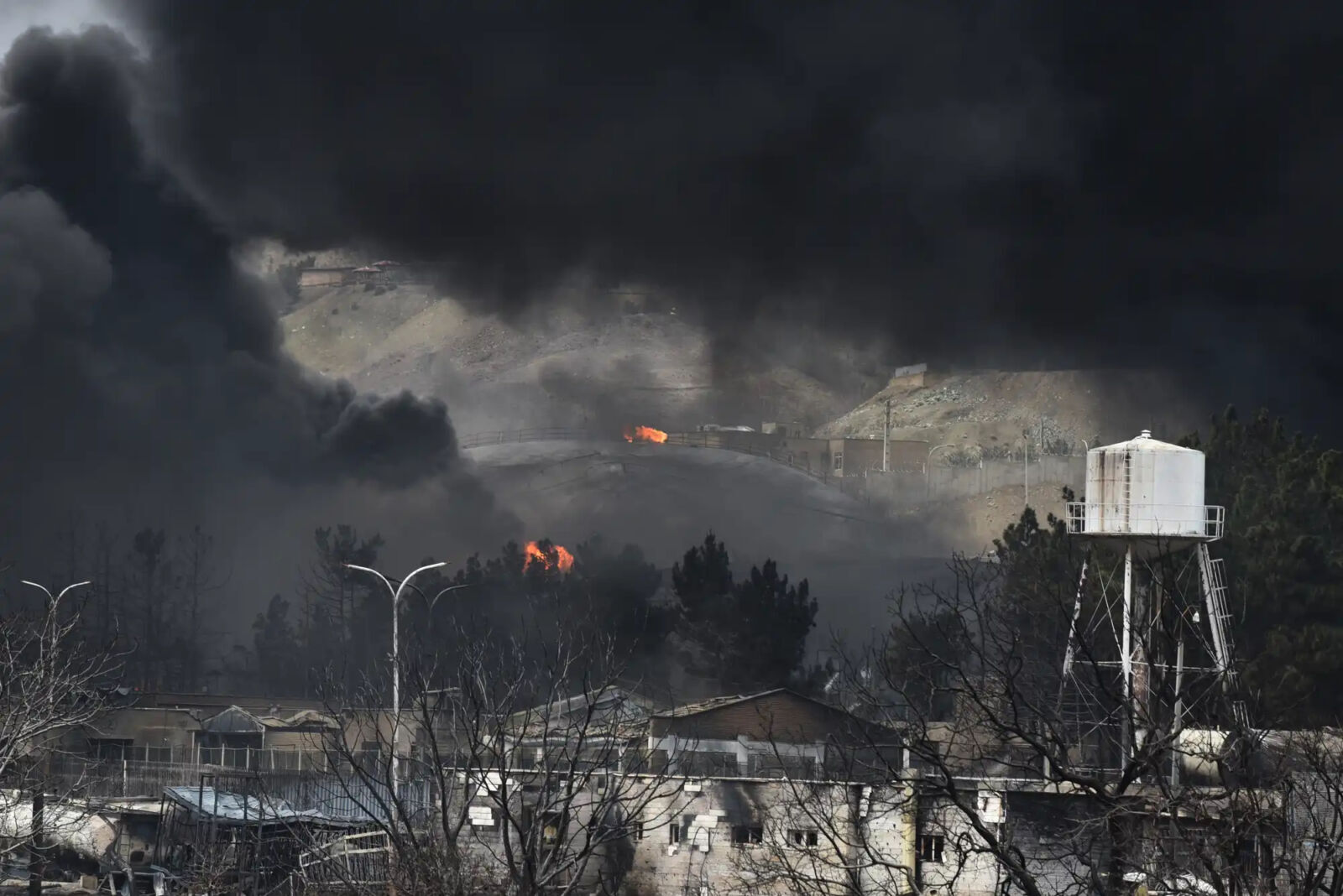
Escalating US-Iran tensions are disrupting global energy markets and policy priorities.
Countries are increasingly prioritising energy security commitments over commitments to their climate transition.
The shift could reshape investment flows, delay decarbonisation, and redefine Africa’s energy strategy.
When Security Overrides Sustainability
As geopolitical tensions between the United States and Iran intensify, a familiar pattern is re-emerging in global energy markets: energy security is taking precedence over climate transition ambitions.
Oil prices have shown renewed volatility, supply routes face heightened risk, and governments are scrambling to secure reliable energy sources. In this environment, long-term decarbonisation goals are being recalibrated, sometimes quietly, sometimes explicitly.
For Africa, the implications are profound. The continent is at the intersection of opportunity and risk, rich in fossil resources; however, it is under pressure to accelerate its clean energy transition.
A Global Reset in Energy Priorities
The US-Iran conflict has amplified uncertainties across global oil and gas markets, particularly around key shipping routes and production stability in the Middle East.
Historically, such disruptions trigger a predictable response: countries prioritise immediate energy security, often by increasing fossil fuel production, securing long-term supply contracts, or delaying the retirement of carbon-intensive assets.
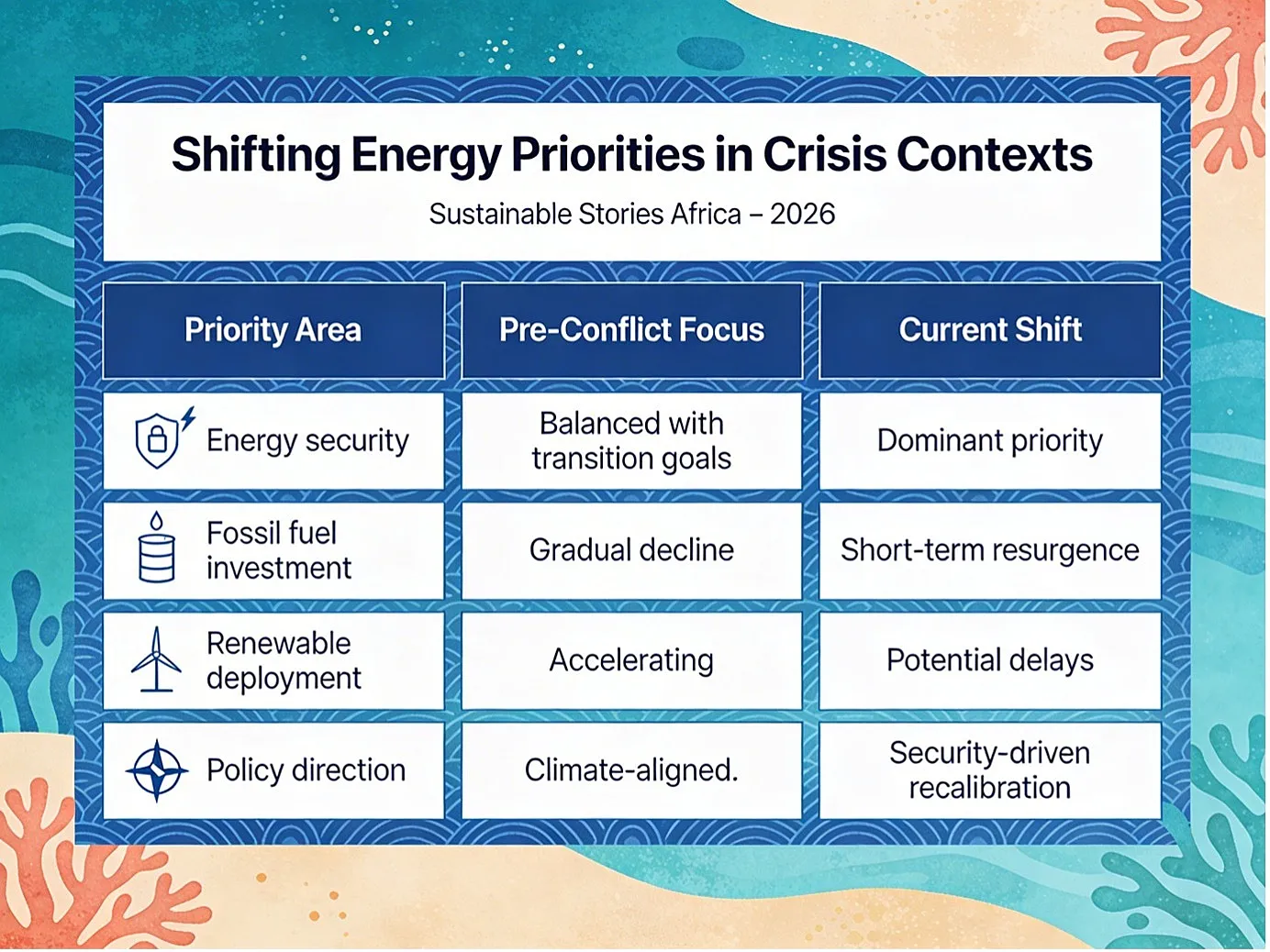
Shifting Energy Priorities in Crisis Contexts
Priority Area | Pre-Conflict Focus | Current Shift |
|---|---|---|
Energy security | Balanced with transition goals | Dominant priority |
Fossil fuel investment | Gradual decline | Short-term resurgence |
Renewable deployment | Accelerating | Potential delays |
Policy direction | Climate-aligned | Security-driven recalibration |
For African countries, this shift creates a dual reality.
On one hand, oil and gas exporters such as Nigeria and Algeria may benefit from higher prices and renewed global demand.
On the other hand, energy-importing nations face rising costs, fiscal pressure, and increased vulnerability to external shocks.
Moreover, the transition narrative becomes more complex. While global capital may temporarily flow back into fossil fuels, long-term climate commitments remain in place, creating uncertainty for investors and policymakers alike.
A Balanced Path Between Security and Sustainability
The tension between energy security and climate transition cannot be a zero-sum game.
For Africa, this moment presents an opportunity to redefine its energy strategy, one that leverages its natural resources while accelerating investment in renewables and resilient infrastructure.
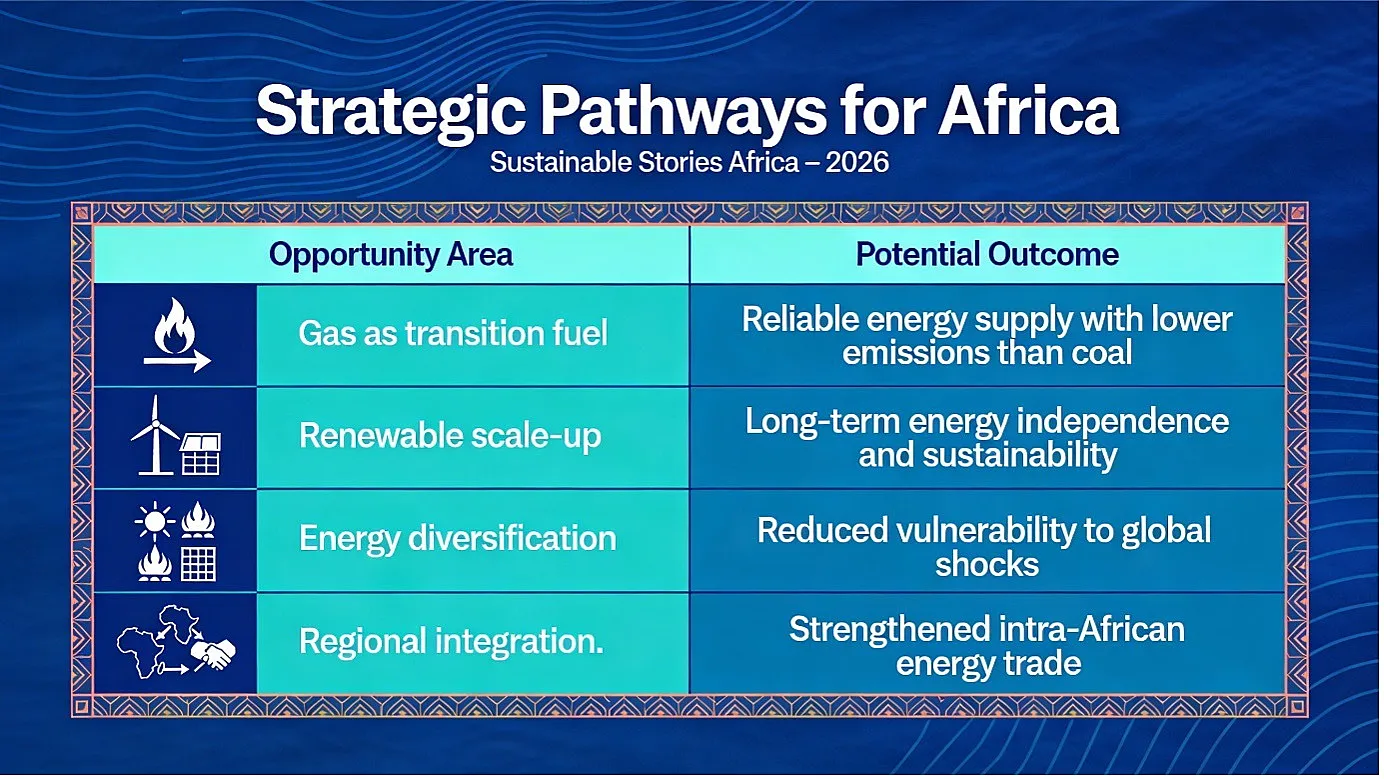
Strategic Pathways for Africa
Opportunity Area | Potential Outcome |
|---|---|
Gas as a transition fuel | Reliable energy supply with lower emissions than coal |
Renewable scale-up | Long-term energy independence and sustainability |
Energy diversification | Reduced vulnerability to global shocks |
Regional integration | Strengthened intra-African energy trade |
A balanced approach, often described as a “just transition”, can enable African economies to meet immediate energy needs without compromising long-term sustainability goals.
The risk, however, lies in overcorrecting. Excessive reliance on fossil fuels in response to short-term shocks could lock in carbon-intensive pathways for decades.
Turning Crisis Into Strategic Alignment
To navigate this complex landscape, coordinated action is essential.
Governments must adopt flexible energy strategies that respond to immediate security concerns while maintaining clear long-term transition roadmaps. This includes investing in gas infrastructure as a bridge, while scaling renewables and storage technologies.
Development finance institutions and multilateral partners should prioritise blended finance models that support both energy access and decarbonisation, ensuring that Africa is not forced to choose between development and sustainability.
Private sector players must also adapt, aligning investment strategies with evolving geopolitical realities while maintaining ESG commitments.
The central challenge is clear: align short-term resilience with long-term transformation.
PATH FORWARD – Balance Security Needs With Long-Term Sustainable Energy Transition
Africa must integrate energy security with climate ambition through diversified energy systems.
By aligning policy, investment, and regional cooperation, the continent can navigate geopolitical shocks while advancing a resilient, sustainable energy future.
Culled From: Energy Security vs Transition Amid US-Iran Conflict