Africa enters the final SDG decade with the world’s most fragile development margins and the greatest distance still to cover.
The 2025 SDG Report shows widening inequalities, climate-driven reversals, and chronic financing gaps threatening to derail progress across the continent. Yet the data also reveals a powerful counter current.
African innovation, demographic dynamism and community-centred resilience are reshaping what sustainable development can look like when global ambition meets local ingenuity.
Africa’s SDG Crossroads Demand Urgent Rethinking
The Sustainable Development Goals Report 2025 paints a sobering picture of the global trajectory. However, nowhere is the tension between ambition and reality more acute than in Africa. With multiple, overlapping crises, such as food insecurity, debt stress, fragility, climate vulnerability, and demographic pressure, the continent faces a development equation that is both urgent and structurally constrained.
Africa accounts for most of the world’s extreme poor, the fastest-growing youth population, and some of the most climate-exposed regions. Yet it receives only a fraction of the financing required to deliver meaningful SDG progress.
Despite these constraints, the narrative is not one of failure but of possibility. African states are pioneering community-centred climate adaptation models, digital public services, women-led micro-enterprise networks, and data-innovation ecosystems that defy conventional development pathways. The 2025 report highlights the scale of the challenge, and also the extraordinary potential for bottom-up transformation if global systems evolve to match Africa’s urgency.
This article, grounded in Sustainable Stories Africa’s analytical style, uses the SDG 2025 data to examine Africa’s development turning point: a moment defined not by deficit, but by the opportunity to redefine global development through resilience, creativity, and structural reform.
Africa Risks Becoming the SDG Decade’s Defining Casualty
The headline finding of the 2025 SDG Report is stark: the world is off track on 85% of SDG targets, and Africa bears the heaviest burden of stalled progress. Extreme poverty is rising again in parts of West, Central, and East Africa; hunger has deepened; conflict remains widespread; and climate-related losses are accelerating faster than global averages.
At least 40 million Africans fell into poverty between 2020 and 2024, pushed by inflation, climate shocks, conflict, currency devaluations, and pandemic aftershocks. More than 260 million Africans face acute food insecurity, driven by droughts, floods, disrupted supply chains, and protracted conflicts. Meanwhile, infrastructure gaps—from energy access to healthcare—continue to widen.
But Africa is not merely the site of SDG setbacks; it is the epicentre of global interdependence. The continent’s trajectory will define the world’s success or failure in poverty reduction, climate stabilisation, demographic resilience, and inclusive growth. What happens in Africa is not a regional footnote—it is the SDG story.
The Data Tells a Harder Truth: Africa Is the SDG Tipping Point
The SDG Report 2025 provides granular insight into where Africa stands and where global support is lagging.
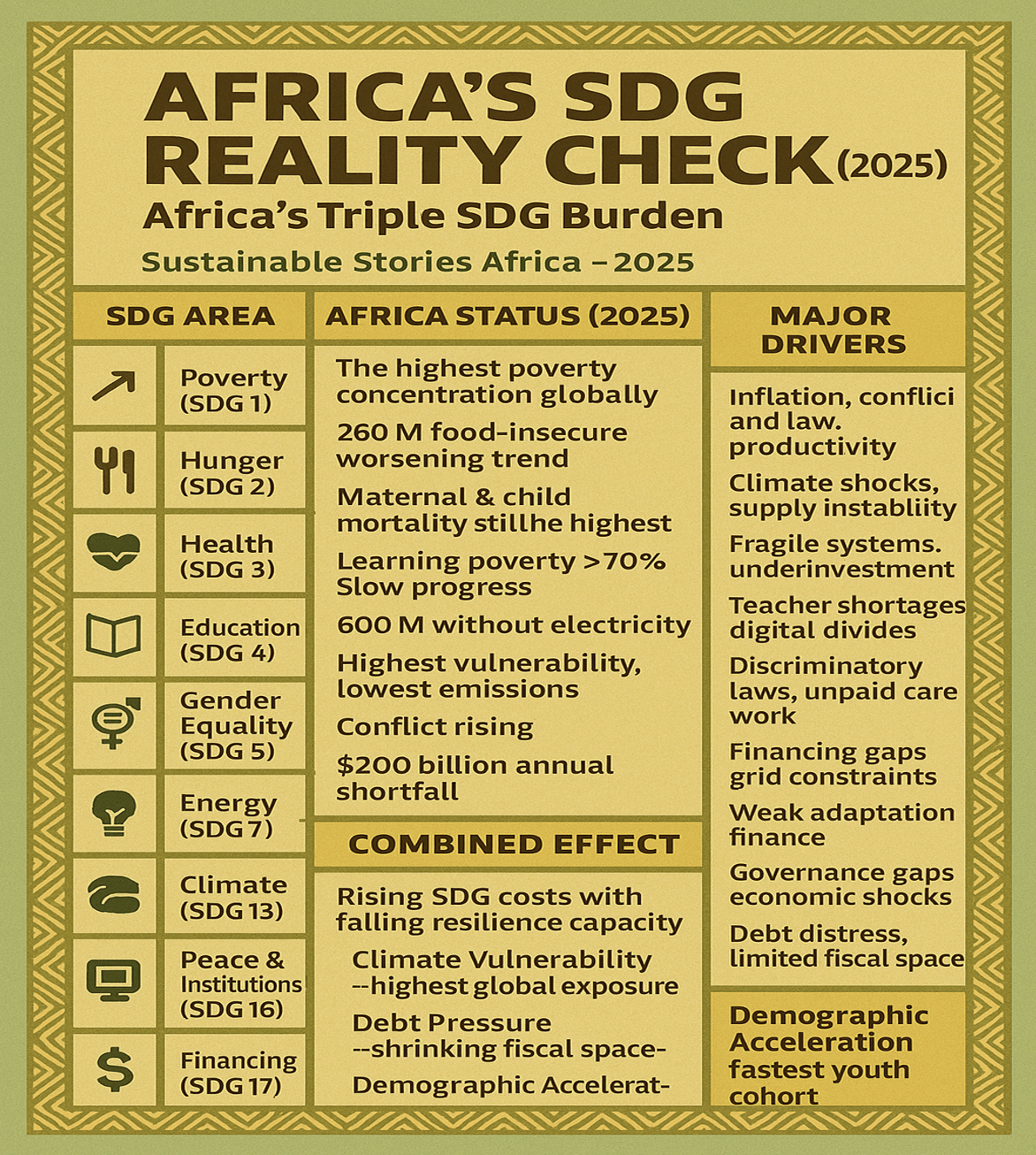
Africa’s SDG Reality Check (2025)
SDG Area | Africa Status (2025) | Major Drivers |
|---|---|---|
Poverty (SDG 1) | The highest poverty concentration globally | Inflation, conflict, and low productivity |
Hunger (SDG 2) | 260M food-insecure, worsening trend | Climate shocks, supply instability |
Health (SDG 3) | Maternal & child mortality is still the highest | Fragile systems, underinvestment |
Education (SDG 4) | Learning poverty >70% | Teacher shortages, digital divides |
Gender Equality (SDG 5) | Slow progress | Discriminatory laws, unpaid care work |
Energy (SDG 7) | 600M without electricity | Financing gaps, grid constraints |
Climate (SDG 13) | Highest vulnerability, lowest emissions | Weak adaptation finance |
Peace & Institutions (SDG 16) | Conflict rising | Governance gaps, economic shocks |
Financing (SDG 17) | $200B annual shortfall | Debt distress, limited fiscal space |
Across nearly all SDGs, Africa’s performance is heavily influenced by global market trends, climate dynamics, and geopolitical shifts—factors the continent cannot shape alone.
Yet underneath the data lies another story: African innovation ecosystems, community resilience networks, and green-growth initiatives continue to show that development can take unconventional forms, even in the face of constrained resources.
Africa Can Still Lead the SDG Turnaround – If the World Recognises Its Power
Despite the grim metrics, the SDG Report outlines several areas where Africa is quietly pioneering new development models.
- Africa’s Climate Adaptation Leadership – Countries like Kenya, Rwanda, and Senegal are advancing community-based adaptation, early-warning systems, and nature-based resilience models that outperform global averages in cost-effectiveness.
- Digital Public Infrastructure (DPI) Momentum – Africa’s fintech, digital ID, payment systems, and cross-border platforms are reshaping service delivery. Nations like Nigeria, Kenya, Ghana, Rwanda, and South Africa are demonstrating how digital ecosystems can accelerate inclusion where traditional systems lag.
- Women-Centred Economic Transformation – Across East and West Africa, women-led micro-enterprises, agricultural collectives, and social-enterprise networks are reducing income volatility and stabilising households, especially during climate shocks.
- Youth-Driven Innovation – Africa’s youth, representing over 400 million people, are driving renewable energy innovation, civic tech, data science, and new forms of climate activism and entrepreneurship.
The real opportunity is this: Africa’s SDG acceleration will not come from copying global models, but from scaling African-rooted solutions.
What the continent needs from the global system is not charity, but fairness, investment, technology transfer, and policy coherence.
What Africa Must Do Now and What the World Must Let It Do
To shift the SDG curve, Africa needs a strategic mix of internal reforms and global structural change.
- Expand Fiscal Space Immediately – Africa’s SDG financing gap exceeds $200 billion annually. Debt restructuring, concessional lending, climate-finance expansion, and innovative instruments (SDG bonds, blended finance) are essential. Without fiscal breathing room, no development strategy is scalable.
- Hardwire Climate Adaptation into Development – Africa must prioritise water management, resilient agriculture, urban planning, flood/drought systems, and green industrialisation—anchored in local ecosystems.
- Accelerate Digital Public Infrastructure (DPI) – Open-source digital ID, payments, mobility data, health information systems, and e-government tools can drive cross-sector SDG acceleration.
- Build Human Capital for the Demographic Peak – Education reform, TVET systems, STEM pathways, and teacher workforce expansion are critical. Learning poverty remains one of Africa’s most urgent SDG threats.
- Strengthen Peace and Governance Systems - Insecurity is reversing gains across the Sahel, Horn, Great Lakes, and parts of West Africa. Rule of law, accountable institutions, community policing, and justice reforms are non-negotiable.
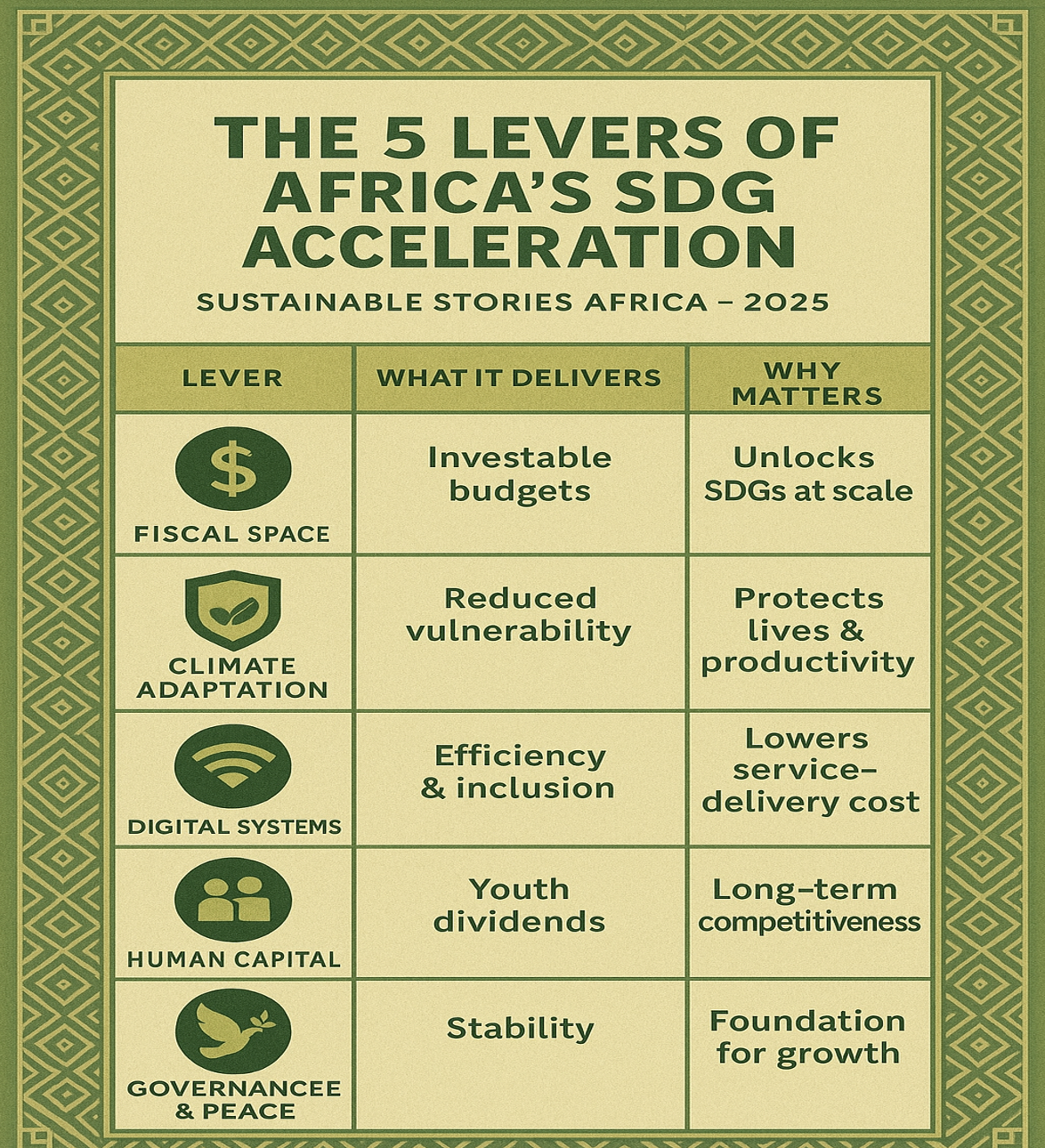
The 5 Levers of Africa’s SDG Acceleration
Lever | What It Delivers | Why It Matters |
|---|---|---|
Fiscal Space | Investable budgets | Unlocks SDGs at scale |
Climate Adaptation | Reduced vulnerability | Protects lives & productivity |
Digital Systems | Efficiency & inclusion | Lowers service-delivery cost |
Human Capital | Youth dividends | Long-term competitiveness |
Governance & Peace | Stability | Foundation for growth |
PATH FORWARD – Finance, Resilience, People, Technology, Peace
Africa can still change the SDG story. By unlocking fiscal space, scaling climate adaptation, building digital public infrastructure, investing in youth, and strengthening governance, the continent can reorient global development trajectories.
However, this requires a global system that recognises Africa not as a development deficit, but as a development engine. The next decade will determine whether Africa becomes the SDGs' greatest setback or their most powerful redemption arc.