
Africa's education systems continue to invest in digital tools, yet the full promise of learning technology remains unrealised.
New evidence shows that constraints ranging from infrastructure gaps and socio-economic inequality to teacher readiness, policy fragmentation and cultural perceptions are slowing digital adoption across schools and universities.
This feature examines how these barriers converge, and what it will take for Africa to unlock inclusive, technology-enabled learning at scale.
Technology Alone Cannot transform African Learning
Across Africa, learning technology is often framed as the silver bullet for transforming education systems struggling with overcrowded classrooms, low literacy levels, teacher shortages and deep inequality.
However, the reality inside many schools tells a different story. Hardware arrives without maintenance plans; digital tools sit unused due to low connectivity; teachers grapple with unfamiliar systems; and students face uneven access shaped by income, gender and location.
The research document Constraints to the Effective Use of Learning Technology shows that technology adoption is constrained not by a lack of tools, but by the ecosystem surrounding them. These constraints, which include, but are not limited to, technical, pedagogical, organisational and socio-cultural, must be understood holistically.
For African nations working to expand digital learning, the imperative is clear: the continent must shift from device-driven enthusiasm to evidence-based integration, ensuring that technology enhances rather than widens existing inequalities.
Africa's Digital Learning Gap Is Wider Than Expected
Despite rapid digital expansion, African education systems face persistent constraints limiting the impact of learning technologies. The document highlights five systemic barriers:
- Infrastructure Gaps: Unreliable electricity, weak broadband, outdated hardware.
- Teacher Preparedness: Low digital skills, inadequate training, resistance to new tools.
- Pedagogical Misalignment: Technology used for substitution, not transformation.
- Institutional Barriers: Poor maintenance culture, limited budgets, unclear ICT policies.
- Socio-economic Inequality: Students' access determined by income and geography.
These constraints reveal a simple truth: technology enters African classrooms faster than the support systems needed to use it effectively.
What the Data Reveals About Africa's Learning Technology Failure Points
The content of the document points to a multidimensional problem that extends beyond hardware. It includes analytical tables and educator surveys showing widespread challenges such as teacher anxiety, lack of technical support, and a mismatch between curriculum and digital tools.
Constraints to Effective Learning Technology Use
| Category | Constraints Identified | Impact on Learning |
|---|---|---|
| Technical | Unstable power, low bandwidth, outdated devices | Interrupts learning, reduces tool reliability |
| Teacher Readiness | Limited ICT skills, low confidence, training gaps | Surface-level usage, minimal integration |
| Pedagogy | Tools used only for presentations, not active learning | No improvement in outcomes |
| Organisation | Weak leadership, unclear ICT strategy, and poor maintenance | Tools break, never replaced |
| Socio-Economic | Students lack devices/data at home | Enlarges inequality in achievement |
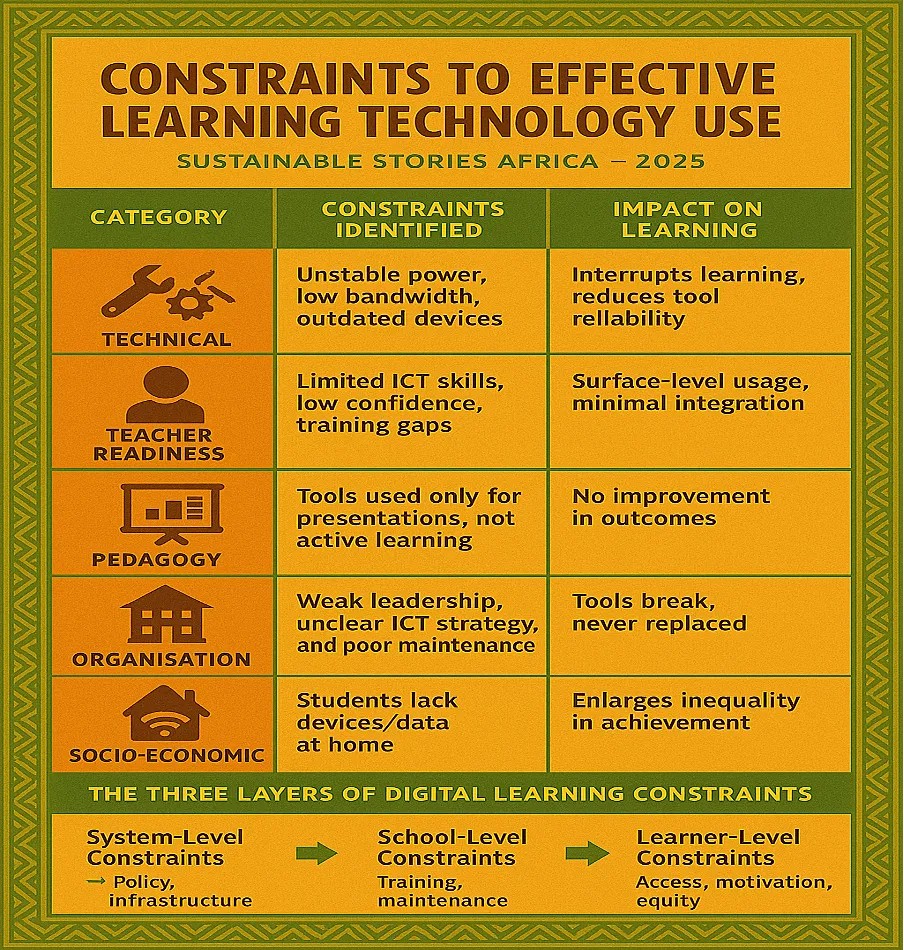
The report also emphasises behavioural barriers: fear of failure among teachers, low motivation when tools do not work consistently, and student distraction when technology is poorly supervised.
Why Africa Must Rebuild Its Learning Technology Ecosystem
The constraints are not simply obstacles, but opportunities for redesigning education systems around evidence and user experience.
- Teachers Need Continuous, Practical Training – One-off ICT workshops do not build competence. Teachers require hands-on guided practice, peer support systems and confidence-building cycles.
- Technology Must Match Pedagogy – Digital tools should support higher-order thinking: collaboration, problem-solving, personalised learning, not just electronic notetaking.
- Infrastructure Investments Must Be Sustainable – Maintenance budgets, solar backup systems and device replacement cycles must be embedded into planning.
- Learners Need Equal Access – Without addressing home connectivity gaps, technology risks widening achievement divides between urban elites and rural or low-income students.
- School Leaders Must Drive Digital Culture – Principals who champion ICT integration can significantly increase teacher adoption and student outcomes.
These measures transform learning technology from a novelty into a catalyst for deeper educational reform.
A Practical Roadmap for Unlocking Effective Digital Learning in Africa
Based on the insights, African governments, schools and partners can take a structured set of actions.
- Strengthen Infrastructure and Technical Support
- Invest in stable electricity and affordable broadband.
- Provide on-site technicians to reduce downtime.
- Adopt device-lifecycle management systems.
- Build Teacher Capacity as a Continuous Process
- Establish digital skills academies for educators.
- Give teachers time and incentives to experiment.
- Promote mentorship between digitally skilled and novice teachers.
- Integrate Technology With Curriculum and Assessment
- Use digital tools to support inquiry-based and competency-based learning.
- Align classroom technology with national curricula and exams.
- Mainstream Digital Equity Policies
- Subsidise devices for low-income learners.
- Expand community learning hubs and public Wi-Fi spaces.
- Improve Leadership and Governance Structures
- Develop whole-school ICT policies.
- Monitor implementation using clear indicators.
- Involve teachers and learners in planning processes.
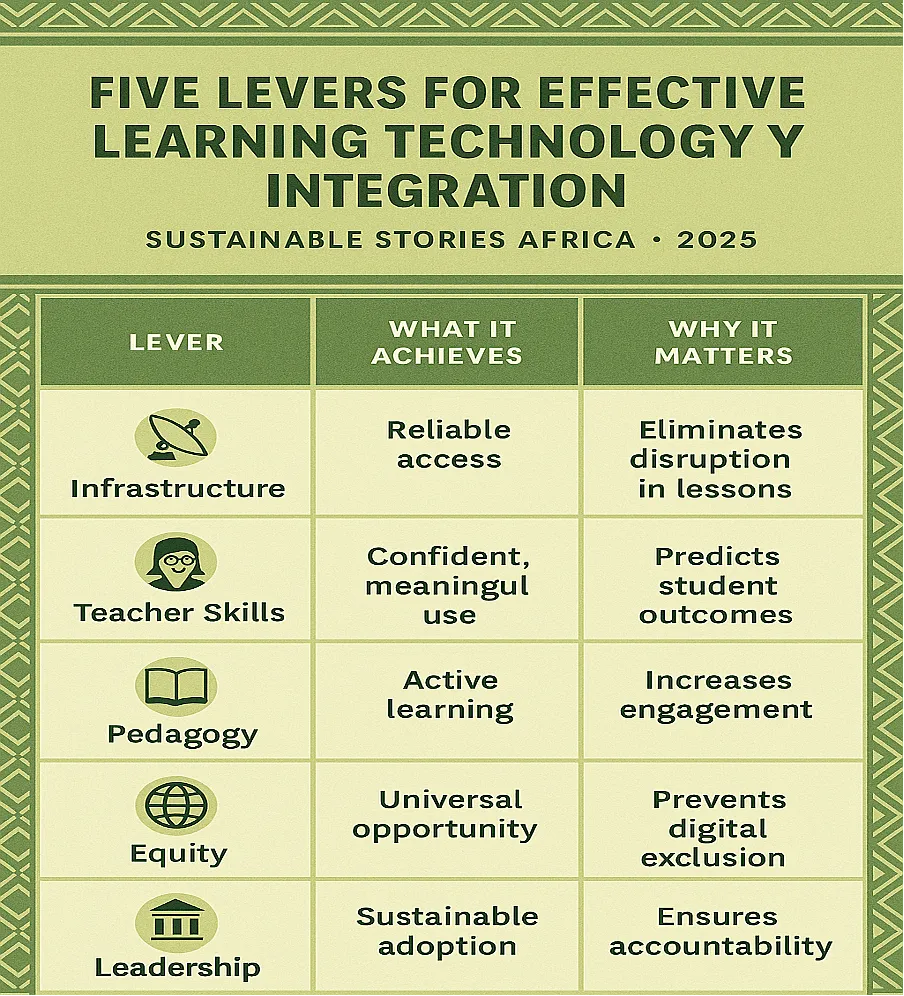
Five Levers for Effective Learning Technology Integration
| Lever | What It Achieves | Why It Matters |
|---|---|---|
| Infrastructure | Reliable access | Eliminates disruption in lessons |
| Teacher Skills | Confident, meaningful use | Predicts student outcomes |
| Pedagogy | Active learning | Increases engagement |
| Equity | Universal opportunity | Prevents digital exclusion |
| Leadership | Sustainable adoption | Ensures accountability |
PATH FORWARD – Build Capacity, Equity, Trust, Technology Works
Africa's digital learning future will not be defined by devices, but by the systems surrounding them.
When infrastructure is reliable, teachers are confident, pedagogy aligned, and equity prioritised, learning technology becomes transformative. The path forward is not more hardware; it is smarter, more inclusive, and more human-centred integration.
The continent can unlock the full promise of digital education by placing learners, teachers and learning outcomes at the heart of every technology investment.