Corporate sustainability in Africa is entering a defining era as investors, regulators, and markets converge around ESG as a metric of long-term value and competitiveness.
However, the continent faces unique challenges: fragmented standards, capability gaps, volatile markets and widening stakeholder expectations. This exclusive SSA analysis unpacks the emerging ESG landscape through key indicators, sector insights and policy trends highlighted in ESG-AT-A-GLANCE, illustrating why African corporates must accelerate credible, decision-useful reporting.
Africa's ESG Moment Requires Strategic Clarity
Across global markets, ESG has evolved from a disclosure buzzword into a central pillar of how companies are valued, regulated and held accountable. Investors increasingly demand data that demonstrates environmental stewardship, governance integrity and social impact.
Meanwhile, global frameworks, from ISSB's IFRS S1/S2 to Europe's CSRD, are redefining what credible sustainability reporting looks like. For African corporations, this shift creates both opportunity and pressure: opportunity to access global capital, and pressure to demonstrate transparency and resilience in competitive markets.
The report ESG-AT-A-GLANCE provides a concise yet revealing snapshot of the continent's ESG maturity. It highlights the governance weaknesses, sustainability gaps and strategic bottlenecks that hamper corporate progress, but also the powerful openings created by policy alignment, green financing, transition industries, and the rise of African-specific disclosure tools.
It frames ESG not as a compliance burden but a strategic pathway for positioning African companies in a decarbonising global economy.
This article draws from those insights to examine what the ESG data reveals and the structural changes Africa must embrace to embed sustainability into the DNA of corporate decision-making.
Africa's Corporations Face Rising Pressure to Prove Sustainability Credibility
The rapid evolution of global sustainability regulations has intensified scrutiny on African corporations. ESG-AT-A-GLANCE shows that investors now expect companies to demonstrate climate resilience, strong governance and transparent social metrics as preconditions for capital access. However, in many African markets, ESG remains unevenly understood, poorly quantified and inconsistently prioritised.
Key observations include:
- Governance remains the weakest pillar for many firms.
- Climate disclosures are increasing but lack decision-useful granularity.
- Social metrics are often broad, descriptive and not independently assured.
- ESG integration varies sharply between listed and unlisted companies.
- Voluntary reporting is gradually giving way to regulatory alignment.
These pressures are not abstract. The African Continental Free Trade Area (AfCFTA), global supply-chain rules, export requirements, and tightening due diligence laws mean companies that under-invest in sustainability risk shrinking competitiveness.
The continent is at an inflexion point: corporations must evolve ESG from storytelling into strategy.
What the ESG Indicators Reveal About Africa's Corporate Sustainability Gaps
The document distils complex ESG data into sectoral and thematic insights, showing how firms are responding and where the biggest gaps remain.
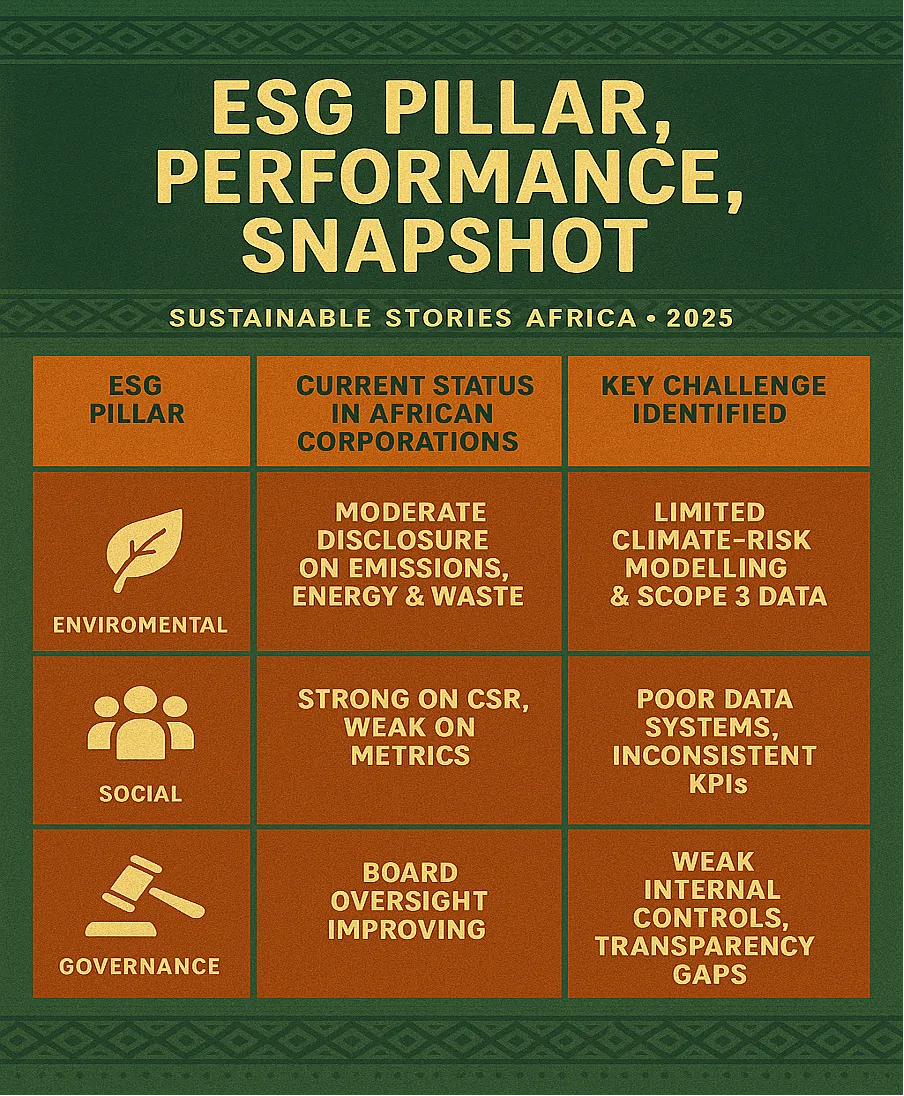
ESG Pillar Performance Snapshot
| ESG Pillar | Current Status in African Corporations | Key Challenge Identified |
|---|---|---|
| Environmental | Moderate disclosure on emissions, energy & waste | Limited climate-risk modelling & Scope 3 data |
| Social | Strong on CSR, weak on metrics | Poor data systems, inconsistent KPIs |
| Governance | Board oversight improving | Weak internal controls, transparency gaps |
Sustainability themes also highlighted:
- Low reporting maturity on biodiversity and nature-based risks.
- High exposure to climate shocks across sectors (energy, agriculture, manufacturing).
- Rising investor appetite for green bonds and sustainability-linked instruments.
- Growing regulatory convergence across Africa's capital markets.
Five Structural Barriers Slowing ESG Adoption
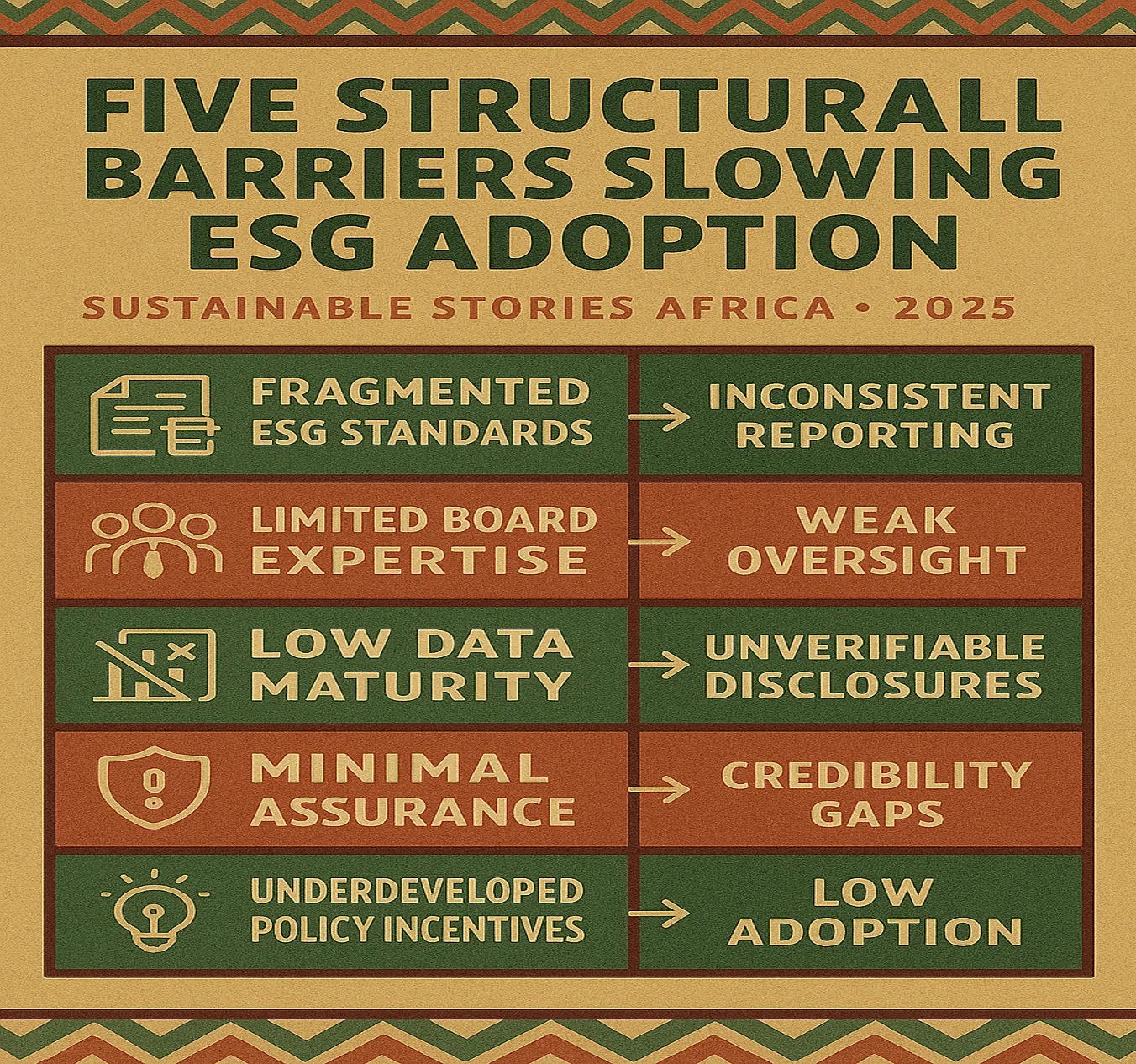
The report also stresses the widening gap between firms that embed ESG into risk management and those treating sustainability as a branding exercise.
Why African Corporations Must Shift from Disclosure to Strategy
ESG is no longer merely about publishing reports—it is about transforming business models. ESG-AT-A-GLANCE illustrates why companies with strong sustainability governance outperform peers:
- They attract cheaper and more diverse capital.
- They anticipate regulatory shifts ahead of market peers.
- They build trust with customers, governments and communities.
- They adapt faster to climate and supply-chain disruptions.
In Africa's high-volatility operating environment, ESG provides strategic advantages:
- Risk Management Becomes Predictive, Not Reactive – Climate stress testing and transition scenario planning are becoming mainstream expectations.
- Governance Maturity Enhances Investor Confidence – Investors prefer companies with strong audit systems, anti-corruption controls and transparent remuneration.
- Social Performance Strengthens Social Licence to Operate – Meaningful community engagement reduces operational risks in mining, energy and agriculture.
- Sustainability Enables Access to Green Finance – African companies are increasingly eligible for sustainability-linked loans, transition financing and thematic bonds.
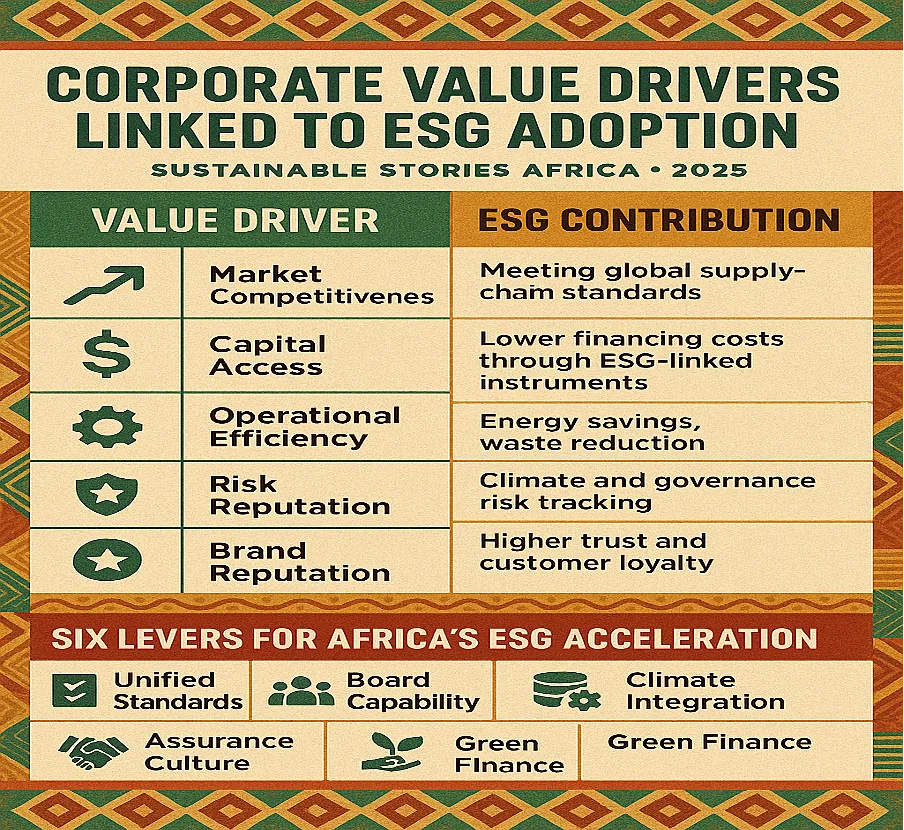
Corporate Value Drivers Linked to ESG Adoption
| Value Driver | ESG Contribution |
|---|---|
| Market Competitiveness | Meeting global supply-chain standards |
| Capital Access | Lower financing costs through ESG-linked instruments |
| Operational Efficiency | Energy savings, waste reduction |
| Risk Mitigation | Climate and governance risk tracking |
| Brand Reputation | Higher trust and customer loyalty |
The message is clear: African businesses that invest early in ESG become more resilient and competitive.
A Strategic Roadmap for Strengthening Africa's ESG Ecosystem
Drawing from the frameworks in ESG-AT-A-GLANCE, several structural actions can accelerate ESG maturity across the continent.
- Harmonise Africa's ESG Reporting Landscape – A unified reporting architecture aligned with ISSB, GRI and regional frameworks would reduce confusion and enhance comparability.
- Build ESG Capacity Across Boards and Management Teams – Board-level ESG committees, sector-tailored training, and integrated risk systems are critical.
- Improve Data Governance and Digital Assurance Tools – Companies need stronger systems for data quality, verification and real-time performance tracking.
- Promote Assurance as the Next Frontier – Third-party assurance strengthens credibility and reduces greenwashing risk.
- Expand Access to Sustainable Finance – Development finance institutions (DFIs), private equity and local capital markets can create incentives for high-quality ESG performance.
ESG-AT-A-GLANCE also notes that Africa must cultivate industry-specific ESG frameworks, from extractives and agriculture to financial services and manufacturing, to reflect local realities and materiality.
PATH FORWARD – Standardise, Assure, Finance, Transform, Compete, Lead
Africa is in a pivotal decade. ESG will increasingly determine which companies attract investment, navigate regulatory transitions and compete in global markets.
To seize this moment, African corporates must move beyond compliance toward strategy, embedding ESG into governance structures, risk models, operational plans and capital allocation.
With harmonised standards, stronger data systems, credible assurance and access to sustainable finance, the continent can redefine its corporate future. The companies that lead this transformation will shape Africa's global competitiveness in the sustainability era.