Africa's energy transition is no longer a copy‑and‑paste exercise from global climate playbooks.
With the release of the African Energy Transition Strategy and Action Plan (ETSAP), the continent has articulated its own logic: development first, decarbonisation alongside access, and realism over rhetoric.
The document reframes energy transition as an African economic strategy, one that tests finance, governance, and political will.
Development First, Transition With Purpose
Africa enters the global energy transition debate from a position which is different from other regions of the globe. The continent accounts for a minimal share of global emissions; however, it carries the world's deepest energy poverty burden.
Nearly 600 million Africans still lack access to electricity, while another one billion rely on traditional biomass for cooking. In this context, energy transition is not a moral exercise; it is a development imperative.
The African Energy Transition Strategy and Action Plan (ETSAP), developed by the African Energy Commission under the African Union, is an attempt to reconcile African realities.
The framework document relating to the period from 2025 to 2063 notes that decarbonisation is not an obstacle to growth, but a pathway to industrialisation, energy security, and resilience anchored in Africa's resource endowment and demographic trajectory.
However, ETSAP is also a stress test. Its ambitions confront weak infrastructure, fragmented markets, fiscal constraints and limited private capital mobilisation.
The report is less a declaration of intent than a continental negotiating position, setting out what Africa will prioritise, and on what terms it will engage the global transition economy.
Africa Is Redefining The Energy Transition
At the heart of ETSAP is a clear departure from one‑size‑fits‑all climate pathways. The strategy explicitly acknowledges that fossil fuels, especially natural gas, still account for over half of Africa's total primary energy supply, and will remain part of the mix in the medium term. Rather than abrupt defossilisation, ETSAP advances managed decarbonisation.
Six strategic pillars structure this vision:
- Universal energy access
- Energy efficiency
- Carbon management for fossil‑derived energy
- Policy harmonisation
- Innovation and Human Capacity
- Sustainable industrialisation.
Together, they reposition the transition as a systems challenge rather than a technology swap.
SSA INSIGHT: Africa's transition narrative prioritises access and resilience over speed.
The Numbers Behind The Strategy
The ETSAP is grounded in extensive modelling across electricity, transport, buildings, industry, agriculture, oil and gas, and clean cooking.
The data reveal a continent where fossil fuels still dominate, but where renewable energy and efficiency gains are increasingly cost‑competitive.
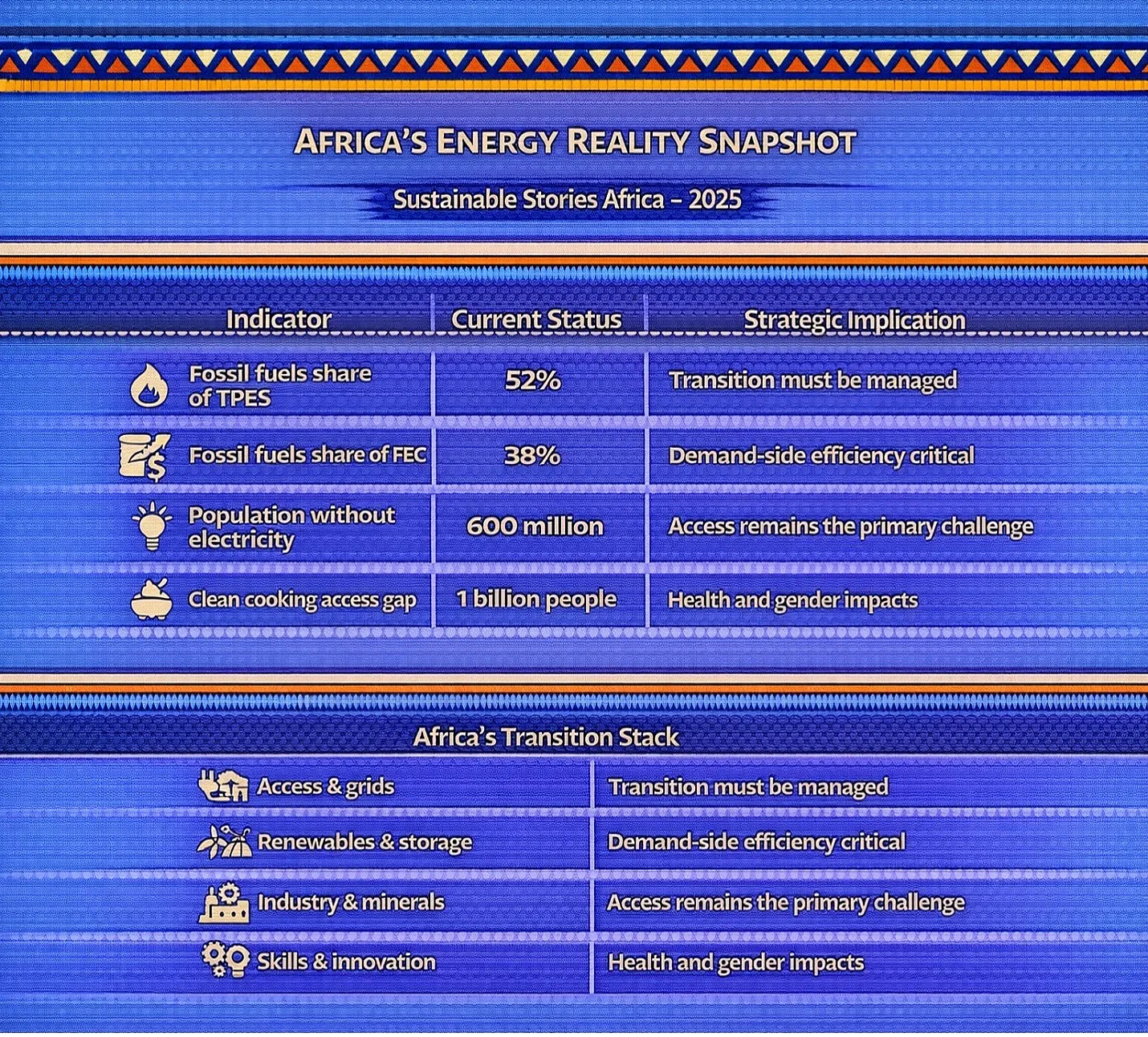
Africa's Energy Reality Snapshot
| Indicator | Current Status | Strategic Implication |
|---|---|---|
| Fossil fuels share of TPES | 52% | Transition must be managed |
| Fossil fuels share of FEC | 38% | Demand‑side efficiency critical |
| Population without electricity | 600 million | Access remains the primary challenge |
| Clean cooking access gap | 1 billion people | Health and gender impacts |
SSA INSIGHT: Africa's energy transition begins with people, not megawatts.
Power, Industry and Regional Integration
Electricity remains the backbone of ETSAP. The strategy emphasises accelerated renewable deployment alongside grid expansion, storage and regional power trade under the African Single Electricity Market. However, it also highlights transmission losses, weak utilities and regulatory fragmentation as binding constraints.
Industrial decarbonisation is framed not as de‑industrialisation, but as transformation. ETSAP links energy policy to manufacturing, minerals beneficiation and localisation of value‑chain management, especially in the areas of battery production, green hydrogen and clean transport technologies.
Gas, Carbon Management And A Balanced Transition
Perhaps the most contested pillar of ETSAP is its treatment of oil and gas. The strategy does not outrightly reject fossil fuels.
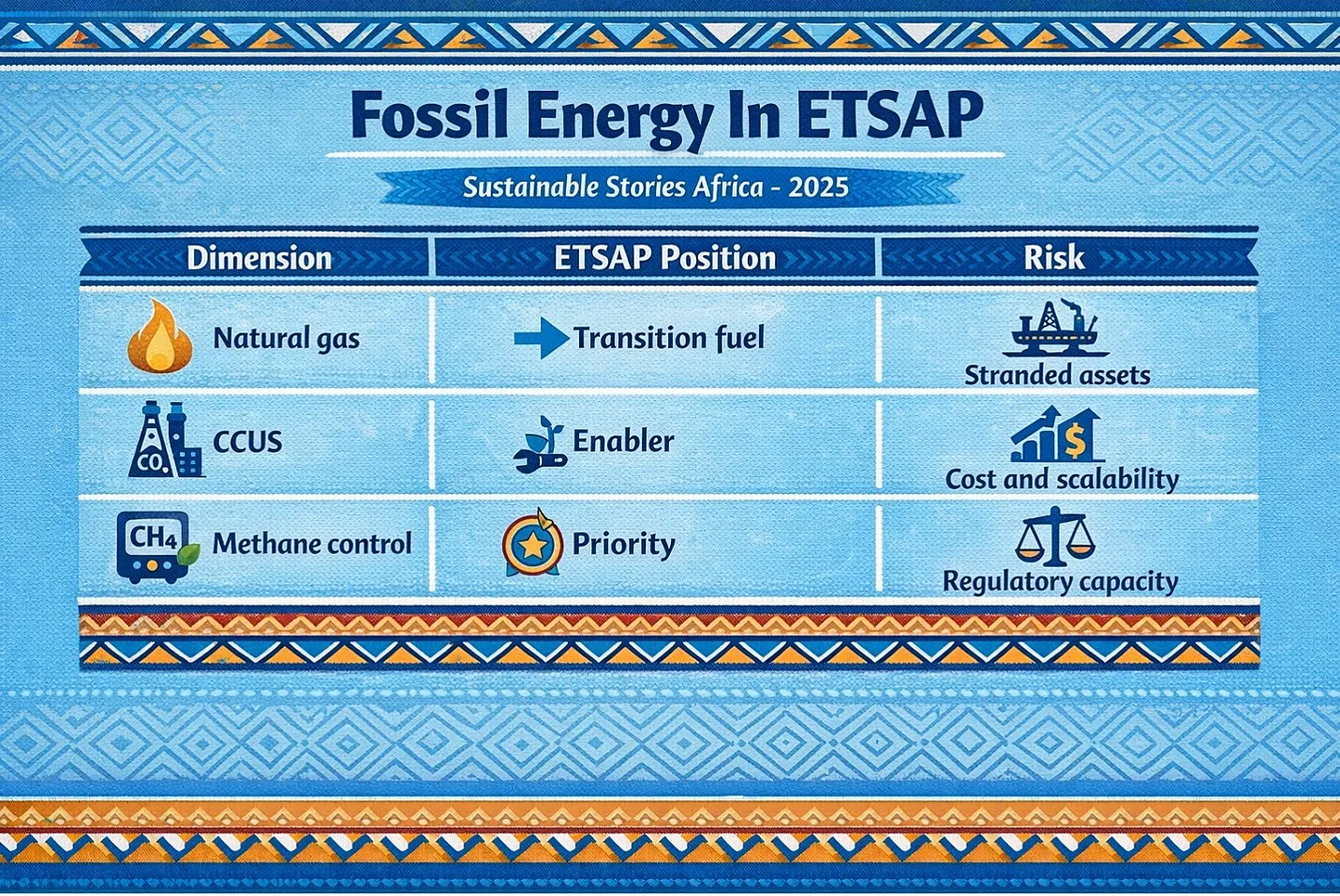
Instead, it calls for methane reduction, flaring control, efficiency improvements and carbon capture, which would position Africa's gas as a transition fuel that underwrites access and industrial growth.
Fossil Energy In ETSAP
| Dimension | ETSAP Position | Risk |
|---|---|---|
| Natural gas | Transition fuel | Stranded assets |
| CCUS | Enabler | Cost and scalability |
| Methane control | Priority | Regulatory capacity |
SSA INSIGHT: The realism of Africa is a challenge to global climate orthodoxy.
Financing The Transition Remains The Hardest Problem
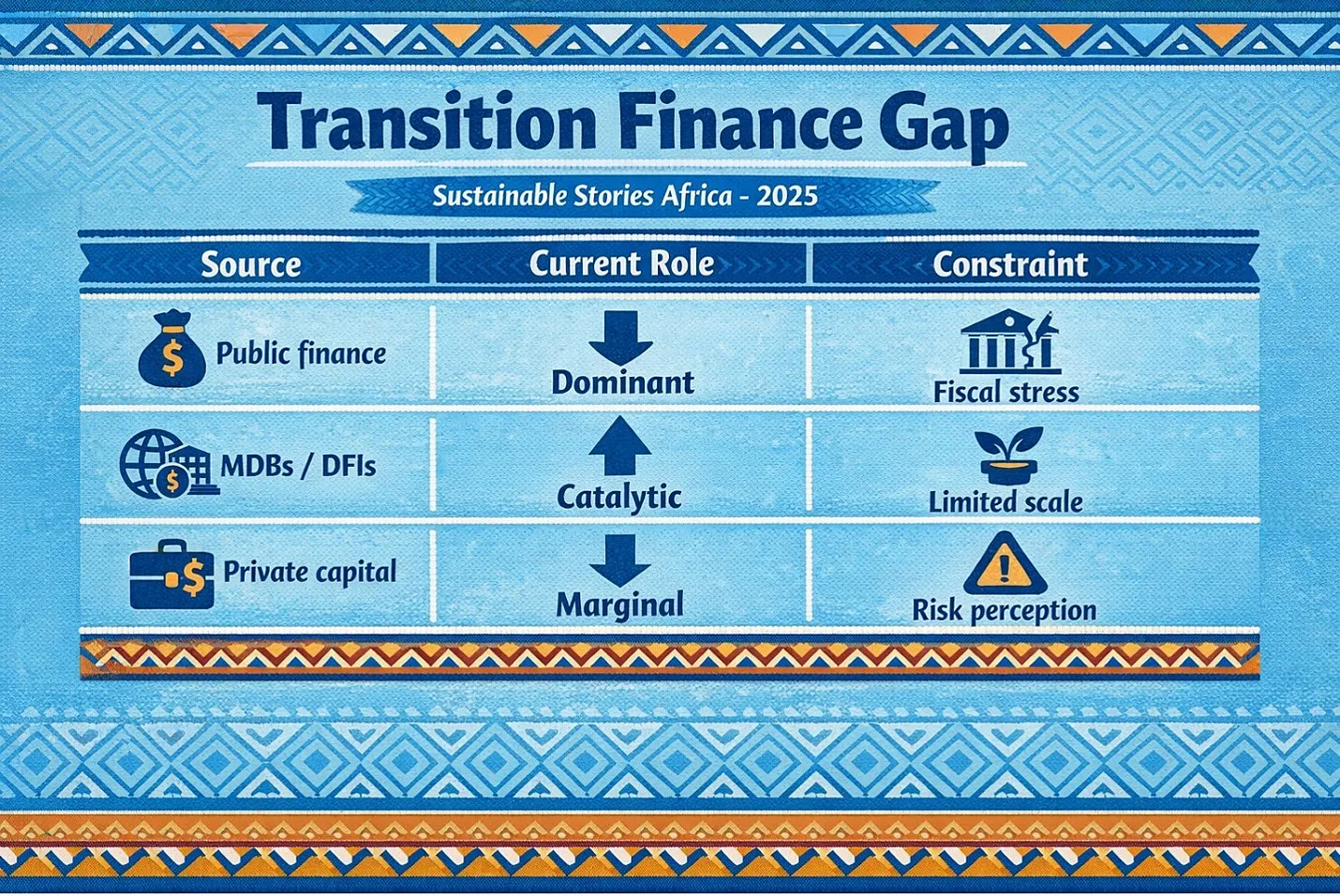
The credibility of ETSAP hinges on financing. The strategy recognises that public budgets alone cannot fund the transition.
It calls for blended finance, development banks, carbon markets and private capital mobilisation; it does not provide any details relating to mechanisms for enforcement.
Transition Finance Gap
| Source | Current Role | Constraint |
|---|---|---|
| Public finance | Dominant | Fiscal stress |
| MDBs/DFIs | Catalytic | Limited scale |
| Private capital | Marginal | Risk perception |
SSA INSIGHT: The transition will stall without capital re‑pricing risk.
From Continental Vision To National Delivery
ETSAP is not a binding treaty. It is a guiding framework designed for domestication. Pilot National Deep Decarbonisation Pathways in Madagascar, Botswana and The Gambia illustrate how countries can adapt the strategy to local conditions.
Implementation will depend on political leadership, regulatory reform, project pipelines and coordination between energy, finance and industrial ministries. Without this, ETSAP risks remaining an elegant blueprint without execution muscle.
PATH FORWARD – Africa Leads With Its Logic
ETSAP marks a decisive shift in Africa's engagement with the global energy transition. It asserts that access, development and decarbonisation must move together.
The real test now lies in financing, governance and delivery. This is where continental vision meets national reality.