Africa's growth story is colliding with climate reality. New scientific evidence shows the continent's development pathway is neither linear nor simple — it bends, rises, reverses, and, in some places, heals.
What this means is profound: economic expansion can either worsen or ultimately improve emissions, depending on income levels, governance, and energy choices.
Growth, Emissions, Turning Points – Africa's Carbon Test
Africa is at a historic inflexion point. Its cities are swelling, its industries accelerating, and its people pushing defiantly forward in pursuit of prosperity. Yet beneath the optimism lies a structural tension: how to grow without destroying the environment that sustains livelihoods, health, food systems, and security.
A continental-scale empirical study covering 46 African countries between 1990 and 2020 confirms that Africa's emissions growth relationship is neither uniform nor monotonic. It is scientific, measurable, and deeply unequal across development stages.
This shows that some African economies will eventually experience declining emissions as incomes rise, validating the Environmental Kuznets Curve (EKC) for lower-middle-income and upper-middle/high-income countries, while low-income economies face a dangerous emissions rebound as development advances.
At the centre of Africa's dilemma are three forces: energy consumption, urbanisation, and institutional capacity. Each determines whether growth heals or harms. That is the real climate story, not slogans, but evidence-based economics demanding serious policy execution.
Africa's Emissions: Growth First, Repair Later – Or Never?
The core revelation of the research is both reassuring and alarming. However, the EKC exists, but only for African economies past a certain income maturity. For low-income countries, the pattern reverses into a U-shape, meaning emissions fall in early development but rise dangerously as economic structures industrialise.
Energy consumption remains the strongest long-run driver of emissions across all income groups, while urbanisation delivers mixed outcomes. Harmful in low-income contexts yet beneficial in structured middle-income economies with better planning.
What the Data Actually Shows: Africa's EKC Reality
The study's methodology is statistically robust, using PMG, CCE-PMG estimators, panel causality testing, and long-run equilibrium verification.
It confirms bidirectional causality between GDP and emissions, and between energy consumption and emissions, revealing a reinforcing cycle: economies grow, emissions rise, and emissions themselves shape economic patterns.
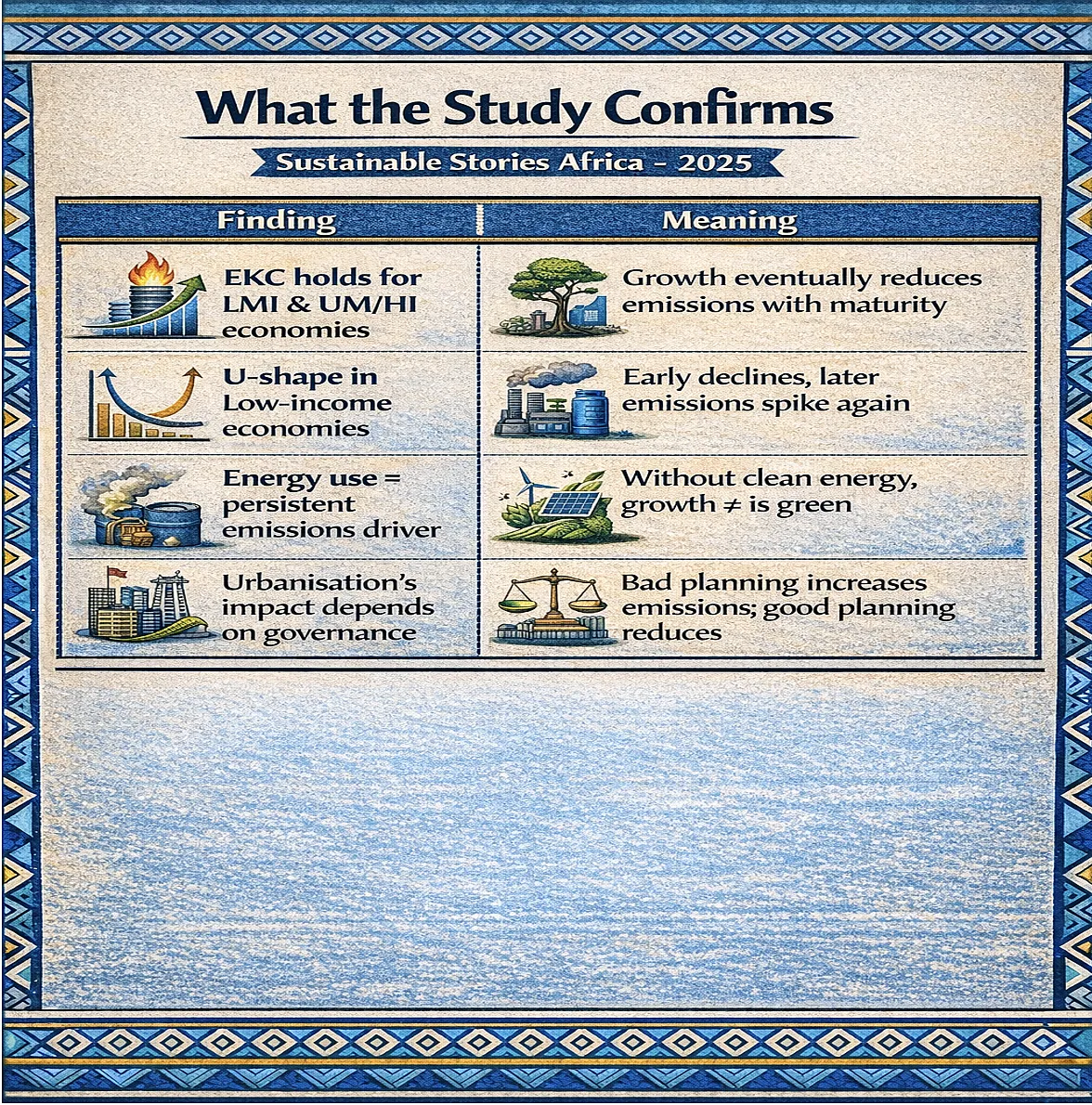
What the Study Confirms
| Finding | Meaning |
|---|---|
| EKC holds for LMI & UM/HI economies | Growth eventually reduces emissions with maturity |
| U-shape in Low-income economies | Early declines, later emissions spike again |
| Energy use = persistent emissions driver | Without clean energy, growth ≠ green |
| Urbanisation's impact depends on governance | Bad planning increases emissions: good planning reduces |
What Could Be Won if Africa Gets This Right
If African states treat this research not as academic literature but as a development playbook, the continent can secure three wins:
- Cleaner Growth Trajectories – move countries faster toward the EKC turning point
- Urbanisation Dividend – cities becoming engines of efficiency, not pollution
- Energy Reform Advantage – renewables and efficiency policies delivering measurable emission control
This is not climate righteousness; this is macroeconomic stability, public health protection, and competitiveness.
This Is Where Africa Must Act Now
This study does not argue against growth. It argues against blind growth. It rejects the lazy narrative that "Africa's emissions are low, so it does not matter." It matters because emissions here destroy lives faster, amplify disaster exposure, and widen inequality.
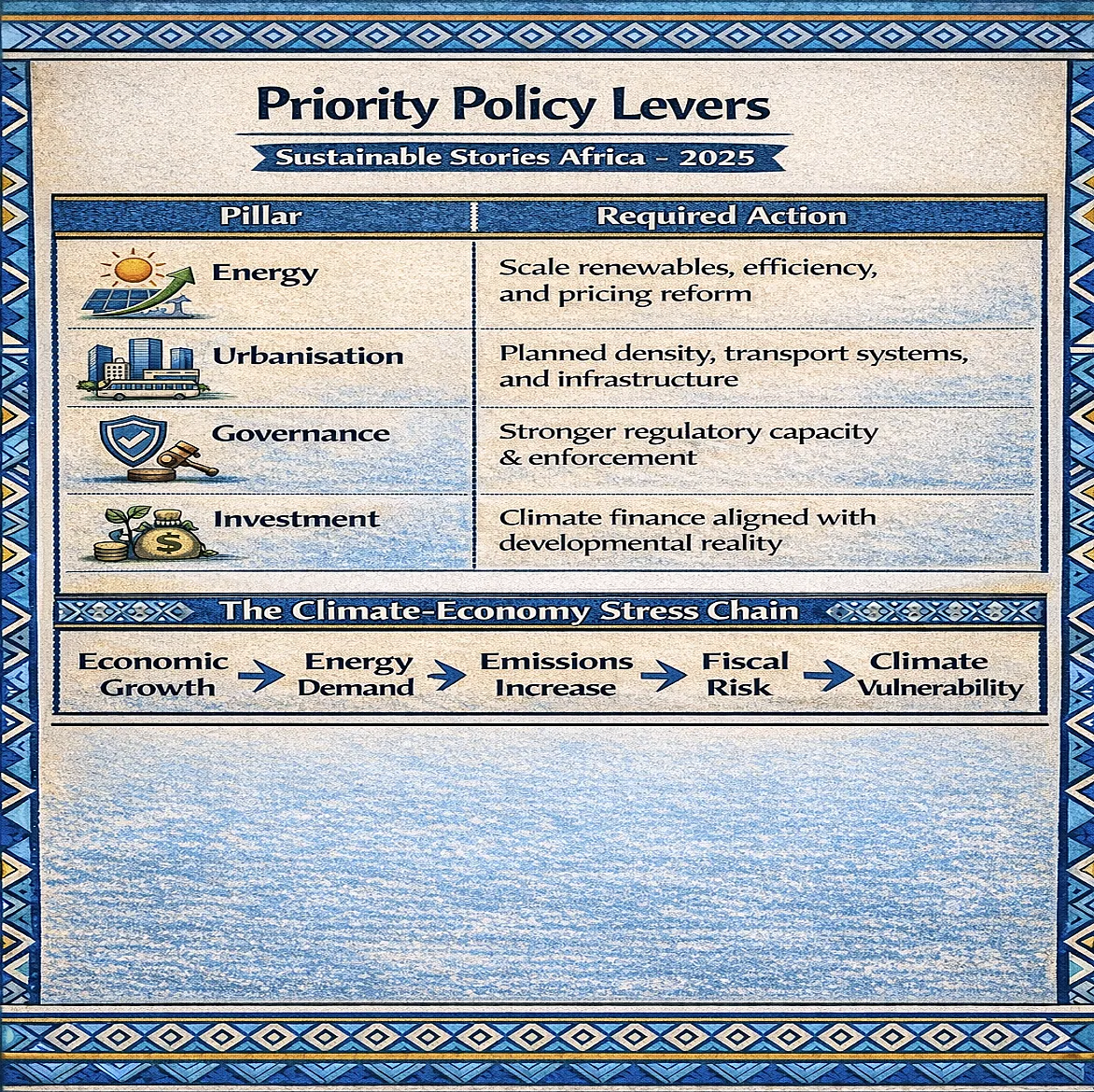
Policy must break this chain at Energy and Urban Systems.
Priority Policy Levers
| Pillar | Required Action |
|---|---|
| Energy | Scale renewables, efficiency, and pricing reform |
| Urbanisation | Planned density, transport systems, and infrastructure |
| Governance | Stronger regulatory capacity & enforcement |
| Investment | Climate finance aligned with developmental reality |
Why This Matters for Investors, Governments, and Citizens
- For governments, this validates structured climate-development planning.
- For investors, it clarifies risk, credibility, and predictable policy environments.
- For citizens, it means the fight for clean air, reduced disaster losses, and sustainable jobs.
The research makes one last powerful point: Africa's emissions problem is not just environmental; it is economic governance, urban governance, and energy governance.
PATH FORWARD – Smarter Growth, Cleaner Future, Shared Security.
Africa must treat climate-economy evidence as strategy, not theory. The priority is accelerating nations across the EKC curve through clean energy, disciplined urban planning, institutional strength, and targeted investment.
Governments need credible execution, investors need confidence, and citizens need proof that development does not mean environmental sacrifice. Africa's future growth must be measured, data-anchored, and climate-secure, because prosperity without sustainability is only a temporary illusion.