Africa has five years to rescue the Sustainable Development Goals, and less than 6% are currently on track. As debt pressures rise and climate shocks intensify, Foresight Africa 2025–2030 argues that the challenge is no longer ambition, but execution.
Five Years To Deliver Development
Africa enters the second half of the SDG decade with a paradox. Growth has returned in many economies, populations are young and expanding, and digital adoption is accelerating. However, progress on poverty, health, education, and climate resilience remains stubbornly slow.
According to Foresight Africa 2025–2030 (pages 49–77), fewer than 6% of SDG targets in Africa are on track, compared with 17% globally. The remaining goals are either stagnating or reversing, particularly those tied to food security, inequality, basic services, and climate adaptation.
The report's message is blunt: the SDG crisis in Africa is not a failure of ideas. It is a failure of systems: financing, governance, and delivery, at a moment when the margin for delay has disappeared.
The SDG Emergency Is Structural
The SDG shortfall is no longer theoretical. It is visible in daily life.
Debt servicing now absorbs over 13% of government expenditure across the continent, crowding out spending on health, education, and social protection.
Climate shocks threaten livelihoods for up to 900 million Africans by 2050, even as adaptation finance remains scarce. Meanwhile, demographic pressure continues to rise, with Africa adding nearly 800 million working-age people by mid-century.
The report framed 2025 as a litmus test for African agency: either governments convert plans into outcomes, or the SDGs risk becoming an accounting exercise detached from lived realities.
Why Progress Has Stalled
Across pages 49–77, Foresight Africa identifies four binding constraints holding back SDG delivery.
- Financing without reform – Africa's SDG financing gap has widened as concessional flows stagnate and borrowing costs rise. Even where resources exist, they are often fragmented across projects rather than aligned to national delivery systems. The result: pilots rather than platforms.
- Policy implementation gaps – The report stresses that many African countries now possess strong policy frameworks, but weak execution. Regulatory overlap, limited sub-national capacity, and fragile data systems prevent national commitments from translating into community-level outcomes.
- Governance credibility – Trust deficits matter. Weak procurement systems, uneven rule of law, and limited accountability undermine service delivery and deter long-term investment. Governance reform, the report argues, is not an abstract ideal but a prerequisite for SDG acceleration.
- Climate and conflict stress – Food insecurity, displacement, and climate volatility intersect with conflict and fragility, particularly in vulnerable regions. Without adaptation-first strategies, SDG gains remain reversible.
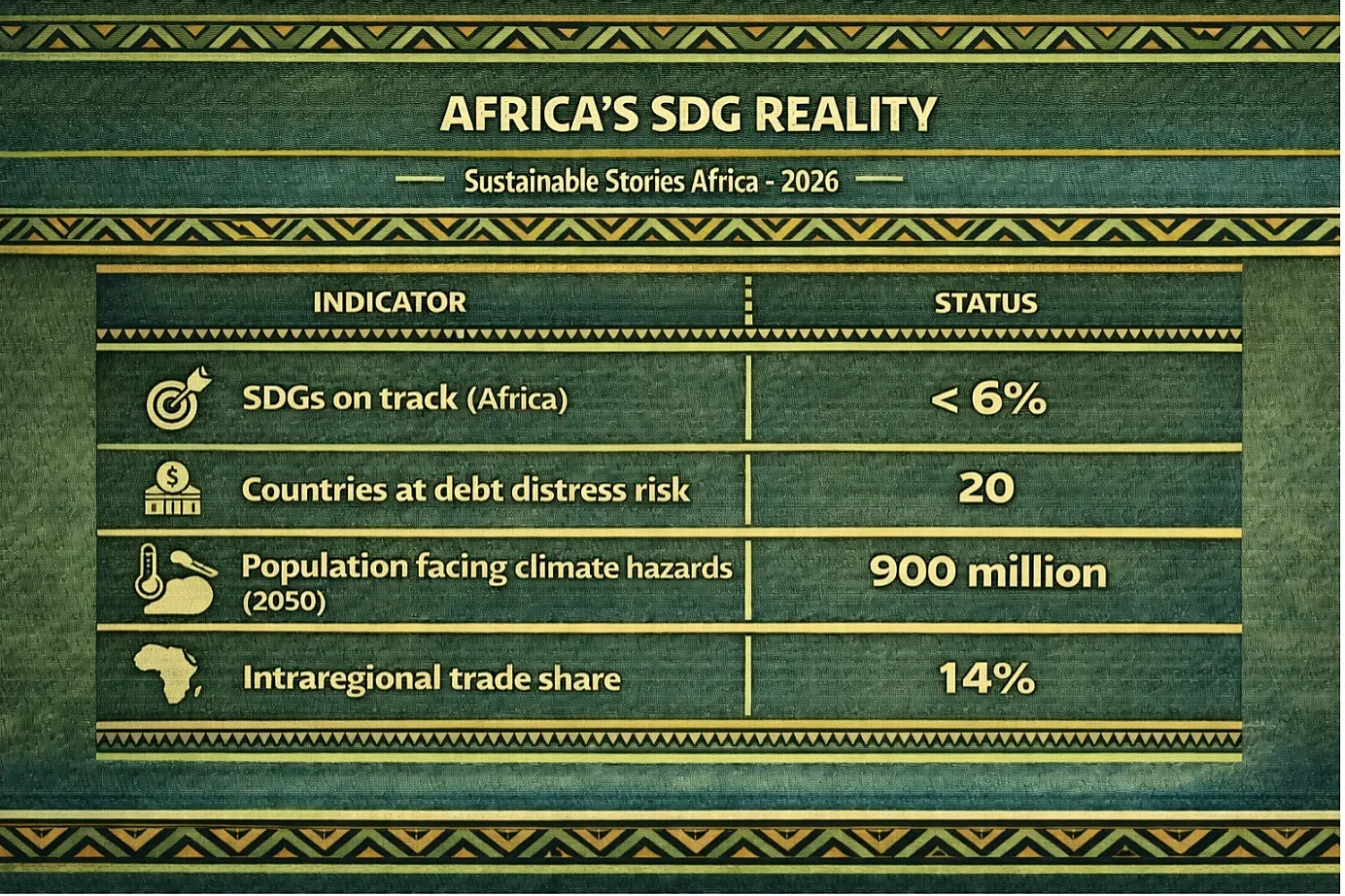
Africa's SDG Reality
| Indicator | Status |
|---|---|
| SDGs on track (Africa) | < 6% |
| Countries at debt distress risk | 20 |
| Population facing climate hazards (2050) | 900 million |
| Intraregional trade share | 14% |
What Acceleration Could Unlock
Despite the sobering diagnosis, the report is not pessimistic. It is conditional.
Progress is possible if Africa shifts from goal-setting to system-building.
- Targeted SDG sequencing, prioritising jobs, food systems, and energy access, can generate multiplier effects across health, education, and gender outcomes.
- Domestic resource mobilisation, paired with transparent expenditure, can restore fiscal credibility and reduce dependence on volatile external flows.
- Regional integration, especially through AfCFTA, can unlock scale—turning fragmented markets into engines for industrialisation and social investment.
- Digital public infrastructure can dramatically improve targeting, monitoring, and service delivery when paired with institutional reform.
The report repeatedly underscores that SDG acceleration is not about doing everything at once, but doing the right things first, consistently.
From Aspirations To Accountability
The call to action is three-fold.
- Governments must treat SDGs as delivery contracts, not diplomatic commitments, embedding them into budgets, procurement rules, and performance metrics.
- Development partners are urged to move beyond fragmented projects toward long-term, country-led platforms, aligned with national systems rather than parallel ones.
- The private sector has a pivotal role: not only as financiers, but as employers, innovators, and partners in service delivery, particularly in energy, food systems, and digital infrastructure.
As the report notes, "Africa does not lack plans. It lacks time."
Path Forward – Delivering Results Before 2030
Africa's SDG recovery hinges on execution: prioritised goals, credible governance, and aligned financing.
With five years remaining, the choice is stark: translate commitments into systems that deliver jobs, services, and resilience, or allow the SDGs to become a missed deadline. Acceleration is still possible, but delay is no longer affordable.