Central Africa sits on some of the world's richest renewable energy resources, yet remains among the least electrified regions globally. Low access rates, fragile grids and under-investment continue to suppress growth across the region's economies.
Planning Power for a Fragmented Region
Central Africa's power challenge is not rooted in resource scarcity. The region is endowed with vast hydropower, solar and wind potential, enough to meet domestic demand and export electricity across the continent. Yet electricity access remains stubbornly low, with seven of the eleven Central African Power Pool (CAPP) countries still below 50% access.
According to the International Renewable Energy Agency (IRENA), regional electricity demand could double by 2040 under current trends, and rise by almost 350% under a more ambitious development pathway aligned with Africa's Agenda 2063. Existing and committed generation capacity, however, would fall short of peak demand by nearly 10 gigawatts, exposing a widening planning gap.
The real question, IRENA argues, is not whether Central Africa should pursue renewables, but how quickly governments can align planning, investment and cross-border cooperation to turn potential into power.
Why Central Africa's Power Gap Matters Now
Central Africa's electricity deficit is becoming a binding constraint on growth. Despite decades of investment, the region remains one of the least electrified globally, with electricity generation per capita ranging from 0.5% to 28% of the global average.
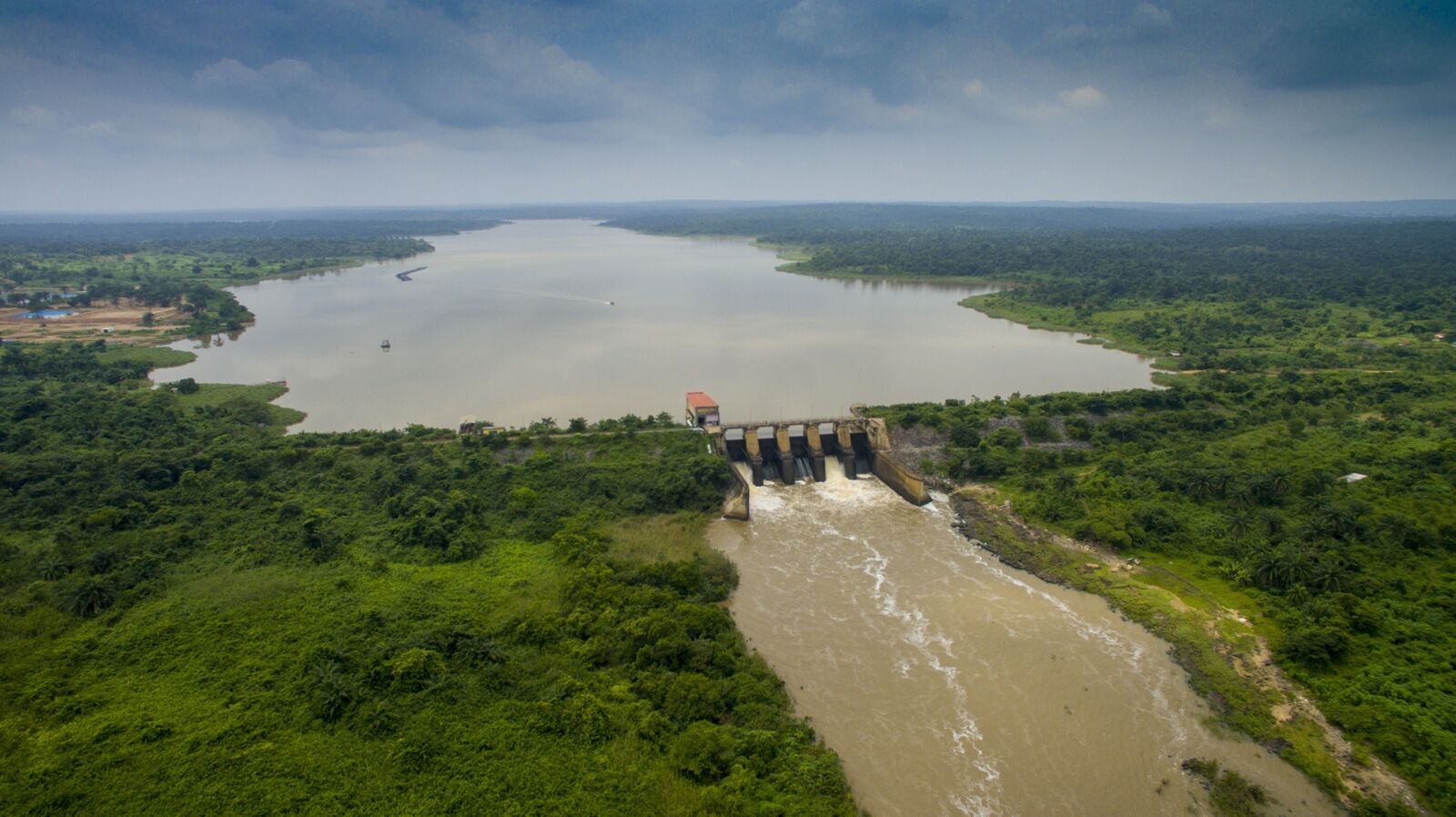
IRENA's modelling highlights a stark reality: without decisive planning, rising demand will outpace infrastructure, locking countries into cycles of outages, diesel reliance and suppressed industrial growth. Even today, installed capacity figures mask fragility, hydropower dominates supply, but climate variability and operational constraints limit effective capacity.
Electricity planning, once treated as a technical exercise, is now a macroeconomic and political imperative.
What the Data Reveals About the Regional Power System
IRENA's regional modelling, the most comprehensive to date, paints a clear picture of Central Africa's power landscape.
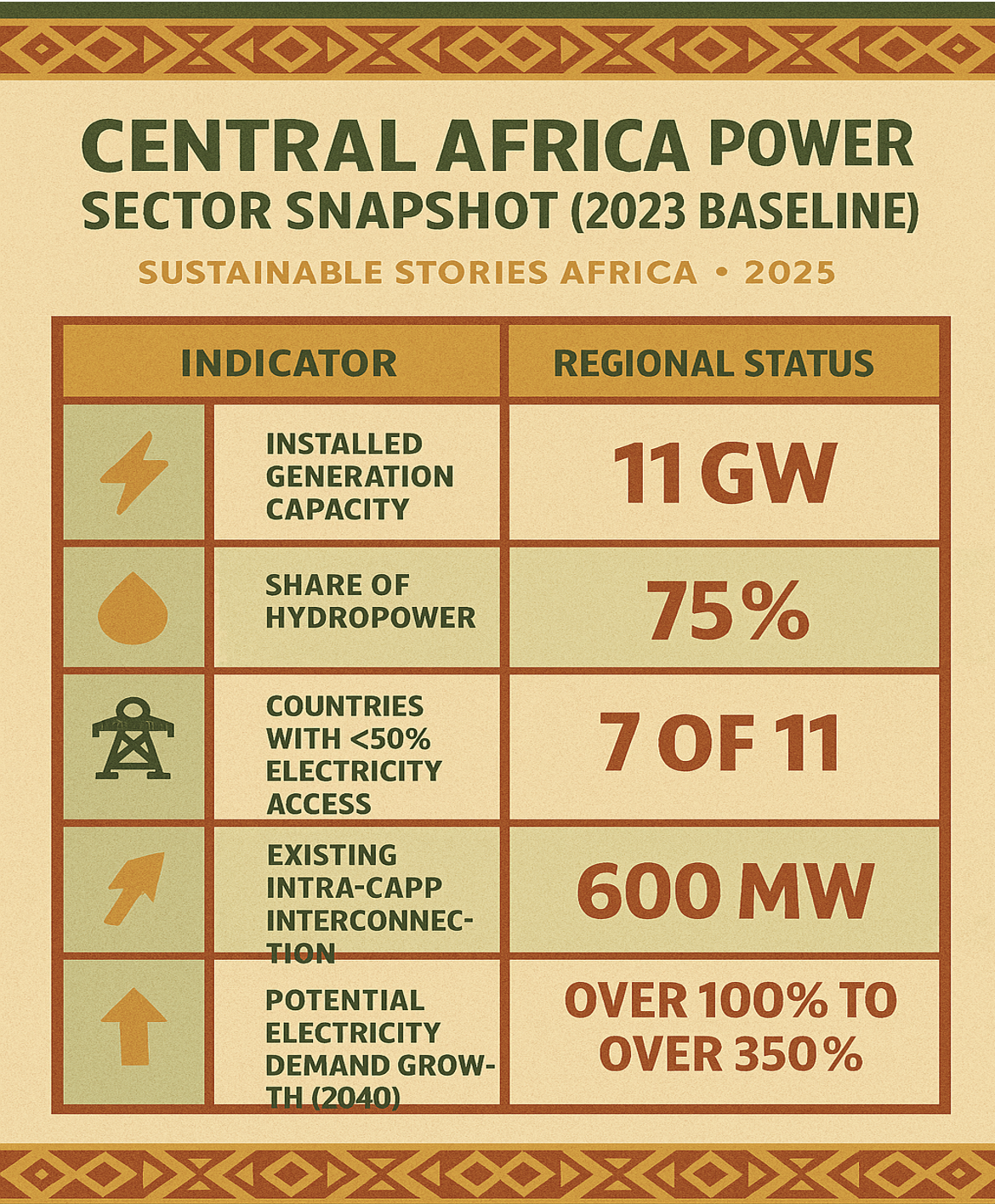
Central Africa Power Sector Snapshot (2023 Baseline)
| Indicator | Regional Status |
|---|---|
| Installed generation capacity | 11 GW |
| Share of hydropower | 75% |
| Countries with <50% electricity access | 7 of 11 |
| Existing intra-CAPP interconnection | 600 MW |
| Potential electricity demand growth (2040) | Over 100% to over 350% |
Hydropower anchors the system today and will remain central in all future scenarios. Yet solar PV and wind, driven by falling costs, rise from near-zero shares today to 7–20% of total production by 2040, depending on demand and climate assumptions.
Crucially, fossil fuels decline further. In most scenarios, their share of electricity generation falls below 5% by 2040, undermining the long-term case for gas expansion in the region.
Renewables Plus Trade Outperforms All Alternatives
IRENA's modelling compares multiple futures, delays in hydropower, dry-year scenarios, high-demand growth and full continental integration.
Across all of them, one conclusion is consistent: renewables combined with cross-border trade deliver the lowest system costs and emissions.
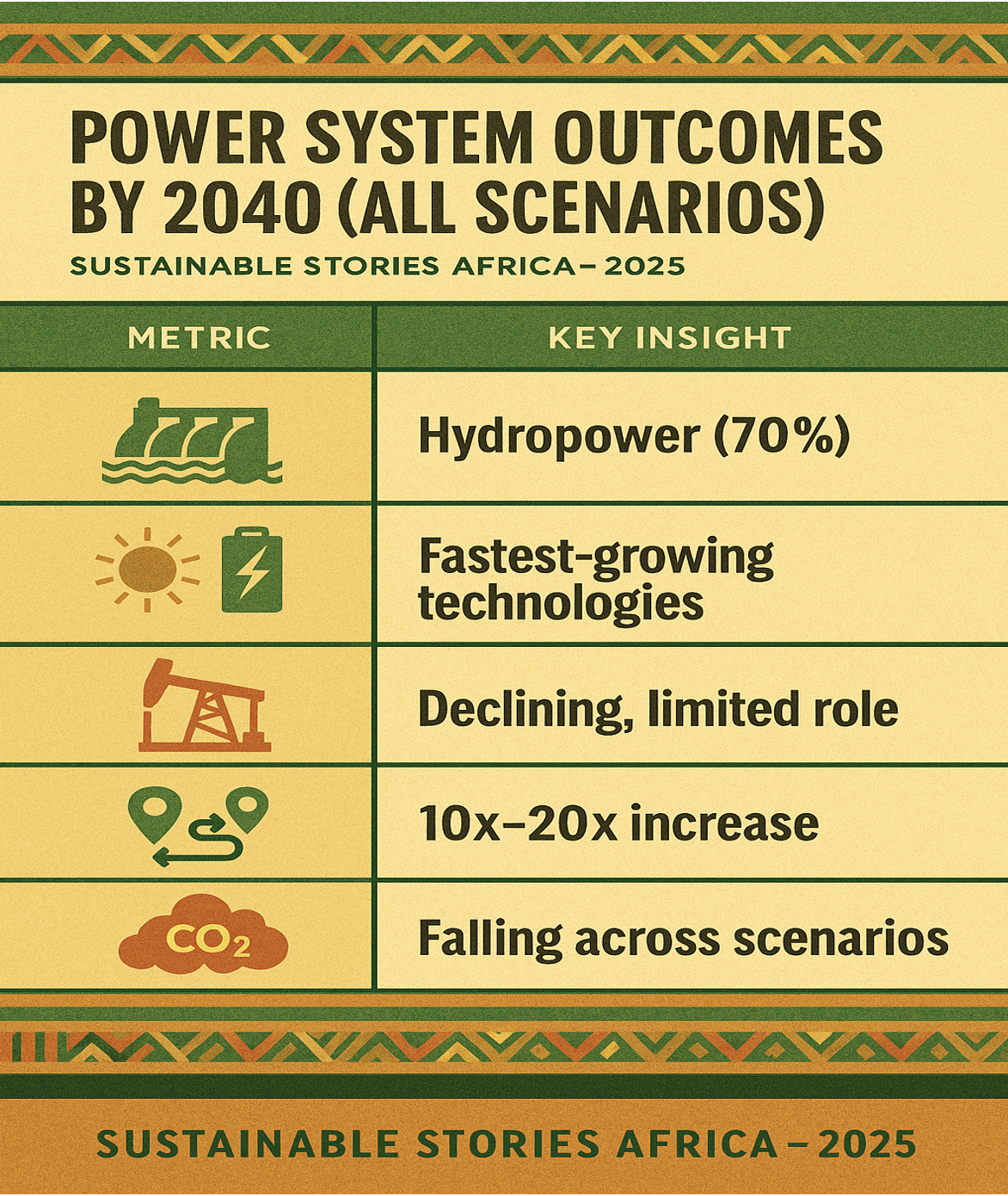
Power System Outcomes by 2040 (All Scenarios)
| Metric | Key Insight |
|---|---|
| Dominant energy source | Hydropower (70%) |
| Fastest-growing technologies | Solar PV, batteries |
| Fossil fuel outlook | Declining, limited role |
| Cross-border capacity growth | 10×– 20× increase |
| CO₂ emissions trend | Falling across scenarios |
Cross-border trade emerges as the system's shock absorber. Expanded interconnections allow lower-cost renewable resources, especially large hydropower in the Democratic Republic of Congo, to serve multiple markets, reducing costs across Central, West and Southern Africa.
The modelling shows that by 2040, interconnector capacity could rise to 40 - 50 GW under full integration scenarios, transforming Central Africa into a continental power exporter.
The Grand Inga Question and Planning Risks
No single project shapes Central Africa's energy future more than Grand Inga. With over 20 GW modelled within the 2040 horizon and up to 40 GW in total potential, it could redefine regional power flows.
But IRENA's analysis is deliberately cautious. Scenarios without Grand Inga show:
- 73% less interconnector capacity
- 81% fewer net exports
- Greater reliance on alternative renewables and storage
This underscores a central planning lesson: megaproject ambition must be balanced with diversification, phased delivery and regional coordination.
What Drives Central Africa's Power Costs
- Demand growth assumptions
- Interconnector investment timing
- Hydropower availability (climate risk)
- Solar PV and battery cost trajectories
PATH FORWARD – Planning Power Beyond National Borders
Central Africa's energy future hinges on regional planning, not isolated national strategies. Renewables, anchored by hydropower, accelerated by solar, and stabilised through batteries, form the lowest-cost pathway forward.
By prioritising cross-border infrastructure, transparent planning and institutional coordination, the region can convert abundant renewable resources into reliable power, lower costs and sustained economic growth.