Ethiopia's green finance story is often told as one of ambition chasing capital. A new SAGFA-backed study shows the reality is more complex and more instructive.
Public money dominates, private capital lags, and industrial transformation remains constrained not by vision but by execution gaps. From governance bottlenecks to weak market pipelines, the findings reveal why Ethiopia's green finance ecosystem is at a decisive inflexion point, and what must change to unlock sustainable industrialisation at scale.
When Green Ambition Meets Financial Reality
Ethiopia has positioned green finance as a cornerstone of its development strategy, aligning climate ambition with industrial transformation.
Anchored in the Climate-Resilient Green Economy (CRGE) Strategy, the Ten-Year Development Plan, and updated Nationally Determined Contributions (NDCs), the country has set out to industrialise without repeating the carbon-intensive mistakes of earlier growth models.
However, ambition alone does not mobilise capital. According to the Sino-African Green Finance Alliance (SAGFA) Ethiopia 2025 Report, Ethiopia faces an estimated $316 billion financing requirement by 2030, with nearly 80% expected from international sources. A structure that exposes deep vulnerabilities in domestic financial markets and institutional capacity.
The report offers a rare, evidence-based window into how green finance actually flows in Ethiopia, who controls it, and why the transition from policy intent to bankable projects remains uneven.
Its findings suggest the country's green future depends less on new commitments and more on fixing coordination, credibility, and execution.
A Green Finance System Under Strain
Green finance in Ethiopia is no longer a niche policy idea; it is central to economic survival. Climate shocks already threaten agriculture, energy systems, and export competitiveness, with projections suggesting climate impacts could cut GDP by up to 10% by 2045 if left unmanaged.
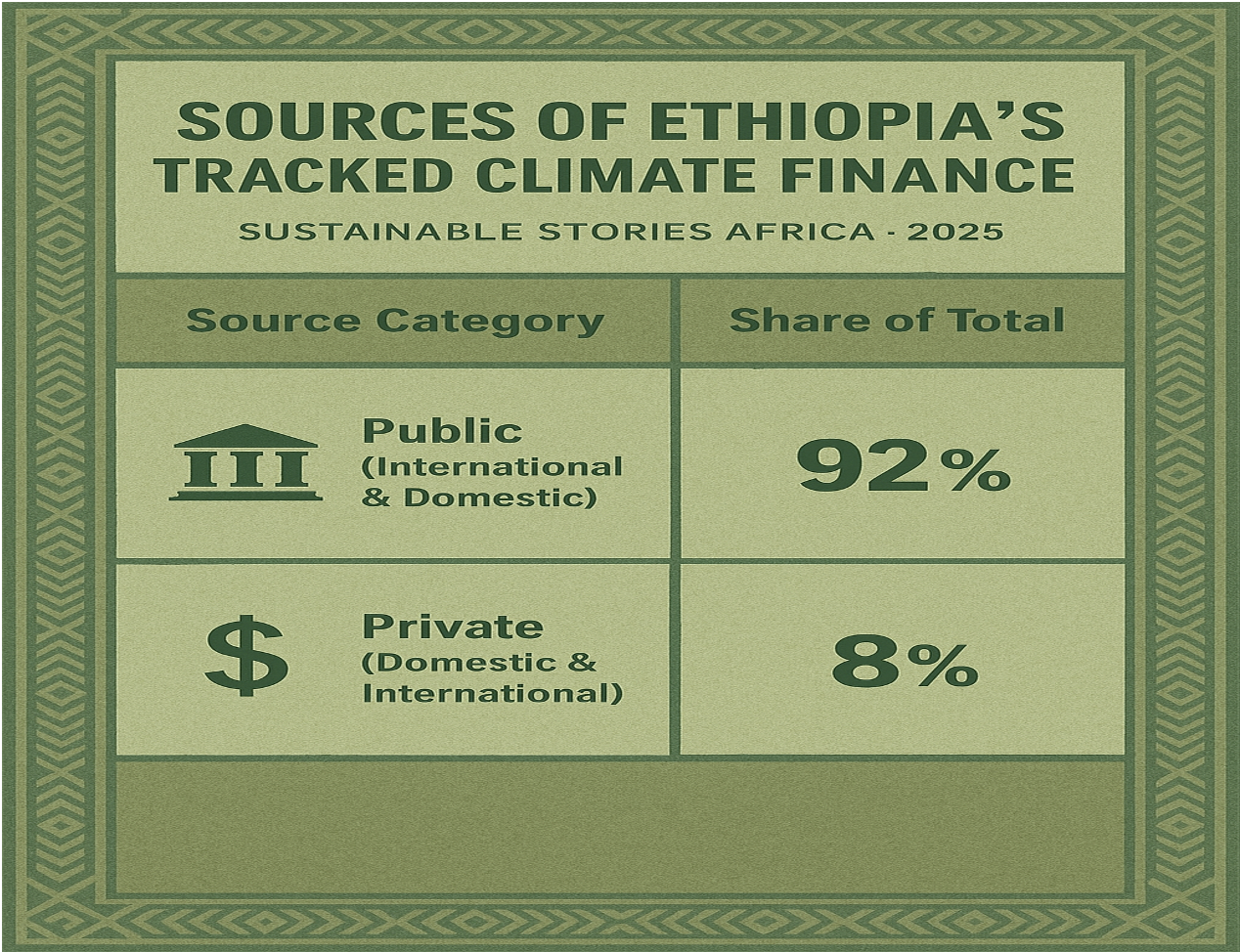
However, the financing ecosystem designed to address these risks remains thin. The SAGFA report finds that 92% of tracked climate finance is publicly sourced, while private capital contributes just 8%. Grants dominate, equity is scarce, and domestic financial institutions remain cautious, under-tooled, and risk-averse.
This imbalance matters. Without private capital, green industrialisation cannot scale. Without scale, Ethiopia risks becoming climate-compliant on paper but structurally constrained in practice.
Where the Money Comes From, and Where It Goes
The report maps Ethiopia's green finance flows with unusual granularity, revealing both strengths and structural weaknesses.
Sources of Ethiopia's Tracked Climate Finance
| Source Category | Share of Total |
|---|---|
| Public (International & Domestic) | 92% |
| Private (Domestic & International) | 8% |
Sources of Ethiopia's Tracked Climate Finance
International public finance dominates, delivered primarily through grants (70%) and concessional loans (25%), while commercial debt and equity remain marginal.
Climate funds such as the Green Climate Fund, GEF, and Adaptation Fund underpin Ethiopia's adaptation agenda, particularly in agriculture and resilience.
However, sectoral allocation tells a more revealing story.
Climate Finance Allocation by Purpose
| Purpose | Share |
|---|---|
| Adaptation | 56% |
| Mitigation | 38% |
| Cross-cutting | 6% |
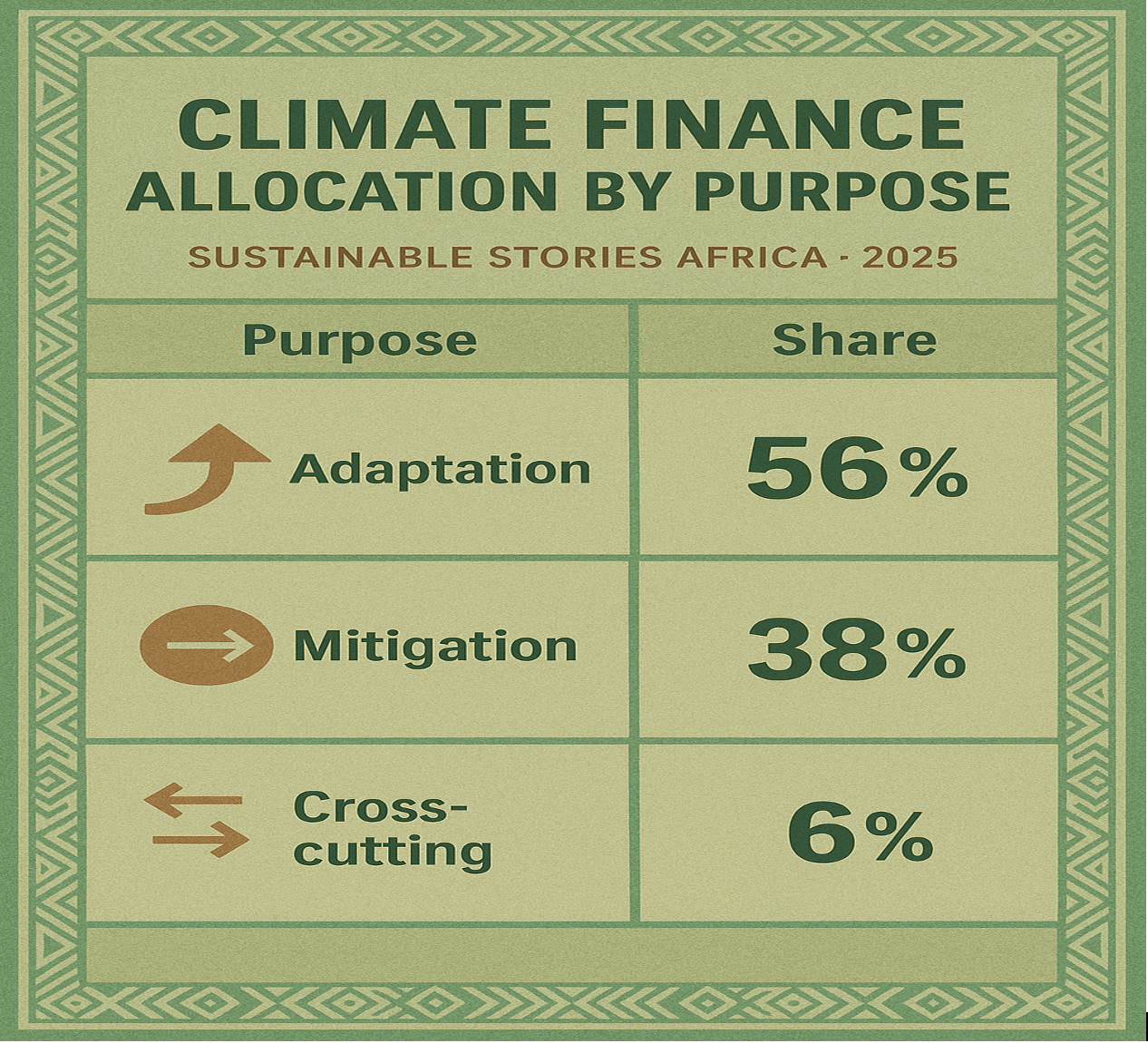
Energy systems and transport, which are critical enablers of industrialisation, receive comparatively limited funding, while AFOLU and cross-sectoral programmes dominate. This reflects vulnerability priorities but also constrains productivity-enhancing green growth.
Why Industrial Transformation Is Stalling
Despite inflows, institutional outcomes remain uneven. Survey data from 41 institutions shows green finance is improving resource efficiency, logistics sustainability, and circular practices; however, adoption remains shallow and fragmented.
The binding constraints are not conceptual; they are operational:
- Weak bank readiness – Limited ability to assess climate risk, structure green products, or monitor outcomes
- Thin project pipelines – MSMEs struggle with feasibility studies, ESIA costs, and certification
- Regulatory friction – Delays in permits, inconsistent power supply, and foreign-exchange constraints
- Data opacity – No unified national registry to track commitments, disbursements, or results
In effect, Ethiopia has a capital without coordination and policies without pipelines.
From Fragmented Finance to Functional Markets
The SAGFA report identifies three priority actions capable of unlocking momentum if executed decisively.
Three Systemic Levers for Scale
| Lever | Purpose | Expected Impact |
|---|---|---|
| Green Enterprise Hub | Build bankable MSME pipelines | Private capital mobilisation |
| National Finance Registry & MRV | Transparency and accountability | Investor confidence |
| Fast-Track Permits & Power Reliability | Reduce project risk | Faster deal closure |
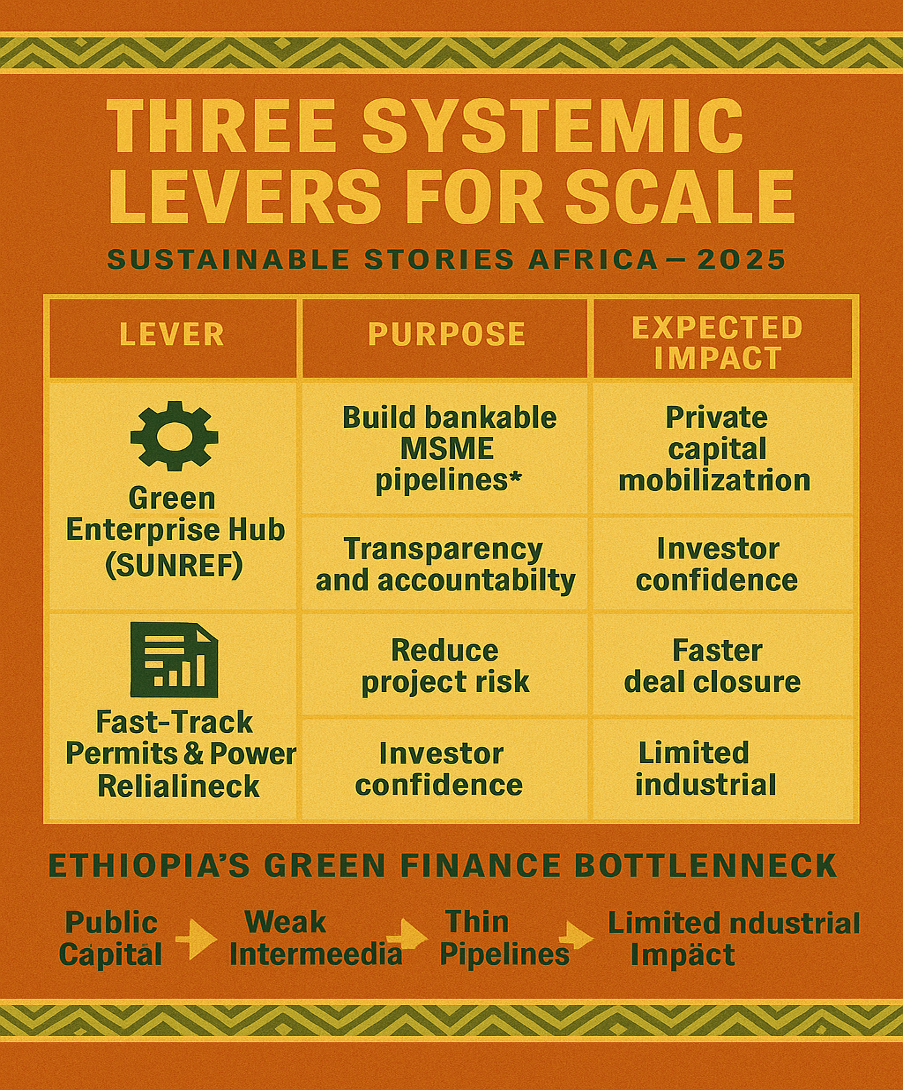
These are not abstract reforms. They are execution tools, designed to reduce transaction costs, crowd-in private capital, and translate green ambition into industrial output.
Without them, blended finance will remain theory, not practice.
PATH FORWARD – Turning Green Finance Into Green Industry
Ethiopia's green transition will be won or lost in execution. The priority is not more commitments, but stronger institutions, capable banks, transparent data systems, reliable infrastructure, and investable pipelines.
By operationalising a national registry, fast-tracking green industry permits, and systematically supporting MSMEs, Ethiopia can move from fragmented flows to functional markets. Green finance is available. The task now is to make it work.